

In brief
A bed gap filler is a foam wedge that closes the space between a mattress and a headboard or wall, so pillows stop falling behind the bed. Measure the widest point of the gap and the mattress width, then pick a filler whose stated gap range and length match. It is a comfort item, not a safety barrier.
Shortlisted for this decision
Affiliate-
Shortlisted
Vekkia Queen Bed Gap Filler
For headboard gaps up to 5.5 inches
Fills a headboard gap up to 5.5 inches across a queen bed, with side pockets and a washable cover.
Check price on AmazonCheck first: Measure first: not for gaps over 5.5 inches, and not a safety barrier.
-
Shortlisted
XetraDesign Queen Bed Gap Filler
For wider headboard gaps up to 7 inches
For wider headboard gaps of up to 7 inches across a Queen bed, with movable side pockets and a washable cover.
Check price on AmazonCheck first: No profile height published; measure your gap and mattress first. Not a safety barrier.
Affiliate links: we may earn a commission from qualifying purchases at no extra cost to you. Prices are shown only on Amazon. Amazon.com (US listing). See the full comparison ↓
Documented options
Bed gap filler: options compared
Options based on manufacturer documentation. Retailer links are affiliate links: we may earn a commission from qualifying purchases.
Affiliate retailer links
-
Vekkia Bed Wedge Pillow for Headboard, Bed Gap Filler
Exact variant: Queen, for gaps 0-5.5 in, White
View product details on Amazon — United States -
Vekkia Bed Wedge Pillow for Headboard, Bed Gap Filler
Exact variant: Queen, for gaps 0-5.5 in, White
View product details on Amazon — Germany -
Vekkia Bed Wedge Pillow for Headboard, Bed Gap Filler
Exact variant: Queen, for gaps 0-5.5 in, White
View product details on Amazon — France -
Vekkia Bed Wedge Pillow for Headboard, Bed Gap Filler
Exact variant: Queen, for gaps 0-5.5 in, White
View product details on Amazon — Spain
Affiliate retailer links
-
XetraDesign Bed Wedge Pillow for Headboard Gap
Exact variant: Queen 60 in, White
View product details on Amazon — United States -
XetraDesign Bed Wedge Pillow for Headboard Gap
Exact variant: Queen 60 in, White
View product details on Amazon — Germany -
XetraDesign Bed Wedge Pillow for Headboard Gap
Exact variant: Queen 60 in, White
View product details on Amazon — France
IN THIS GUIDE
Who needs a bed gap filler?
Many beds leave a space between the mattress and the headboard or wall. Pillows slide into it overnight, and glasses or a phone disappear behind the bed. A bed gap filler, also sold as a mattress gap filler or headboard gap filler, is a long foam wedge that closes that space.
It is most useful for people who read or sit up in bed, and for anyone who finds it hard to bend down and fish items out from behind the frame. It will not change how the bed feels, and it is not the right fix for every gap.
- Readers who prop pillows against the headboard every night
- People who struggle to reach or bend behind the bed
- Beds pushed against a wall with a visible gap
- Guest rooms where pillows keep ending up on the floor
Why is there a gap between the mattress and headboard? Free fixes first
Before buying anything, find the cause. Common ones are a mattress shorter than the frame, a headboard bolted further back than it needs to be, a mattress that creeps away on a slatted base, or a bed that has drifted off the wall.
Some causes have free fixes. Living Spaces notes that many headboards can be lowered or moved by loosening the bolts, repositioning and retightening, and that a taller foundation can close a gap below a high headboard. Pushing the frame tight to the wall solves the wall version.
- Mattress shorter than the frame: a filler or a correctly sized mattress
- Headboard set back: move or lower it on its brackets
- Mattress creeping away: a non-slip pad under the mattress
- Bed drifting off the wall: push it back and check the feet
- Gap at the side, beside a bed rail: get personal advice, not a filler
How to measure for a bed gap filler, and which size to buy
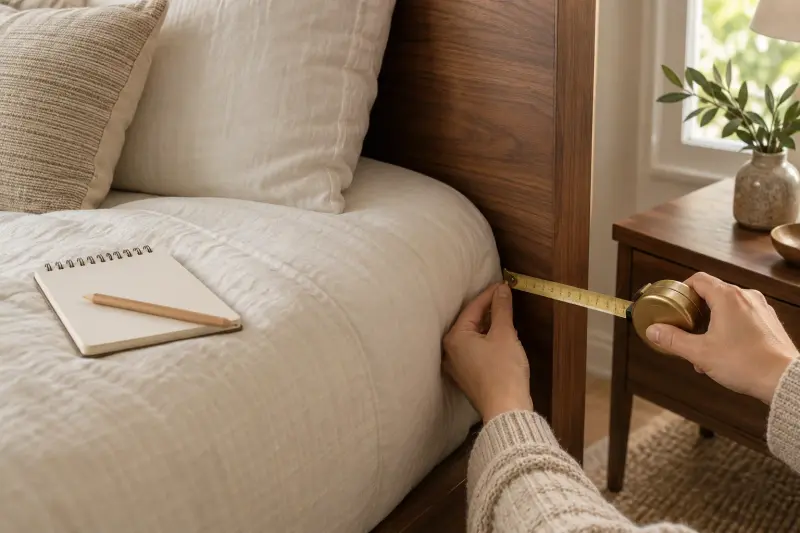
Gaps are rarely even. With the mattress in its usual position, measure at both ends and in the middle, then note the widest figure. Measure the mattress width too, because fillers are sold by bed size.
Check the mattress top height above the frame. A filler that sits far below the top of the mattress will not stop pillows slipping, and one much higher can feel like a ridge under your head.
Then compare your widest figure with the product's stated range. Vekkia, for example, says its wedge is designed for gaps from 0 to 5.5 inches (0-14 cm), and XetraDesign says its wedge fits gaps up to 7 inches (18 cm). If your gap is wider, fix the cause first rather than forcing in a bigger wedge.
- Widest gap, measured at three points with the mattress in place
- Mattress width: Twin, Full, Queen, King or California King
- Mattress top height above the frame or headboard rail
- Space for cables and any wall outlet behind the bed
| Bed size | Vekkia filler length |
|---|---|
| Twin | 39 in (99 cm) |
| Full | 54 in (137 cm) |
| Queen | 60 in (152 cm) |
| California King | 72 in (183 cm) |
| King | 76 in (193 cm) |
Bed gap fillers compared: Vekkia and XetraDesign
We found two bed gap fillers whose listings and maker pages we could match. The facts below come from Vekkia's and XetraDesign's product pages. They describe what each maker states, not how it performs in your bed.
Both makers sell the same design across several sizes. The Vekkia Amazon listing we checked is the Queen size in white, so pick the size that matches your own mattress before adding it to your cart.
| Filler | Gap range | Profile | Foam | Extras and care |
|---|---|---|---|---|
| Vekkia Bed Wedge Pillow for Headboard | 0-5.5 in (0-14 cm) | 8 x 6 in (20 x 15 cm) triangle | High-density foam | Two side pockets; removable, machine-washable cover |
| XetraDesign Bed Wedge Pillow | Up to 7 in (18 cm) | Not given; compare with your mattress top height | 30 ILD high-density foam | Two movable side pockets; removable, machine-washable cover |
How to fit a bed gap filler, care and common mistakes
Push the mattress toward the headboard, slide the wedge into the gap, then let the mattress settle back. The flat side usually faces the headboard. Check the fit after a few nights, because foam relaxes and mattresses move.

Wash the cover as the care label directs, and let new foam air out after unpacking. Most problems come from the wrong length or depth: a filler shorter than the mattress leaves open ends, and one that is too large pushes the mattress forward and opens a gap at the foot.
Keep the side pockets for light items. Weight can pull the wedge down into the gap, and hard objects are uncomfortable to roll onto at night.
- Smooth the fitted sheet before placing the wedge
- Recheck the gap after the first week
- Match the filler length to the mattress width
- Replace the wedge if it flattens or sags at one end
Is a bed gap filler safe? When filling the gap is not enough
A gap filler is a comfort product. It is not designed or tested as a safety barrier. The FDA warns that the bed frame, rails and mattress should leave no gap wide enough to trap a person's head or body, and that people with confusion, restlessness or poor muscle control are at higher risk.
If you are filling a gap because someone slides toward it, gets stuck or has been found wedged, stop and ask a clinician, occupational therapist or care provider. They can look at the whole bed setup, including rails and mattress fit.
- Do not use a filler to manage entrapment risk
- Ask for advice if the sleeper has dementia, restlessness or poor muscle control
- Never wedge foam into hospital or adjustable bed gaps without the maker's approval
- Keep loose items out of beds used by people at risk
MAKE THE SPEND MEANINGFUL
Bed gap filler: low-cost alternatives
- Push the bed frame tight to the wall or tighten a loose headboard to close the gap at no cost
- Roll a spare firm blanket inside a pillowcase as a temporary filler for a narrow gap
- Add a bedside caddy for glasses and phone so small items stop falling behind the bed
In brief
Bed gap filler: questions answered
How do I fill the gap between my mattress and headboard?
First check why the gap exists. Many headboards can be moved or lowered on their brackets, and pushing the frame to the wall closes a wall gap for free. For a gap you cannot remove, a bed gap filler wedge sized to your mattress width works for modest gaps, while a rolled blanket in a pillowcase can serve short term.

How do I choose the right size mattress gap filler?
Measure the mattress width and buy the matching size so the filler spans the whole head of the bed. Then measure the gap at both ends and the middle, take the widest figure, and confirm the product's stated range covers it. Also check that the filler sits close to the top of the mattress.
Why is there a gap between my mattress and headboard?
Usually because the mattress is shorter than the frame, the headboard is mounted further back than needed, or the mattress slides away on a slatted base over time. Measure the frame's inside length against the mattress length and check the headboard brackets. The cause tells you whether a filler, a non-slip pad or a simple adjustment is the right fix.
Is a bed gap filler safe for an older adult?
For a person who sleeps safely in a standard bed, a filler is simply a comfort item. It is not a safety device. If the sleeper is confused, restless or has slipped into a gap before, ask a clinician or occupational therapist to review the whole bed, because foam can compress and gaps can reopen.
How this guide was prepared
AI-assisted editorial research, checked against the linked primary sources.
Written with AI assistance from the sources listed below and checked against them. We have not tested these products in person.
How we use sources and AI assistance ↗Sources & fact checks
The guide separates sourced facts from editorial questions and examples. How we use sources and AI assistance.
- Living Spaces: how to fill the gap between a mattress and bed frame ↗
- Vekkia Bed Wedge Pillow: gap range, sizes, materials and cover care ↗
- XetraDesign Bed Wedge Pillow for headboard gaps up to 7 in ↗
- FDA: recommendations for consumers and caregivers about adult portable bed rails ↗
Found an error or an outdated detail? Contact the editorial team.