
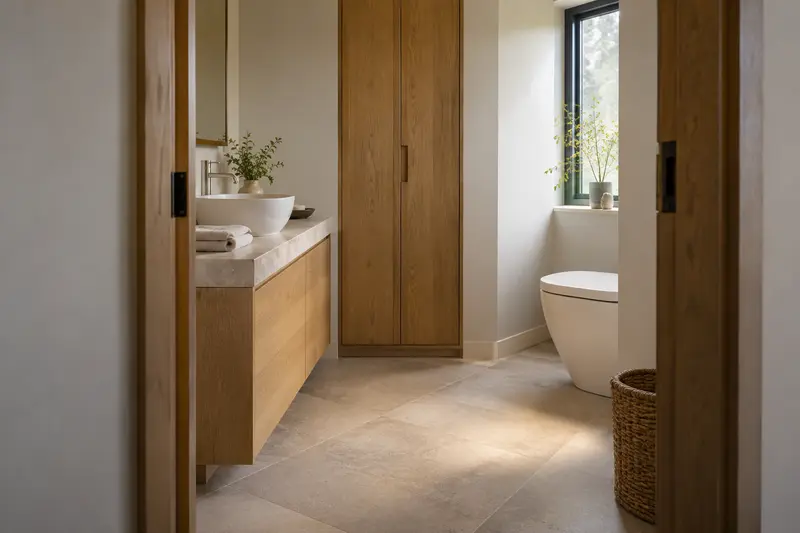
In brief
Start with the walking and washing route, then decide what needs storage. Use wall or cupboard space only where mounting, reach and care are suitable. Removing unused items can create more useful space than buying a taller organizer.
IN THIS GUIDE
Start with the occupied route before adding storage
A small bathroom does not need storage in every empty-looking gap. Begin with the door, the fixtures and the route used during ordinary tasks. Include any assessed shower chair, support or assistance space. A cabinet that fits against a wall can still obstruct an approach, conceal a control or interfere with the door.
Sketch the room from above and mark the door movement. Draw existing storage at its full footprint, including handles and doors when opened. Avoid reducing a curved cart or projecting shelf to an optimistic rectangle that omits the part nearest the route. Useful planning shows the room in use rather than as an empty floor area.
Do not rehearse an awkward movement to demonstrate a layout problem. Record concerns from normal use and ask an appropriate assessor about reach or assistance requirements. A storage article cannot choose a personal transfer position or certify an accessible route. It can help explain why a proposed item needs review before purchase.
Separate a tidy appearance from usable space. A closed cabinet can hide a large inventory but still occupy the only useful approach to a fixture. Conversely, an existing small cupboard may be sufficient after unused items leave the room. The first decision is what space must remain available; storage choices follow that decision.
Count daily items, spares and things that can leave the room
Make an inventory before browsing organizers. Divide items into those used during the bathroom routine, supplies kept for later and objects that do not need to remain in the room. Record actual quantities. “Many bottles” is difficult to plan around; five daily containers and eight unopened spares give a clearer purchasing brief.
Keep each item's own storage requirements in view. Medicines and temperature-sensitive products should not be moved to a bathroom shelf simply to make another cupboard look tidy. Ask the relevant professional or manufacturer about uncertain storage instructions. Cleaning supplies also need their appropriate packaging and access arrangements, rather than decorative unlabelled containers.
Count duplicates without making another household member's decisions for them. Ask what they use and what they want to keep. A shared bathroom needs an agreed allocation, not a surprise clear-out followed by a large storage purchase. Removing genuinely unused items can reduce demand, while merely hiding someone else's belongings creates a different problem.
After the inventory, set a modest storage objective: daily items available for the agreed routine, spares in an appropriate existing location and no unnecessary floor furniture. That objective may be met without buying anything. If a purchase remains useful, its required capacity can be stated clearly rather than inferred from a product's attractive photograph.
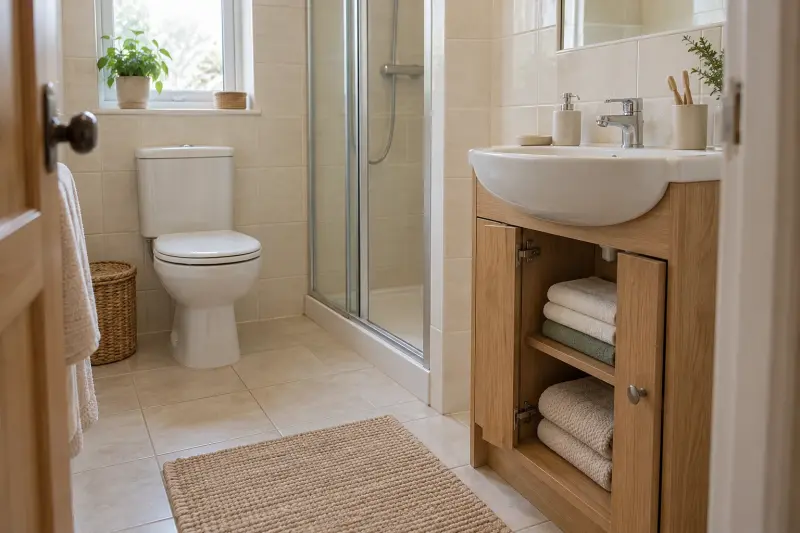
Match storage location to the actual retrieval task
The best location depends on when an item is used and who retrieves it. A towel needed at the end of washing differs from a spare bottle fetched once in a while. Put those tasks into the plan separately. Daily storage should not become a display collection that forces the user to search through rarely used supplies.
Describe a retrieval difficulty in ordinary words: “The clean towel is behind the open door,” or “The shaving items are in two cupboards.” That gives a provider or household helper something concrete to review. Do not solve an uncertain reach problem by recommending a high shelf, deep lean or a new reaching technique.
Where a seated task is part of an assessed arrangement, bring the storage question to the appropriate provider. The position of equipment, controls and items needs to be considered together. A holder being within an arithmetic distance does not establish that it is comfortably or appropriately reachable for the individual.
For shared use, separate daily personal items without adding several competing organizers to the same small area. A simple existing drawer section may work better than multiple wall cups. Agree whose items go where, how they are identified and how the area is left after use. The plan should reduce searching rather than merely increase the number of containers.
Measure full projection and opening space
Record width, depth and height, but also the parts that project during use. A door, pull-out basket, lid or handle can matter more than the cabinet's closed dimensions. Ask for the exact product drawing or documented measurements when a retailer photograph hides those details. Do not assume the advertised width covers every projection.
Use a paper footprint in a dry planning area if it helps compare dimensions. It is a layout illustration, not a trial of support or personal access. Keep it away from the bathroom routine if it could obstruct the space. Mark clear differences between the product's occupied area and any additional area needed to open or maintain it.
For an arithmetic example, an imagined unit 18 centimetres deep with a handle projecting another 3 centimetres reaches 21 centimetres from the wall. A drawing that shows only 18 centimetres understates the projection by 3 centimetres. That calculation does not establish a required passage width; it simply shows why the complete shape must be recorded.
Ask the relevant provider about any personal approach or assistance requirement rather than inserting a universal clearance number from a different building standard. Private bathrooms, regulated facilities and different countries may have different contexts. Keep the worksheet as a measured description of your proposal, with unresolved access questions clearly assigned for review.
Check the actual mounting surface and permitted use
Wall storage may keep furniture off the floor, but it introduces mounting questions. Identify the actual surface and ask the manufacturer what the exact product permits. Smooth appearance alone does not establish compatibility. Texture, material, seams and the proposed location can matter, and the correct instructions are more useful than a generic “no drilling” label.
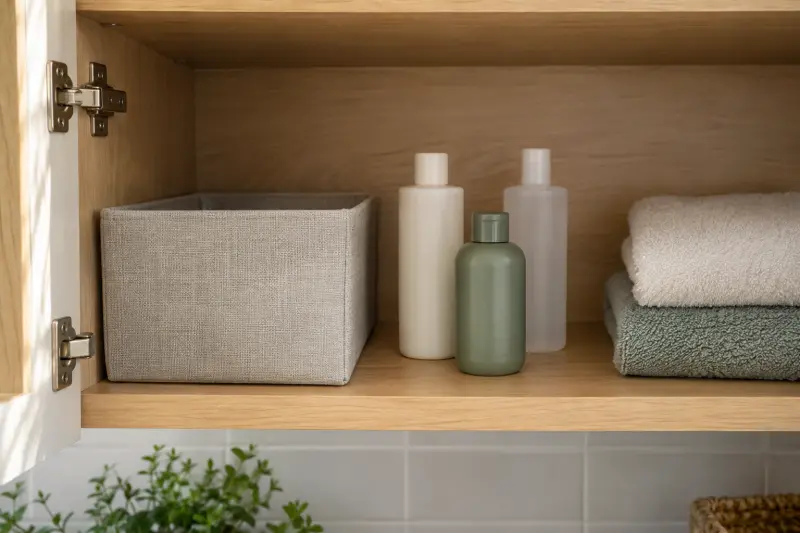
OXO's US StrongHold Suction Shower Accessories Cup page lists smooth glazed surfaces, mirrors or glass as preferred and excludes textured or porous examples, including some stone, acrylic or metal. Those limits apply to that named storage cup. They are not a claim that every suction accessory works on every surface of those broad materials.
Ask for documented load and mounting information rather than inventing a bottle count from a photograph. The total contents and their arrangement need to stay within the exact instructions. If information is missing, ask the maker before ordering. Do not add adhesives or other fasteners to make an unsuitable mounting method appear compatible.
Storage is not body support. A caddy, shelf or towel fixture should not be grasped as a transfer aid, even when its mounting seems firm. Keep any assessed rail or approved support available and treat its installation separately. A convenient storage purchase cannot replace an unresolved support requirement.
Review existing cupboards before buying a floor unit
An existing cupboard can often answer the spare-supply task. Start by measuring usable interior space and noting shelves, hinges and the door movement. Keep the space's own suitability for the contents in view. The aim is to use an appropriate location, not to transfer everything into one damp or inaccessible cupboard because it is already available.
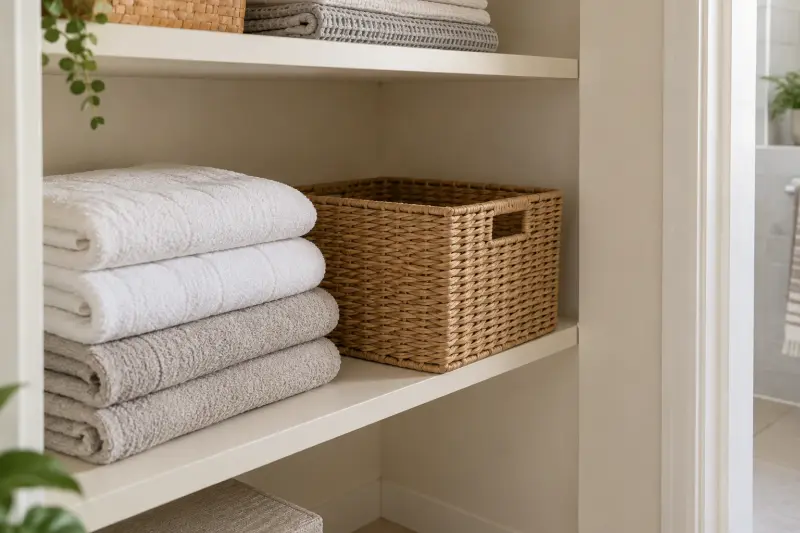
A small ordinary basket inside suitable storage may keep related items together without placing furniture on the bathroom floor. Compare its actual footprint and whether it can be handled comfortably. Do not assume that a large basket is easier because it carries everything at once. A manageable amount and an understandable label can be more useful than maximum capacity.
Use simple labels describing contents or the agreed user allocation. Avoid publishing private medication or health information. A label such as spare towels can reduce searching without revealing sensitive details. If visual or handling concerns are involved, ask the intended user and relevant professional what format works for them rather than selecting a decorative system automatically.
Make a no-purchase version of the plan first: remove unused items, regroup what remains and use existing appropriate shelves. Then note the one requirement it still fails to answer. That unanswered task is a stronger basis for a new organizer than browsing an entire matching bathroom range and looking for space afterward.
Include care access and damp-item storage
A storage solution needs a care plan. Ask how the exact organizer is cleaned and whether it can be removed under its instructions. Consider the surfaces behind or underneath it and who can access them comfortably. A narrow unit can fit mathematically yet make ordinary cleaning awkward enough that the household struggles to maintain the arrangement.
Do not apply another product's washing method to the chosen item. A metal rack, coated shelf and suction cup can have different instructions. Keep the manufacturer's care information with the order record. If the proposed location requires awkward removal, ask whether a different configuration would better meet the task instead of treating difficult maintenance as inevitable.
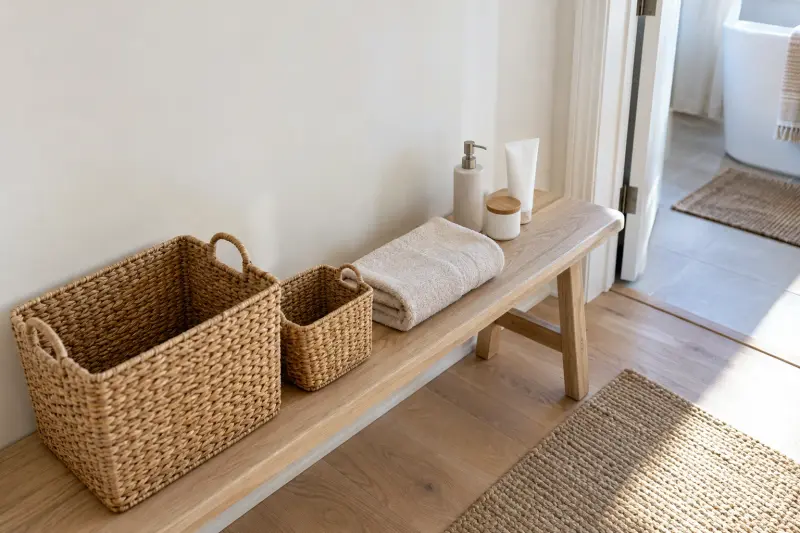
Think separately about items that are wet after use and supplies intended to remain dry. A ventilated-looking basket is not proof that every stored object can stay there. Follow the contents' own care and storage instructions. If a product's suitability is uncertain, leave it out of the proposed container until the appropriate answer is obtained.
For a shared bathroom, agree who removes empty packaging and restocks the daily items. A useful organizer can become crowded when old and new containers accumulate together. The inventory should make replacement straightforward without needing an extra shelf for everything. The purpose of capacity planning is an understandable routine, not an excuse to retain every container indefinitely.
Worked example: the narrow cart that creates a new problem
Imagine a fictional bathroom with a small gap beside the basin. A household spots a narrow rolling cart and sees a chance to add three shelves. In a simple floor sketch, the cart appears to fit. But the documented handle projection and the way its contents are retrieved occupy part of the approach used during the ordinary routine.
The household redraws the cart at its complete shape and lists its intended contents. Most are unopened spare products that do not need to be retrieved during washing. The daily items already fit in the existing suitable drawer once unused packaging is removed. The cart was solving a storage habit rather than a necessary room task.
The revised plan places appropriate spares in another existing location and uses one drawer section for daily items. A small remaining question concerns a towel's position, which is reviewed separately with the user and relevant provider. The household does not add a wall hook until its location and mounting requirements are understood.
This example does not certify a room layout or prohibit all carts. It shows how a complete footprint and inventory can reveal an unnecessary purchase. Another bathroom may have a suitable location for a documented unit. The worksheet helps explain the difference without claiming that a photograph, narrow dimension or attractive finish establishes personal usefulness.
Compare one organizer at a time against a defined task
For each candidate, write the exact task it answers and the required capacity. Then record complete dimensions, permitted location, mounting method, care requirements and the remaining confirmation. A candidate that fails one essential requirement should not stay on the shortlist because it has more shelves or a pleasing colour.
Compare different formats without treating them as interchangeable. A cupboard basket holds spares, a drawer divider groups daily items and a shower cup serves a smaller in-routine storage task. Buying all three because they share a finish can add complexity. Choose the format linked to the unanswered task in your no-purchase plan.
If considering a freestanding item, discuss its occupied location and movement with the relevant provider where access or support concerns exist. Do not stabilize it with improvised hardware or place it where someone might use it as a support. The exact manufacturer's instructions and room requirements remain necessary even for an ordinary household storage product.

For a mounted item, establish property permission and a competent installation plan where needed. Keep storage fixing separate from electrical, plumbing and support installations. The purchasing worksheet should identify who resolves the mounting question. It should not provide drilling positions or assume that a tile can carry any proposed organizer.
Read inclusions, regional terms and the complete purchase scope
Ask what arrives in the box and what must be supplied separately. A photograph may show accessories, contents or mounting pieces that are not included. Record the exact model and variant on the order. Where permanent installation is involved, separate product price from fitting and any making-good work so a cheap headline amount does not hide necessary costs.
Read the current regional return conditions before opening, mounting or using the item. Ask how installed or hygiene-related goods are handled by that seller. Do not assume that a return policy from a different country or a similar brand applies. Keep the written answer with your measurements and product documentation.
Avoid purchasing several organizers “to try” when return handling is unclear. A documented shortlist can often settle dimensions and mounting questions before delivery. If a physical sample or showroom visit is relevant, ask what can be reviewed without committing to installation. Appearance can be evaluated there, but it does not certify the proposed room arrangement.
The affordable outcome may be one basic container in existing suitable storage, a focused mounted item or no new product. We do not publish a universal price threshold. Value depends on the actual task, confirmed compatibility and complete scope. A cheaper organizer that cannot be placed appropriately is not a saving.
Questions that make vague product descriptions useful
When a seller says “ideal for small bathrooms,” ask for the complete dimensions and the occupied shape during use. When a listing says “no-drill,” ask for the exact permitted surfaces and load information. These are different questions, and neither is answered by a staged photograph of a compact room.
Ask whether the chosen item can be cleaned in the proposed position under its instructions. A detachable design might be helpful, but detachment and reattachment still need to be manageable and correctly understood. If the listing lacks care information, ask the manufacturer rather than assuming that all parts tolerate a domestic dishwasher or cleaning spray.
If an organizer is described as accessible, ask what specific feature that means. A wide opening or large handle may answer one task but not another. The intended user and appropriate assessor should resolve personal reach or handling questions. Do not translate a general adjective into a promise about the person's routine.
Finally, ask whether the new purchase creates another need: more storage, a new mounting kit or another place for wet items. A useful addition should simplify the documented task. If it creates a chain of purchases without solving the first question, return to the inventory and room sketch. The worksheet can reveal that cycle before checkout.
Finish a clear-route storage worksheet
Use one row per stored group: purpose, quantity, proposed location, full footprint, access method, mounting evidence and care task. Add a column for the source of each confirmation. This gives the household a clear way to compare an existing cupboard with a new organizer without collecting diagnoses or private possessions in an online tool.
Mark outcomes plainly. “Existing drawer answers the daily-item task” is different from “wall mounting awaiting manufacturer confirmation.” An unknown should remain visible until the responsible person supplies an answer. Avoid turning several optimistic assumptions into a score that declares a bathroom accessible. The worksheet describes decisions; it does not certify the room.
Keep the route and assessed supports on the layout as protected requirements. A later storage purchase should not silently occupy that space. If the routine changes or new equipment is supplied, revisit the storage plan with the relevant provider. The best arrangement today may need an adjustment later, but that does not mean an elaborate expandable system is needed now.
Once the plan is complete, buy only what answers the remaining confirmed task. Our bathroom reach-organizer guide can develop a specific daily-item question, while this worksheet keeps the whole room in view. A successful result is a usable, understandable layout and a smaller justified order, including no order when existing storage is enough.
MAKE THE SPEND MEANINGFUL
Before adding to the basket.
- Remove genuinely unused items with the household’s agreement.
- Use an appropriate existing cupboard or drawer for supplies that need not be in the routine area.
- Group daily items in a suitable existing container where it answers the task.
- Choose one confirmed organizer rather than a matching storage collection.
How this guide was prepared
AI-assisted editorial research, checked against the linked primary sources. Product testing and a credentialed individual review are not claimed.
AI-assisted, source-checked editorial; no hands-on test, human expert review or personal suitability assessment claimed
How we use sources and AI assistance ↗Sources & fact checks
The guide separates sourced facts from editorial questions and examples. We have not claimed hands-on product testing. How we use sources and AI assistance.
Found an error or an outdated detail? Contact the editorial team.