

In brief
Compare the seat’s full footprint, the shower’s usable space and the user’s transfer needs. Confirm the exact manufacturer instructions and weight limit, then check how the person reaches the water controls and washing items. A shower chair, stool, transfer bench and wall-mounted seat serve different tasks. Choose the arrangement for the task, not the largest claimed capacity.
Documented options
A clearer comparison.
Research options based on manufacturer documentation. These are not results of hands-on testing. Manufacturer links are informational; no commission relationship is currently active.
IN THIS GUIDE
Name the task before choosing a seat
Do you want to sit while showering inside an enclosure, cross a tub edge, or create seating that folds away for another user? Describe that task to the supplier. Product labels can sound similar while the equipment is intended for different arrangements. If balance, transfers or assistance needs are uncertain, ask an appropriate health professional to assess the setup.
Include the person’s preferences: back support, arm position, cleaning effort and shared-bathroom storage. Someone else’s favorite chair may answer a different need. Keep the first shortlist small and use a clear reason for each candidate. A missing backrest or an awkward arm can matter more than an impressive-looking product photograph.
Write one plain sentence explaining the intended task and take it to the supplier or appropriate health professional. Sitting inside an enclosure, managing a tub-edge task and sharing a room with another user are different questions. Similar product names can hide different intended uses. Do not select by a photograph of a chair alone or assume that an ordinary stool performs the same role as equipment with specific bathing instructions. The exact product and actual user need matter together.
For a hypothetical household, the user wants a seated shower but the initial search returns products intended for another bathroom arrangement. They clarify the task before choosing materials or accessories. Another shopper wants something that can be moved for a second user and needs the handling and storage routine discussed. Neither becomes a universal recommendation for everyone over fifty. Where balance, support or transfers are uncertain, obtain an appropriate assessment rather than using this article as a fitting prescription.
Separate essential needs from preferences. A back, arm arrangement or particular cleaning design may matter to the actual person, while a decorative finish is another field. Ask about the supplied components and the maker's intended configuration. Do not remove an arm or substitute a foot to make a favorite design fit. If a preferred option creates an unresolved use or assembly question, ask the manufacturer and relevant professional before purchase. A more elaborate chair cannot make an unclear individual task disappear.

Editorial illustration Include the user in the conversation with appropriate support. A family member can record questions and compare documents without deciding physical suitability from a catalogue. Keep health histories, body photographs and sensitive care details in the appropriate private assessment rather than a public product quiz. Use your notes to identify the exact information to request. A general buying guide and a catalogue cannot assess the person or bathroom.
Keep a no-purchase option visible until the task is understood. Existing suitable equipment may already serve the documented purpose, while another arrangement may need assessment. A small storage accessory or washing aid can address its own task but is not a substitute for an unresolved seating or support need.
Measure the usable floor area
Record the narrowest usable part of the enclosure, the door opening and swing, the floor shape, drain position and existing fixtures. Distinguish the seat dimensions from the spread of its legs. Ask the supplier for the overall footprint at the proposed height. A chair that fits while the door is open may obstruct the door or the user once it is inside.
Make a simple sketch rather than climbing, stretching or testing an uncertain transfer for the sake of measuring. Include where the person approaches and where assistance would be provided. The drawing supports a conversation; it is not an installation or clinical assessment. Do not assume an advertised compact chair will fit a sloped or unusually shaped shower floor.
Measure the space through an appropriate method without creating a physical test for the user. The narrowest usable floor area, approach, door swing and existing fixtures all belong in the factual enquiry. Ask the supplier for overall dimensions and the relevant leg footprint at the proposed approved setting. A seat-top width alone can leave the actual floor arrangement unexplained. Compact is a marketing description until the required dimensions are known.
For a hypothetical enclosure, the chair fits the measured outline with the door open, but the door's ordinary movement needs further review. The buyer marks that field unresolved and asks the responsible supplier or professional about the actual arrangement. Another floor slopes or has an unusual shape, so a rectangular footprint comparison is not enough evidence. The article does not prescribe leveling, shimming, changing feet or a universal floor-compatibility test. Those questions belong with exact instructions and appropriate assessment.
Keep the approach and assistance question separate from the empty-chair outline. A product can appear to occupy the available space while leaving personal access unresolved. A private sketch can identify the locations for discussion, but it is not a clinical or installation approval. Do not attempt an uncertain transfer merely to prove a measurement. If taking dimensions is difficult, obtain appropriate help. Household observations and professional confirmation should remain different evidence fields on the comparison record.
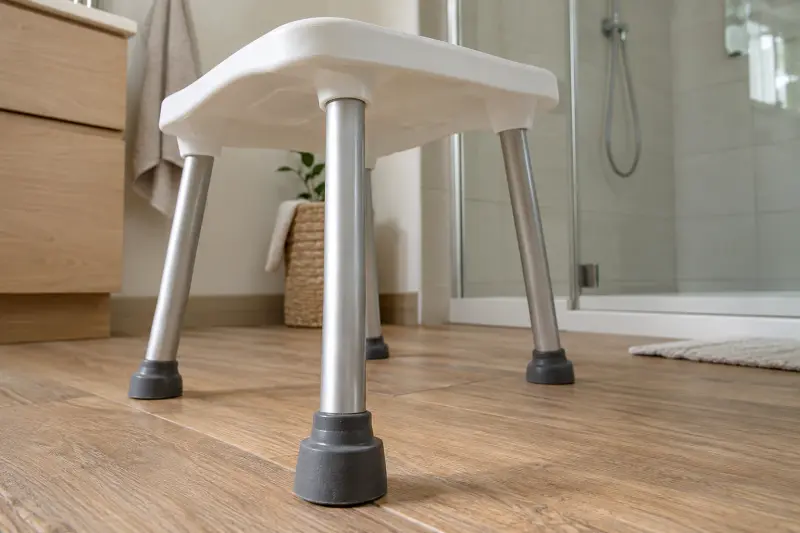
Editorial illustration Include door and fixture interactions without altering the room to rescue a purchase. A caddy, handshower lead or another object can change the practical question. Ask whether the proposed arrangement and equipment instructions address the complete setup. A styled photograph cannot establish this. Keep drawings private and share only necessary details through verified responsible channels. The public guide needs no photograph of the user or personal bathroom routine to explain that space and suitability require separate checks.
If a model or height setting changes during quoting, request the affected overall specification again. An earlier footprint may not describe the current order. The useful outcome is an exact candidate with a documented spatial enquiry, rather than a generic chair label treated as proof of fit.
Read the instructions as part of the purchase
Moen’s DN7100 technical sheet specifies use by people weighing less than 400 pounds, equal-height locked legs, correct assembly and no modification of components. It also directs the user to consult a healthcare professional about individual needs. These requirements apply to that exact product; they are not a universal rule for every shower seat.
For any candidate, find the current instructions before paying. Check the adjustment range, assembly method, cleaning instructions, replacement parts and permitted surfaces. Ask whether the quoted model includes every required component. Do not improvise missing feet or substitute hardware. If the information is unavailable or contradictory, keep the question unresolved and contact the manufacturer.
Read the actual instructions before treating a capacity headline as a shortlist. The cited Moen DN7100 sheet identifies product-specific limits and assembly requirements, including locked equal-height legs and no component substitution. Its wording is less than four hundred pounds, which should not be silently rounded into a universal four-hundred-pound entitlement. Keep those facts attached to the exact model and ask the maker or appropriate professional about the actual use. Capacity alone does not resolve individual suitability or floor fit.
For a hypothetical retailer listing, a broad headline omits the assembly sheet. The buyer requests the current manufacturer's document and checks the model identifier. Another item arrives with a component whose identity is unclear. They contact the responsible seller or maker rather than improvising a replacement or using hardware from a similar chair. The website offers no assembly tutorial or inspection process that certifies an unknown item. Exact instructions and appropriate assistance are part of the purchase, not optional paperwork afterward.
Ask who provides any required assembly and explanation, and whether the quoted package includes every specified part. A delivery service that leaves a carton does not establish completion of the agreed equipment arrangement. Keep technical work within the maker's instructions and the provider's responsibility. If the actual document says to seek healthcare advice for individual needs, do so. A product page's attractive accessibility language should not override that direction or the uncertainty in a personal task.

Read cleaning, adjustment and replacement-part information with the same care. Do not transfer a procedure from another model or assume all bathing equipment permits the same cleaners or component changes. Ask where the current instructions can be retained privately and which local contact answers a later issue. A US technical document is not automatically the same regional offer or support route elsewhere. If a material question is unanswered or conflicting, keep it visible before ordering.
If a retailer changes the model during quotation, keep the earlier comparison but obtain the new instructions before treating the offer as equivalent. A similar seat outline can conceal different adjustment limits, parts or use requirements. Mark the old document as superseded for that candidate so a helper does not later assemble or explain the new item from the wrong sheet.
The required information can make a modest documented item more useful than a complex poorly explained one. The article has not tested either candidate and makes no safety ranking. It helps the shopper connect the offered equipment to a current source and the responsible personal or technical review.
Keep the useful items within the routine
Plan where the handshower, soap and towel will be placed while seated. Ask whether reaching an item requires twisting, leaning or getting up before the shower is finished. A small organizer might help with storage, but it must not be mistaken for a support handle. Keep caddies and cords away from the approach and the door.
The National Institute on Aging’s home-safety guidance recommends installed grab bars and attention to wet surfaces in bathrooms. A seating purchase belongs within that wider setup. If additional support is needed, have the support arrangement assessed and installed appropriately; an attractive shower accessory does not perform the same job.
Plan ordinary belongings as a separate layout question. The handshower, soap and towel need their intended places considered with the assessed routine, without prescribing a reach maneuver in this article. Ask an appropriate professional about personal access where needed. A suction organizer is storage under its own instructions, not a support handle. A decorative shelf or caddy should not be presented as transfer equipment because it is near the seat.
For a hypothetical user, one item remains inconvenient despite a well-documented chair enquiry. The household asks whether reorganizing existing appropriate storage answers that specific task. Another situation concerns support, so a caddy comparison is not the right next step. The distinction prevents an ordinary accessory sale from appearing to solve a personal-assistance question. A washing aid can serve its documented purpose but cannot replace the assessment of seating, wet-floor conditions or support.
The cited National Institute on Aging guidance places bathroom equipment within a wider home-safety context, including grab bars and wet surfaces. Keep the relevant support arrangement appropriately assessed and installed rather than proposing an improvised substitute. This website has not surveyed the bathroom or determined which installation an individual needs. A general article can help readers identify a next question, while the actual plan belongs with appropriate advice and exact equipment instructions.

Consider shared use and the ordinary care routine. Who cleans the item, where it is kept under instructions and whether another user changes the arrangement are practical questions. Do not add a foldaway, removable or wheeled feature without reading its exact supported use and handling guidance. A product that looks easy to move may still leave a task unanswered for the actual household. Where help is needed, make that responsibility visible rather than asking the user to demonstrate a difficult action unaided.
Keep ancillary purchases purposeful. A correctly documented storage item should answer one remaining organization need, with surface suitability and product instructions checked separately. There is no requirement to add a bathroom-accessory bundle to make a seating order complete. Existing suitable towels, storage and ordinary care arrangements can remain part of the plan.
Use a seat-and-shower comparison record
Use four comparison rows: person, enclosure, use sequence and maintenance. Under each, write what must be true and where the evidence comes from. Keep capacity, dimensions and assembly requirements tied to the exact model number. Separate a manufacturer fact from your own preference. For example, “the listed footprint fits the measured space” still leaves transfer and floor suitability to confirm.
Before opening the packaging, check what the retailer allows you to return and under what condition. Hygiene-product return terms can differ from ordinary furniture. Request help if the setup is uncertain. The most useful choice may be a straightforward seat with complete instructions and confirmed fit rather than a more elaborate one selected for extras.
Use the comparison record as an evidence map with separate rows for person, enclosure, sequence and maintenance. Add exact capacity and dimensions to the relevant item identity, and note which responsible source addresses each question. A preference such as liking the back shape is different from a manufacturer limit or an appropriate assessment. Do not produce a single suitability score from those mixed fields. A chair can have clear specifications while a personal access question remains open.
For a hypothetical final comparison, one item has complete instructions but an unresolved door interaction. Another appears smaller but lacks the required local documentation. The buyer asks for the missing answers rather than awarding a best label from images. A third outcome is retaining existing appropriate equipment after its current instructions and relevant assessment are considered. These paths keep the task central and leave room to wait when an essential answer is unavailable.
Check the exact seller, regional model and supplied components again at checkout. Read current delivery, assembly, inspection and return terms for the actual transaction. A seller's hygiene-product description needs proper clarification where relevant; this guide does not determine every legal exception or promise a preference refund after use. Statutory rights and voluntary shop policies should stay distinct in the applicable jurisdiction. Keep private receipts and identifying details outside public website comments.

At handover, ask the responsible provider to explain the actual supplied item and current instructions through the appropriate process. Resolve missing, damaged or substituted components with the maker or seller rather than modifying the equipment. Keep the relevant documents and local support route accessible privately. If the room or equipment changes later, revisit the affected questions under the appropriate professional plan. Previous fit should not be treated as permanent approval for every new surface or task.
This guide has not tested shower seating or assessed any user. Its useful result is a clearly defined task, exact documented equipment and an understood routine with the needed assessment. A sale can follow that resolved need; retaining existing suitable equipment, exploring another assessed arrangement or buying no extras are equally valid informed outcomes.
MAKE THE SPEND MEANINGFUL
Before adding to the basket.
- Use an existing suitable storage location before adding a shower caddy.
- Compare a simple supported seating arrangement when additional features do not serve the assessed task; do not trade away required fit or support for a lower price.
How this guide was prepared
AI-assisted editorial research, checked against the linked primary sources. Product testing and a credentialed individual review are not claimed.
source-checked editorial; no hands-on testing or expert suitability assessment claimed
How we use sources and AI assistance ↗Sources & fact checks
The guide separates sourced facts from editorial questions and examples. We have not claimed hands-on product testing. How we use sources and AI assistance.
- Moen: DN7100 shower-chair technical specification ↗
- National Institute on Aging: room-by-room home safety ↗
Found an error or an outdated detail? Contact the editorial team.