
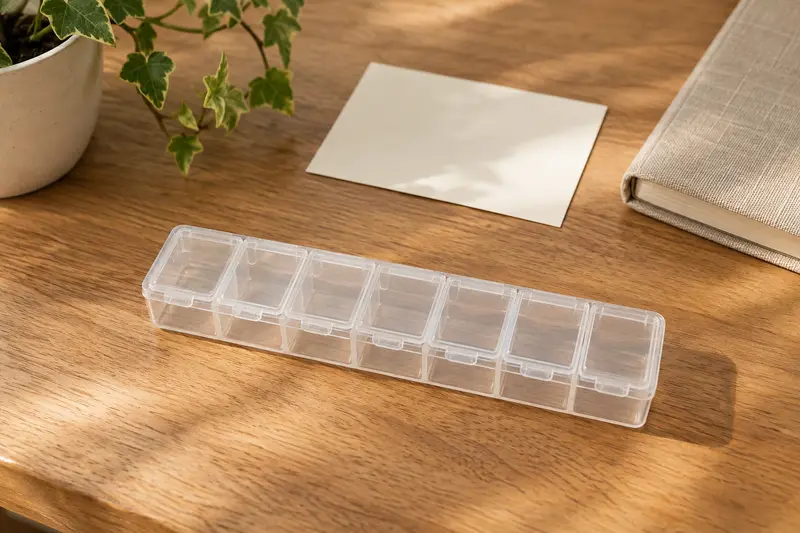
In brief
Ask your pharmacist whether the exact medicines can be placed in an organizer before moving them from their original packaging. Then compare labels, compartments and opening with the intended user. An organizer is a storage aid, not a reason to change doses, schedules or prescribed instructions.
IN THIS GUIDE
Ask the pharmacist before moving medicines into an organizer
A weekly pill organizer is a container, not a decision about medicines. Before transferring anything from original packaging, ask your pharmacist whether an organizer is appropriate for the exact medicines and the person. Keep doses, schedules, missed-dose questions and prescription changes with the prescribing or pharmacy team. A shopping guide cannot make those decisions.
NHS Specialist Pharmacy Service guidance specifically calls for pharmacist advice about medicine suitability and can support selection and use of organizers. Its separate compliance-aid guidance favours original packaging with appropriate pharmaceutical support unless a suitable alternative is needed. We use those sources to establish a professional-first purchasing process, not to authorize an individual arrangement.
Describe the practical difficulty you want to discuss: reading labels, opening packaging, keeping track of the agreed routine or another specific issue. Do not decide that all medicines should move into a box because a retailer says it improves organization. Different difficulties may need different pharmacy-supported solutions, including retaining the original labelled packaging.
If an organizer is appropriate after that conversation, the remaining shopping questions concern the agreed container configuration, readable identification, handling, filling responsibility and suitable storage. That order is important. A large capacity, cheerful colour or easy-open lid cannot establish medicine stability or replace professional advice. The useful purchase must follow the actual pharmacy-confirmed arrangement.
Describe the user’s practical task without collecting health data
Use a private paper buying note to describe the practical problem and confirmed container requirements. You do not need to submit medicine names, diagnoses or a prescription photograph to a public website. Keep sensitive details in the private pharmacy conversation and the records your healthcare team recommends. A public product comparison needs no personal medicine list.
Ask the intended user how they want to manage the agreed routine and what they find difficult. A family member may prefer a month-sized case while the user finds a smaller weekly layout easier to understand. More capacity is not automatically useful. The person's preference belongs beside the pharmacy requirements rather than being replaced by the buyer's idea.
Separate wanting a reminder from wanting a different container. A reminder can address one issue while an opening difficulty or medicine-storage requirement calls for another professional discussion. Do not assume that a timed dispenser, app or ordinary plastic box solves all three. Bring the actual problem to the pharmacist before choosing a feature bundle.
Write the first worksheet entry as an action: “discuss the practical difficulty with the pharmacist,” followed by the questions requiring an answer. Leave the container shortlist blank until the appropriate arrangement is established. This prevents shopping momentum from turning an unconfirmed idea into a medicine-management plan.
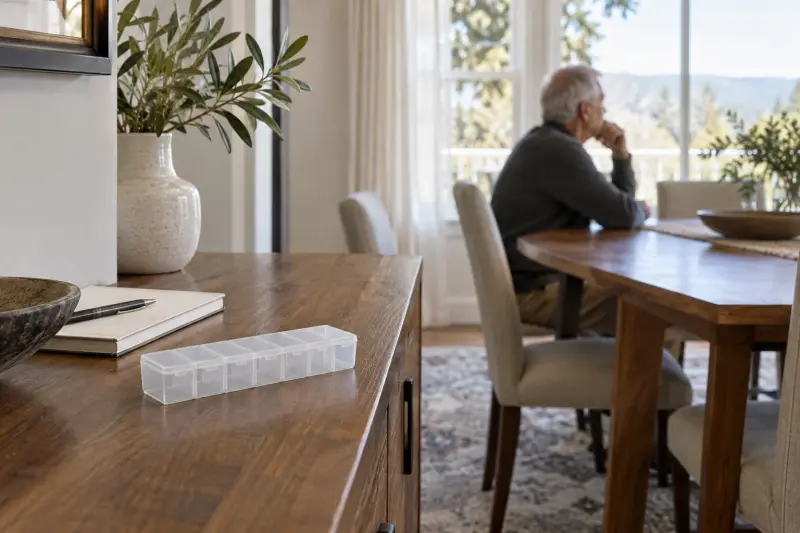
Match the number of compartments to the agreed arrangement
After professional suitability is established, record the required labels and compartment pattern exactly as agreed. A weekly case can have one or several sections per day, but its layout should serve the actual arrangement. Do not add divisions as a reason to change a prescribed schedule or move medicines that the pharmacist has not approved for transfer.
For a geometry-only illustration, seven rows with two compartments each provide fourteen spaces. Seven rows with four compartments each provide twenty-eight. That arithmetic compares container layout; it does not tell anyone to take medicines two or four times per day. The pharmacy-confirmed requirement determines which pattern, if any, is relevant.
Avoid buying the largest format because its unit price appears lower. Extra compartments can introduce labels that the user does not need, and a large case can be harder to store or carry. Ask the user to review the empty proposed layout and discuss any confusion with the pharmacy team before proceeding.
Keep a clear distinction between the main organizer, spare containers and any medicines that remain in their original packaging under professional advice. The buying card should not pretend that every item belongs in one box. The agreed arrangement may involve more than one type of packaging, with identification and responsibility explained by the appropriate professional.
Compare readable identification beyond colour
Look at the actual day and section labels on the empty product or its documented images. Check whether the words are readable to the intended user and whether the orientation remains understandable when a section is removed. A photograph taken close up can make small lettering look larger than it is in ordinary use.
Colour can be an additional cue, but it should not be the only information the user relies on. Ask about the person's preferences rather than assuming that a rainbow design is clearer. The relevant comparison is whether the agreed labels can be understood consistently, including by a helper following the pharmacy-approved arrangement.
Be cautious about custom relabelling. A decorative sticker can obscure the original identification or detach, and a handwritten schedule can become outdated when a prescription changes. Ask the pharmacist which information should be retained and how changes should be handled. The website does not generate medication instructions or a new schedule for a purchased container.
If a retailer gives only a broad “large print” claim, request the actual label dimensions or an opportunity to view the empty item. Keep the sample comparison separate from filling it with medicines. A product can be visually attractive while failing a practical readability question, and that is a valid reason to exclude it before buying.
Discuss the opening mechanism and the intended user
Ask how the empty organizer opens and closes, and whether the intended user can manage that mechanism comfortably. Consider latch shape, individual sections, outer cases and the need to hold the item while opening it. Do not make assumptions about dexterity from age or buy an easy-open design without considering the agreed storage and access requirements.
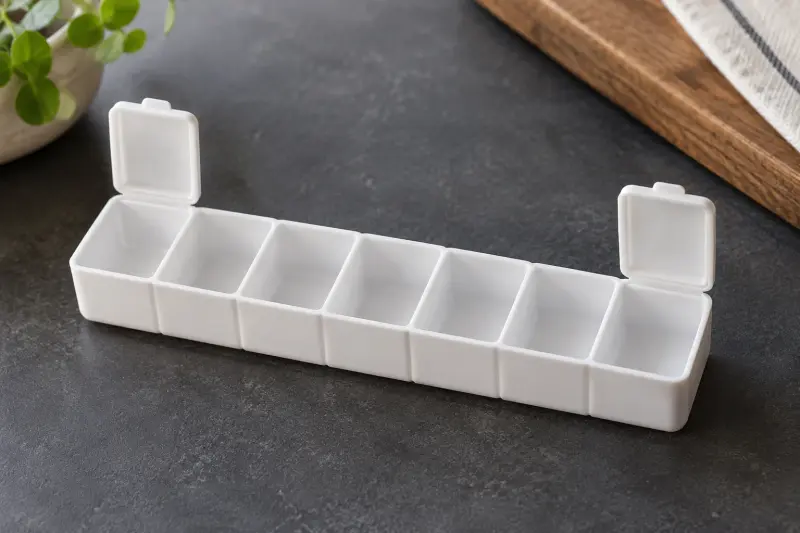
A demonstration with an empty item may help explain a preference, but it is not a medical assessment or a test of adherence. If handling is difficult, discuss that problem with the pharmacy team rather than forcing repeated attempts or modifying the latch. Another pharmacy-supported arrangement may be more appropriate than a different shopping feature.
Read exactly what the manufacturer claims about closure and permitted use. A firm click does not automatically mean child resistance or a seal suitable for every medicine. Conversely, an item described as easy to open may not be appropriate where access by children is a concern. These separate questions must both remain on the card.
Ask the seller about current return conditions before opening packaging or trying the product. Personal-use items can have seller-specific restrictions. An empty sample available through a relevant local route may help comparison, but do not assume every seller provides one or accepts returns after use. Resolve handling and pharmacy requirements before buying a large multi-pack.
Measure usable compartments without treating capacity as suitability
Overall case dimensions do not reveal the usable compartment dimensions. Ask for the interior width, depth and height where a container has already been confirmed as relevant. Curved corners, dividers and lids can reduce the practical space. A photographed handful of tablets is not a reliable capacity specification for someone else's medicines.
The pharmacist should address what may be stored together and what must remain in original packaging. Do not use a geometric calculation to authorize combining medicines. NHS SPS explicitly says its stability tool supports professional judgement and has limitations; a retailer's compartment capacity cannot replace that judgement.
For an empty-container comparison, record the interior dimensions and whether the agreed contents can be accommodated under professional advice. Avoid pressing, splitting or altering medicines to make them fit. This article provides no directions about changing a dosage form or adapting a prescription to a purchased box.
Ask whether a removable section keeps its identification and closure when separated from the outer case. A compact travel piece may lose information or have different containment questions from the complete organizer. Treat that as a separate practical feature requiring pharmacy and product confirmation, rather than assuming that portability is always an advantage.
Agree filling, checking and identification with the pharmacy team
Ask who fills the organizer and who checks the agreed arrangement. Keep those responsibilities within the pharmacist's advice and any relevant care-service process. A household should not assume that the person buying the container is authorized or prepared to manage medicines simply because the product looks straightforward.
Ask what information should stay available for medicine identification and what happens when the routine changes. Do not rely on colour, shape or a loose tablet to identify a medicine. Keep original information and any professional instructions as advised. Record the responsible role and contact route in your private paper notes, keeping the medicine list within the appropriate professional records.
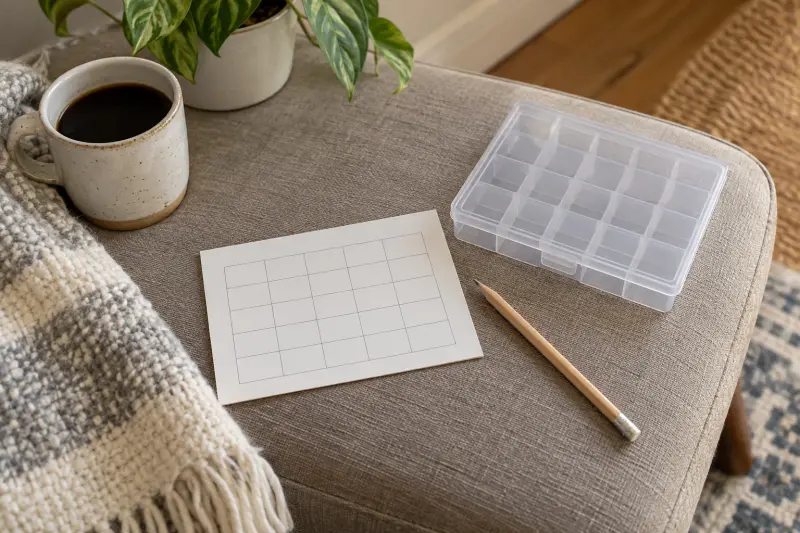
Editorial illustration
Where more than one person helps, clarify how they communicate under the agreed process. An organizer should not create an informal system in which everyone assumes someone else filled or checked it. Bring an unclear responsibility back to the pharmacy or relevant care team rather than inventing a website checklist that certifies the contents.
We do not give filling sequences, dose calculations or advice about correcting an error. If a question arises about what is in a section, a prescription change or a missed dose, contact the appropriate professional. A container buying guide can help define practical questions; it cannot safely replace the person's actual medicine-management instructions.
Worked example: avoid buying complexity before the arrangement is settled
Imagine a fictional shopper choosing a large four-section-per-day organizer for a relative because it appears to offer maximum flexibility. The relative has not yet discussed transfer from original packaging with the pharmacist. The shopper's feature comparison therefore begins after an unresolved medicine-suitability question rather than before an informed purchase.
The family pauses the order and asks the pharmacy team about the practical difficulty and actual medicines. It does not change doses or schedules to match the container. Once an appropriate arrangement is established, the family records the confirmed labels, required container pattern, filling responsibility and storage requirements in its private card.
The intended user then reviews empty candidate layouts. One has many unused labels and an outer case they find awkward. Another better matches the confirmed practical requirements. The family asks the seller for usable dimensions and product information without treating its choice as proof of medicine stability or clinical benefit.
This example does not conclude that an organizer was bought or that a particular layout improves adherence. It shows how a pharmacy-first process can prevent an unnecessary complicated purchase. The outcome could be original labelled packaging with an agreed reminder, a suitable organizer or another professional-supported arrangement. The container follows the plan rather than dictating it.
Choose a storage location under medicine-specific instructions
A bathroom cabinet is familiar, but familiarity does not establish appropriate medicine storage. MedlinePlus, from the US National Library of Medicine, warns that bathroom heat and moisture may affect medicines and advises asking the pharmacist about specific storage requirements. Follow the actual medicine and professional instructions instead of choosing a location only because it is convenient.
Record the confirmed storage requirement privately and ask how the agreed organizer arrangement meets it. Do not infer an airtight, light-protective or temperature-controlled property from a colourful lid or fabric pouch. A marketing term needs the exact product documentation, while medicine suitability remains a pharmacy question.
The US National Capital Poison Center notes that many organizers are not child-resistant and that medicines should remain out of children's sight and reach. Plan for visiting children as well as children living in the home. A case left in a bag or on a counter is still accessible; a closure colour does not establish resistance.

Ask the appropriate professional how to reconcile handling needs with secure, suitable storage. We do not prescribe a particular shelf height, cabinet or locking arrangement for every household. The buying worksheet should identify the unresolved issue rather than announce that an easy-open case is safe for children or that a locked box meets every medicine's environmental requirements.
Plan what happens when the routine changes
A prescription change, a new helper or a change in practical ability can require another pharmacy conversation. Do not treat a previous approval for an organizer as a permanent answer for every future medicine or arrangement. Keep the appropriate contact route and ask how the person should report a change under the agreed process.
If the intended user wants a different reminder or container, discuss the practical reason without altering the prescription independently. A new product can create different identification, opening and storage questions. More features do not automatically make the arrangement better. The pharmacy-supported plan should stay central when comparing a connected dispenser or larger case.
For travel, ask the pharmacist about packaging, identification and storage before relying on removable day sections. Check the actual destination and carrier requirements through their relevant official routes where needed. We do not claim that an organizer alone satisfies border, airline or prescription-documentation requirements in every country.
Keep the change record concise and private: what practical issue changed, which professional was contacted and the confirmed next action. No website calculator needs to receive a diagnosis or medicine list to help you remember that a question is pending. The record should support the professional conversation, not generate a new medical answer.
Buy the simplest confirmed configuration and read actual terms
Once professional and practical questions are settled, compare the exact model, included pieces, usable dimensions and documented closure information. Keep current regional stock and checkout terms separate from general research links. We do not rank unnamed containers as tested, publish assumed prices or claim an approved affiliate route for this guide.
Ask the seller what is included and whether spare sections or an outer case are part of the named configuration. An attractive photograph may show a multi-pack while the price refers to one piece. Confirm the actual item identifier and quantity. Avoid buying a month-sized bundle unless the professional arrangement and user preference actually require it.
Read current returns, warranty and care information before opening or using the container. Do not apply another seller's policy or a different country's consumer rules automatically. Ask about uncertain hygiene restrictions or defective-item handling in writing. The relevant scope is the supplied container, not a guarantee that it will be clinically suitable.
The inexpensive alternative may be original labelled packaging with an agreed reminder or another pharmacy-supported approach. An organizer can be a useful practical aid when appropriate, but it is not essential for every reader. A clear decision against an unnecessary purchase is as valuable as selecting a simple relevant container.
Your compartment, opening and storage decision card
Finish a one-page card with professional suitability confirmed, required layout, usable dimensions, readable identification, opening preference, filling responsibility and suitable storage. Keep sensitive medicine details elsewhere under the pharmacy team's advice. The card should be sufficient to compare containers without becoming a public medication record.
Use outcomes such as confirmed, awaiting pharmacist advice or unsuitable for the agreed practical requirement. Do not calculate a medical suitability score from the number of compartments or a child's age. Container features and professional judgement serve different roles, and an essential unresolved requirement cannot be cancelled by several appealing extras.
Add one next action at the bottom. It may be ask the pharmacist about transfer, view an empty sample, obtain interior dimensions or retain the existing agreed arrangement. Keep this action tied to the real difficulty. Browsing hundreds of similar boxes is unlikely to resolve a medicine-suitability question that requires professional advice.
Our bathroom-storage guide can help organize ordinary household items, but medicine storage follows its own requirements. The useful outcome here is a simple, understood pharmacy-supported arrangement with clear responsibility. We make no claim of improved adherence, treatment benefit or error prevention from purchasing a product, and we do not prescribe changes to medicines.
MAKE THE SPEND MEANINGFUL
Before adding to the basket.
- Ask whether original labelled packaging with an agreed reminder answers the need.
- Use a private paper preference card without submitting medicine details online.
- View an empty suitable sample through an available local route before a large order.
- Avoid unnecessary multi-packs or connected features when the agreed arrangement does not need them.
How this guide was prepared
AI-assisted editorial research, checked against the linked primary sources. Product testing and a credentialed individual review are not claimed.
AI-assisted, source-checked editorial; no hands-on test, human expert review or personal suitability assessment claimed
How we use sources and AI assistance ↗Sources & fact checks
The guide separates sourced facts from editorial questions and examples. We have not claimed hands-on product testing. How we use sources and AI assistance.
- NHS Specialist Pharmacy Service: pharmacist advice on suitability and selection of pill organizers; updated September 2026 ↗
- NHS SPS: compliance-aid suitability and stability information supports professional judgement ↗
- US National Library of Medicine MedlinePlus: original packaging, medicine-specific storage and bathroom moisture cautions ↗
- US National Capital Poison Center: organizers and medicines must be kept out of children’s reach and sight ↗
Found an error or an outdated detail? Contact the editorial team.