

In brief
Read the exact suction product’s permitted use before considering it. Some are balance aids that explicitly must not bear body weight. A suction attachment or green indicator should not be treated as equivalent to an assessed, properly installed fixed rail.
IN THIS GUIDE
Define the support task before considering a suction device
A suction handle may be attractive because it appears easy to move and avoids drilling. Those qualities describe attachment convenience, not the support task it can perform. Begin with what the person needs and obtain appropriate assessment where balance, transfers or body-weight support are involved. A purchasing article cannot decide the person's technique or required support.
Write the intended task in ordinary language rather than a product name. “I want to discuss help getting into the bathing position” is more useful than “I need a suction bar.” The first leaves the appropriate solution open. The second can constrain the conversation around a device whose instructions may exclude the actual requirement.
Do not try a movement without the relevant support merely to prove that equipment is needed. Explain existing difficulties to the appropriate professional. If a family member shops on someone's behalf, keep the person's own preferences in the brief and describe any help that is currently provided. Convenience for the buyer is not the same as suitability for the user.
Our comparison starts by separating requirements from features. A permitted balance-assist task, an assessed body-weight support task and a storage task belong in different categories. A handle can look familiar while serving only one of them. The rest of the buying record should keep that distinction visible instead of allowing a low price to erase it.
Read the explicit limitation before the appealing features
Drive Medical's Canadian product page for RTL13084 describes the device as a balance assist and states that it is not intended to support body weight or provide leverage. It also calls for an attachment check before every use. Those restrictions belong at the start of a purchasing comparison, beside the convenient attachment features.
The same page uses reassuring language about its indicators. Read that language together with the restriction rather than treating the green display as permission for any task. The product's stated attachment condition does not override its permitted-use limit. We do not recommend RTL13084 for an individual's assessed requirement or claim current stock in every market.
For another product, obtain that product's own current instructions. Do not generalize a load figure, permitted surface or checking routine from RTL13084 to a different suction device. Conversely, a different product's claimed capacity should not be inserted into this model's description. The exact manufacturer, model and region must stay attached to each fact.
If your required task exceeds a documented restriction, remove the candidate from that task's shortlist. It is not a drawback to balance against a discount. The worksheet should show a mismatch plainly and identify the appropriate assessment or installed-support enquiry. Buying a convenient device cannot change what its instructions permit.

Ask what an indicator establishes and what it leaves open
An indicator is a feature of a named device, with a meaning defined in its instructions. Ask the manufacturer what it signals, when it must be checked and what action the instructions require when it is not in the expected condition. Do not infer a broader safety claim from the colour or from a retailer's photograph.
Keep three questions separate: is the product attached as its instructions describe; is the actual surface permitted; and is the person's task within the permitted use? Even where the first question has a documented answer, the other two do not disappear. An indicator is not an assessment of the person, the routine or every force someone might apply.
A fictional comparison card might read: “Indicator information available; permitted task confirmed as balance assist only; personal requirement awaiting assessment.” That is a clear statement of what is known. It should not be shortened to “green means safe,” because that wording removes the exact use limitation and the unresolved personal question.
Ask how the intended user or responsible helper will understand the checking requirement. If a necessary signal or check cannot be managed reliably, explain that to the appropriate assessor or provider. Do not try to compensate by choosing a brighter colour, placing a reminder sticker on the device or reducing the requirement to an occasional glance.
Confirm the actual surface using the exact product documentation
A bathroom surface that looks smooth in a photograph may still need a manufacturer-specific compatibility answer. Record the actual material and proposed location, and ask for the exact product's permitted surfaces and any restrictions involving seams, texture or placement. This guide does not supply a universal surface list or mounting recipe.
Do not assume that every item described as glass, acrylic or tile is equivalent for an attachment system. A product's current instructions may distinguish particular surfaces or conditions. If the seller gives a broad claim such as “works anywhere smooth,” ask for the manufacturer's documentation supporting that claim before treating the candidate as compatible.
For a property you do not own, ask who can confirm the surface and permit any equipment arrangement. A rental restriction on drilling does not automatically make suction appropriate. The property constraint belongs in the brief, while support suitability and installation requirements remain separate questions for the relevant people.
If the surface or permitted use cannot be established, leave the candidate unresolved. Do not experiment with improvised adhesive, extra tape or another component to make it attach. That changes the arrangement without evidence of approval. The next action is a clear manufacturer or provider enquiry, not an unofficial modification followed by a household strength test.
Make required checks a real household responsibility
Where the exact instructions require a check before use, the household needs to know who performs it and how the documented procedure is understood. A purchase made by someone living elsewhere can leave that responsibility unclear. Ask the intended user and provider to resolve it before considering the arrangement complete.
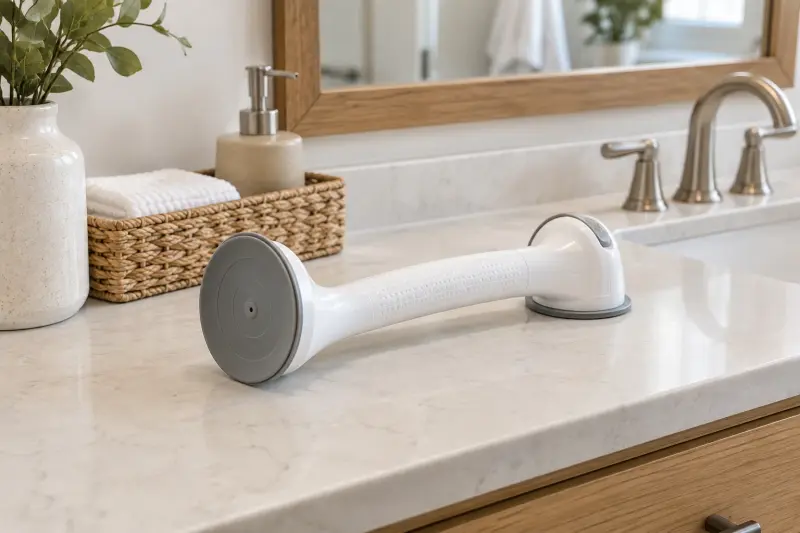
Do not turn a required check into a generic weekly cleaning reminder. The timing and method come from the applicable instructions. Keep those instructions accessible and ask the maker or provider about unclear wording. This article does not describe how to test a support by applying body weight or reproduce reattachment steps for every model.
Record what happens when the required condition is not established. Identify the responsible contact and appropriate next action under the documentation. A plan saying “we will probably notice if something changes” is not a defined responsibility. Nor does a spare device remove the need to understand the supplied product's limits and requirements.
A user who does not want or cannot manage the required routine should have that concern represented in the assessment. It is not a reason to pressure them into accepting equipment because the installation appears simple. A different appropriately assessed solution may answer the task more clearly, even if it involves another commissioning pathway.
Compare support systems by their permitted task and installation scope
A fixed rail, an approved adhesive-mounted system and a removable suction device should not be compared as interchangeable ways to buy the same handle. Their permitted use, supporting requirements and installation scope can differ. Start with the assessed task, then request the documentation for the relevant system and actual surface.
Etac's Flex international page distinguishes screw-mount and adhesive-mount variants and provides separate manuals. That is a useful example of why the mounting method belongs to the exact configured product. It does not mean a generic glue can turn any rail into an adhesive system, or that the same instructions apply to both variants.
Ask an appropriate installer to confirm the selected system's actual requirements. We do not give drilling positions, substrate calculations or adhesive procedures. A rail's advertised dimensions and capacity are not enough to establish an installation. The installed arrangement and personal task need their respective confirmations.
Compare complete scope once the relevant category is established: assessment, survey, exact equipment, installation, making good, handover and service. A product-only amount for a suction device cannot fairly be compared with an assessed installed rail as if both orders answered the same requirement. The difference is scope and permitted task, not simply an expensive versus cheap handle.
Bring rental and temporary-use constraints into the assessment
A renter may reasonably want to avoid damage to a wall. A traveller may want portable equipment. Both are valid practical constraints, but neither determines personal support suitability. Describe the constraint to the appropriate assessor or provider before selecting a no-drill product. The solution must still answer the actual task under its instructions.
Ask the property owner or responsible accommodation provider what arrangements can be considered and who can inspect the location. Do not assume that a hotel photograph proves a surface is compatible or that a rental policy prohibits every professionally installed option. Keep the actual answer in writing and identify the person responsible for the property decision.

For travel, an existing equipment arrangement at home should not be assumed to apply to another bathroom. The fixtures, surface, layout and available support may differ. Ask the relevant provider how to plan the necessary arrangements. An accessory packed in a suitcase is not a completed compatibility or suitability check at the destination.
If the requirement cannot be resolved before a temporary stay, do not buy a convenient-looking handle to hide the gap. Seek appropriate advice about the available arrangement. A purchasing guide can help organize questions for the accommodation and equipment provider, but it cannot certify an unfamiliar room or teach an alternative transfer method.
Worked example: no-drill preference versus a body-weight requirement
Imagine a fictional renter whose family sees a suction handle advertised beside bath equipment. They initially shortlist it because it avoids drilling. Their stated shopping purpose, however, is a handle to pull on while getting into a bathing position. That intended use must be examined before surface fit, colour or delivery speed.
The family obtains the named product's manufacturer information and records its permitted-use limitation. For RTL13084, the body-weight and leverage restriction means that this candidate does not answer the described task. A positive customer review, a green indicator or a reduced price cannot resolve that mismatch.
The household then prepares an assessment brief describing the routine and the rental constraint. It asks the relevant professional and property contact about appropriate support and installation options. It does not substitute a towel rail or buy generic adhesive to modify the suction product. The product question becomes a task-and-property question that the appropriate people can answer.
This example does not prescribe a fixed rail for every renter or conclude that any named system is suitable. It illustrates an exclusion decision before purchase. The useful outcome may be an assessed installation, another equipment arrangement or a different confirmed solution. No order is needed until the actual requirement and responsibilities are understood.
Build an evidence table that keeps unknowns visible
Use five rows: required task, permitted use, actual surface, required checks and responsible person. Add the exact model and document beside each answer. A product does not pass because three of five rows look promising. An essential mismatch or unresolved requirement remains visible and determines the next action.
For permitted use, retain the limitation as well as the feature. For surface, keep the manufacturer's actual answer or the appropriate survey confirmation. For checking, record the documented timing and who can perform the requirement. Do not fill a blank with an assumption because the worksheet feels unfinished. Its value is identifying missing evidence early.
Give each row an outcome: confirmed for this question, mismatched or awaiting a named answer. The wording “confirmed for this question” matters. A supplier can identify product information without assessing the person, while an assessor can explain the support task without completing a property installation. Separate confirmations avoid creating an approval nobody actually gave.

At the bottom, write the next question and the person who can answer it. If several questions remain, begin with the task restriction; it may exclude the product before a detailed surface enquiry is useful. This order prevents unnecessary shopping work and makes the decision record understandable to another household member.
Ask about care and service without making unauthorized changes
Find the exact care requirements and ask who manages them. A bathroom accessory may need particular cleaning or component attention under its instructions. Do not copy a cleaning method from a suction storage cup, another support product or a household window tool. Similar attachment principles do not make their permitted care interchangeable.
If a component appears damaged or the attachment condition changes, use the manufacturer's or responsible provider's guidance. Keep the model and observation with the enquiry. Do not continue using a questionable arrangement while comparing bargain replacements, and do not treat a household test as a condition assessment.
Ask about approved replacement components and whether a service route is required. A marketplace listing for a similar cup or latch does not establish an approved substitute. An unavailable part may require another documented decision, but it does not justify modifying the device or assembling a hybrid product from several sellers.
Keep the care record brief: identity, required task, observation, advice and action. Avoid inventing a universal replacement interval or claiming that a limited warranty means indefinite suitability. Equipment condition and personal support needs can change independently. Bring the relevant question to the maker, service or appropriate assessor rather than letting an old purchase decision answer every future concern.
Read online listings critically and compare only relevant orders
Online search results can place storage handles, balance aids and fixed rails beside one another. Ignore the shared category label until the actual manufacturer documentation establishes the product's purpose. A low-cost item can be useful for its permitted task, but it is not a substitute simply because it resembles something that provides body-weight support.
Read the listing's exact model and region. A seller may copy a feature while omitting a limitation or show a photograph of a different version. Ask for clarification where the item identity or instructions are unclear. Do not choose whichever page uses the strongest safety language; choose evidence relevant to the exact task and supplied product.
If considering a purchase after the appropriate confirmations, read current inclusions, delivery scope, warranty and return conditions. Keep hygiene or used-item restrictions visible where the seller applies them. We do not assume a universal refund rule or that an installed product can be returned on the same terms as an unopened accessory.
Our information links are not claims of affiliate approval, stock or a tested recommendation. The buying decision can end with excluding the candidate. A useful guide helps a reader avoid an irrelevant order as well as consider an appropriate one. That is especially important when the attractive feature is convenience but the unresolved issue is support.
Your instruction-evidence decision card
Finish a one-page card that begins with the assessed task and the exact product's permitted use. Continue with actual surface evidence, required checking responsibility and the appropriate contact route. Keep personal advice privately; the public shopping record needs no diagnosis or detailed health data.
Write the conclusion as an action, not a score. Examples include “exclude this candidate from the body-weight task,” “ask maker to confirm the surface,” or “return to the assessor with the property constraint.” A numerical suitability score can hide the fact that an essential instruction explicitly excludes the intended use.
If a different installed arrangement becomes relevant, use our grab-rail installation questions guide to prepare its separate scope. Do not carry a suction product's dimensions, limits or checking routine into that new system. The category change creates new documentation and responsibilities rather than automatically solving every question.
The aim is a support decision the household can explain clearly. It includes why a convenient product was rejected, which evidence is still needed and who owns the next step. Waiting for an appropriate answer is useful progress. It is preferable to completing a purchase while hoping that a limitation will not matter during the actual routine.
MAKE THE SPEND MEANINGFUL
Before adding to the basket.
- Seek the appropriate assessment before buying an unresolved no-drill accessory.
- Ask the property contact and provider about a documented suitable arrangement.
- Use a paper evidence card instead of buying a planning tool.
- Do not substitute a towel rail or storage handle for assessed support.
How this guide was prepared
AI-assisted editorial research, checked against the linked primary sources. Product testing and a credentialed individual review are not claimed.
AI-assisted, source-checked editorial; no hands-on test, human expert review or personal suitability assessment claimed
How we use sources and AI assistance ↗Sources & fact checks
The guide separates sourced facts from editorial questions and examples. We have not claimed hands-on product testing. How we use sources and AI assistance.
- Drive Medical RTL13084 Canadian page: balance-only limitation and attachment checks ↗
- Etac Flex international: separate screw-mount and adhesive-mount variants and manuals ↗
Found an error or an outdated detail? Contact the editorial team.