
In brief
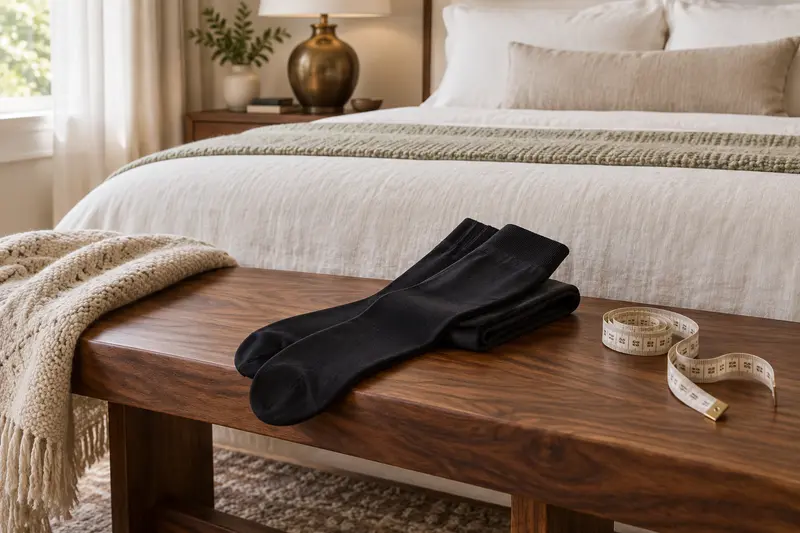
Compression socks for women and men are sold by pressure, printed in mmHg, and by measured leg size, not shoe size. Ask a clinician which pressure suits you, then measure your ankle and calf in the morning. A plain knee-high in a named pressure, such as 15-20 mmHg, is the simplest place to start.
Shortlisted for this decision
Affiliate-
Shortlisted
Truform 15-20 mmHg stockings
For 15-20 mmHg pressure a clinician suggests
A named 15-20 mmHg medical stocking with a published size chart, so you can match your measurements and the pressure a clinician suggests.
Check price on AmazonCheck first: Confirm the listing is the knee-high 8875 style, and measure ankle and calf before ordering.
Affiliate links: we may earn a commission from qualifying purchases at no extra cost to you. Prices are shown only on Amazon. Amazon.com (US listing). See the full comparison ↓
Documented options
Compression socks for women and men: options compared
Options based on manufacturer documentation. Retailer links are affiliate links: we may earn a commission from qualifying purchases.
Affiliate retailer links
-
Truform 15-20 mmHg Compression Stockings, Men and Women, Medical
Exact variant: Black, Medium
View product details on Amazon — United States
IN THIS GUIDE
Who compression socks are for, and who should ask first
Compression socks are snug, stretchy socks that squeeze the leg, with the most pressure at the ankle. People buy them for long days on their feet, for travel, or because a health care provider suggested them.
MedlinePlus notes that providers may prescribe compression stockings for conditions such as varicose veins or after surgery. That is a medical decision, so this guide covers sizing, fit and care rather than what the socks can do for any condition.
Comfort matters as much as fit. A sock you find too hard to pull on, too warm or too tight at the top tends to stay in the drawer, so think about daily wear before you order.
- Ask a clinician before buying if you have a circulation, heart, skin or nerve condition.
- If a provider names a pressure level, buy exactly that level.
- Stop wearing them and ask for advice if they pinch, numb or mark the skin.
- Family members can help with measuring, but the wearer should choose the style.
Pressure levels in mmHg, explained plainly
Pressure is printed as a range in millimeters of mercury, written mmHg. Truform, for example, sells the same knee-high in style 8875 at 15-20 mmHg, style 8865 at 20-30 mmHg and style 8845 at 30-40 mmHg.
A higher number is not a better product. It is a stronger squeeze, and the higher ranges are usually chosen with a clinician. If nobody has given you a number, ask before you pick one.
Pressure ranges are also how a clinician, pharmacist or fitter will talk about socks. Writing the range down, along with the length and toe type you were advised, makes it much easier to compare listings later.
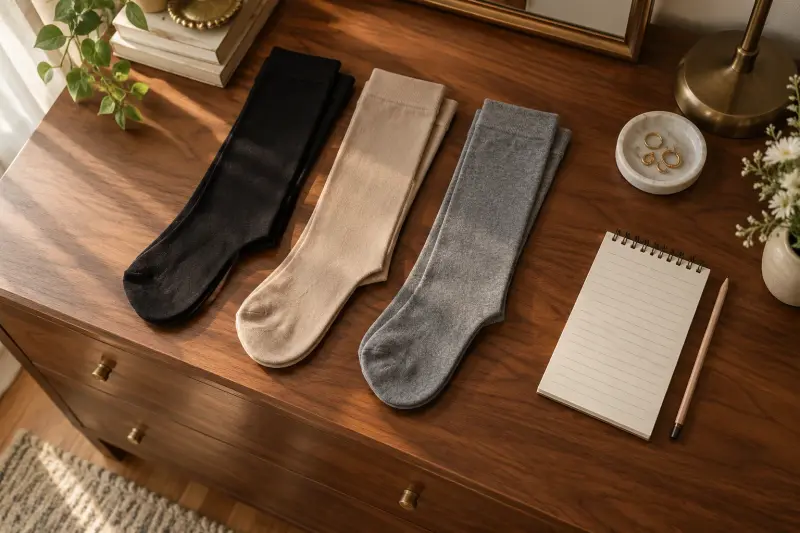
- 15-20 mmHg is the lowest range sold under medical style numbers by Truform.
- 20-30 and 30-40 mmHg are firmer and are usually set by a clinician.
- Check the pressure on the package, not only on the product photo.
- Do not mix ranges between legs unless you were told to.
How to measure for compression socks for women and men
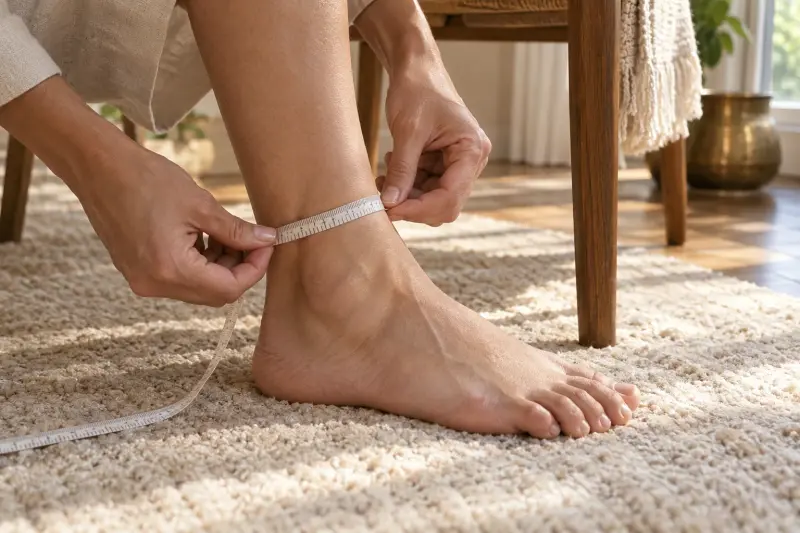
Compression socks are sized by leg measurements, so shoe size alone can lead to the wrong pair. Truform's size chart asks for ankle circumference, calf circumference and the length from floor to knee, taken on bare skin with the leg at a right angle to the foot.
Measure in the morning, when legs are usually least swollen. MedlinePlus also suggests a medical equipment store, where staff can measure your legs for a good fit.
Keep your numbers on a card or in your phone. Sizes vary between brands, so the same person may be a medium in one range and a large in another, and the chart for each product is what counts.
- Use a soft tape measure, not a metal one.
- Measure the narrowest point above the ankle bone.
- Measure the widest part of the calf.
- Write down both legs; they are not always the same size.
- If you fall between sizes, ask the maker or a fitter before ordering.
How the pick compares on the facts
We list one named knee-high because the pressure is tied to a published style number. Many socks sold online are unbranded multipacks with no maker page, so their pressure and sizing are hard to confirm.
Below are the facts from Truform's own page for style 8875 and the matching Amazon listing title. Confirm the style number and length on the listing before you order.
We have not tested this or any other sock. The comparison only lines up what the maker publishes, so it cannot tell you how the socks will feel on your legs or whether they suit your health needs.
- Pressure: 15-20 mmHg (style 8875); firmer styles 8865 and 8845 are sold separately.
- Length and toe: knee-high, closed toe with a roomy toe box that is not compressed.
- Build: smooth latex-free knit with a reinforced heel pocket.
- Listing variant: Black, Medium, sold for men and women.
- Care: hand wash in lukewarm or cold water and dry flat.
Putting them on, wearing and washing
MedlinePlus suggests putting stockings on first thing in the morning, before getting out of bed. Roll the stocking down, set your heel in the heel pocket, then pull up and smooth out every wrinkle.
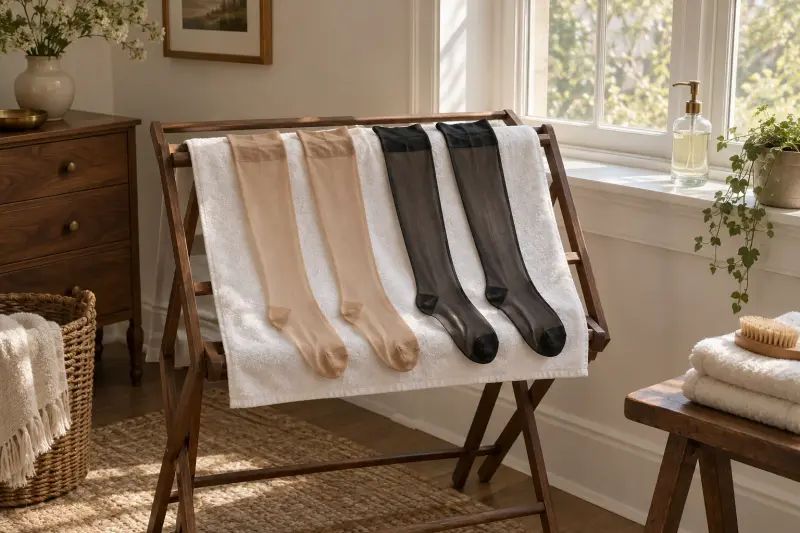
Wash them often with mild soap and let them air dry. Owning two pairs lets one dry while you wear the other, and MedlinePlus suggests replacing them every 3 to 6 months so they keep their squeeze.
If your hands are weak or bending to your feet is hard, ask an occupational therapist about a stocking aid or donning frame. These simple frames hold the sock open so you can step in and pull it up with straps.
- Sit down to put them on; a sturdy chair or bed edge helps.
- Rubber gloves can give a better grip on the fabric.
- Never roll the top band down; it can dig in.
- Dry flat away from heaters and direct sun, as Truform advises.
Common mistakes to avoid
Most problems come from the wrong size or the wrong pressure. A sock that is too tight at the top can work against the point of graduated pressure.
Another common mistake is buying a mixed multipack with no maker details. You cannot check the pressure or the size chart, and a clinician cannot match it to advice.
Finally, do not ignore discomfort. Pain, tingling, skin color changes or deep marks are reasons to take the socks off and call your clinician, not reasons to push through the day.
- Buying by shoe size instead of ankle and calf measurement.
- Choosing a firmer range because it sounds stronger.
- Wearing wrinkled or folded socks that bunch behind the knee.
- Keeping worn-out pairs long after they lose their stretch.
MAKE THE SPEND MEANINGFUL
Compression socks for women and men: low-cost alternatives
- Ask your clinician or pharmacy whether a prescribed pair is covered by your insurance or health plan.
- Start with one measured pair before buying a multipack, so you know the size works.
- A medical equipment store can measure you at no extra cost when you buy there.
In brief
Compression socks for women and men: questions answered
What are the best compression socks?
There is no single best pair for everyone. The right pair has the pressure level your clinician suggests, fits your measured ankle and calf, and is a length you can put on and wear. A named product with a published size chart and style number is easier to check than an unbranded multipack.
Are compression socks for women different from compression socks for men?
Many medical styles, including the Truform knee-high listed here, are sold as unisex and are sized by leg measurements. Women's and men's ranges may differ in colors, foot size steps or top bands. Use the size chart for the exact product rather than the label on the box.
What does 15-20 mmHg mean?
It is the range of pressure the sock applies, measured in millimeters of mercury. It is the lowest range Truform sells under its medical knee-high style numbers. Firmer ranges such as 20-30 and 30-40 mmHg exist, and a clinician should help decide which level, if any, suits you.
How often should compression socks be replaced?
MedlinePlus suggests replacing compression stockings every 3 to 6 months so they keep their compression and support. Replace them sooner if the fabric is thin, the top band is loose, or they slide down. Washing gently and drying flat away from heat can help them last.
How this guide was prepared
AI-assisted editorial research, checked against the linked primary sources.
Written with AI assistance from the sources listed below and checked against them. We have not tested these products in person.
How we use sources and AI assistance ↗Sources & fact checks
The guide separates sourced facts from editorial questions and examples. How we use sources and AI assistance.
Found an error or an outdated detail? Contact the editorial team.