
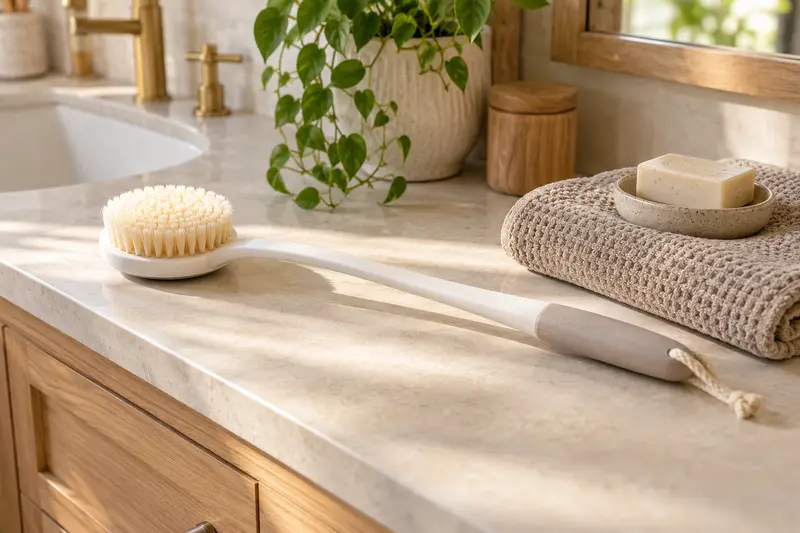
In brief
Separate applying a washing product, washing an area, rinsing and retrieving supplies. Choose a documented aid for the unresolved action, with understandable handling and care. Compare the exact body-washer or back-washer model rather than buying by length alone. A washing aid provides neither body support nor a transfer solution; wider painful or uncertain bathing tasks need appropriate advice before an accessory purchase.
Documented options
A clearer comparison.
Research options based on manufacturer documentation. These are not results of hands-on testing. Manufacturer links are informational; no commission relationship is currently active.
IN THIS GUIDE
Separate washing, application, rinsing and retrieval before shopping
Write the action you want to improve in ordinary words. Applying a washing product, washing a particular area, rinsing and retrieving a bottle are different tasks, even when all occur during one bath or shower. A long handle may be relevant to one action and irrelevant to another. Start with the action that remains difficult, then identify the kind of aid whose documented purpose matches it. This makes a small purchase easier to evaluate without assembling an entire bathroom collection first.
For application, ask what you want to put on the washing head and whether that use is covered by the exact instructions. An item sold as a body washer should not automatically be treated as an applicator for every lotion, prescribed preparation or household substance. Product texture, cleaning and intended use can create separate questions. If the concern involves a treatment or skin condition, obtain the relevant advice rather than changing the application method because a longer handle looks convenient.
For washing, describe the area and the present difficulty without attempting an unfamiliar movement to demonstrate it. The problem might concern the head’s position, a grip preference or the effort of maintaining the tool. Those lead to different comparisons. Someone shopping for another person should preserve that person’s own explanation. A relative who can comfortably handle an accessory has learned about their own handling, not established that it serves the intended user’s task or preferred bathing arrangement.
For rinsing, first identify what the existing permitted arrangement already provides. A handshower and a cloth-covered washer perform different jobs: water delivery is not the same as moving a washing head. If the difficulty concerns retrieving the handset or returning it to its holder, our hose-and-handset guide addresses that purchase question separately. Buying a longer washer because both tasks involve reaching can leave the rinsing problem untouched. Keep the two tasks on separate rows until the actual gap is understood.
For retrieval, distinguish finding an object from using it. A crowded shelf may make the correct aid hard to identify even when its grip and head are satisfactory. An existing suitable storage location could answer that organizational problem without another washing tool. Conversely, moving a bottle cannot resolve an uncertain washing motion. Describe whether the obstacle occurs before washing, during the action or while putting things away. The sequence is useful shopping information without becoming a personal assessment or a prescribed bathing method.

Consider a fictional buyer who already manages an assessed bathing arrangement and wants help with one washing action. They investigate a documented aid for that action while retaining the equipment that works. Another fictional buyer is unsure about getting into the bath and hopes a matching accessory kit will make the whole routine manageable. That kit does not answer the transfer question. Painful, difficult or unsafe bathing needs deserve appropriate professional review; a washing aid is not intended as a handle for body support.
Finish the initial brief with what should remain unchanged in the useful routine: a preferred control, an existing washing product or an agreed helper’s task, for example. Tell the retailer the action and handling questions, while keeping health information in the appropriate private discussion. This brief can be a few lines on paper.
Compare the exact body washer, back washer and handling task
Separate total product length, usable gripping area and the head’s position. A length figure alone cannot describe all three. Ask the supplier what the stated dimension measures and examine the exact model’s documented shape. Two aids of similar length may place their heads differently, while a larger figure may add little to the intended action.
The Etac Beauty body washer, item 80210076, is a concrete manufacturer example. Its international listing gives an overall length of 380 millimetres and a listed weight of 112 grams, with polypropylene and TPE materials. It describes an oval handle with a non-slip surface and replaceable, machine-washable cloths. These identify the product under discussion. They are not our wet-handling test, a measured grip result or an endorsement for a particular user. Confirm the locally supplied item against its documentation.
The Etac Beauty back washer has its own product record. The maker lists item 80210080 at 770 millimetres and 203 grams and describes its back-washing purpose. This is a different identified product, rather than a second name for the body washer. Its larger listed dimensions do not make it the automatic upgrade. Keep the candidate aligned with the intended action and ask about the actual shape and handling before deciding that the longer specification answers the user’s request.
Product photographs can confuse this distinction, particularly when a retailer groups several items from one family on the same page. Confirm which model the selected option and price describe. Ask whether the pictured tool is the item that will arrive, what attachment is included and which replacement belongs to it. A family name or shared finish does not establish identical contents. Retain the model identifier on the enquiry so a later stock substitution cannot quietly change the aid being compared.
At a permitted inspection or demonstration, ask to have the gripping area, head attachment and relevant action explained. Examine the exact quoted item where practical, with appropriate help. Record what was actually shown and what remains unknown. A dry showroom impression and a complete wet bathing routine are different kinds of evidence. Do not turn the appointment into a strength or endurance test, and do not push through pain or an uncertain movement to decide whether an inexpensive product deserves purchase.
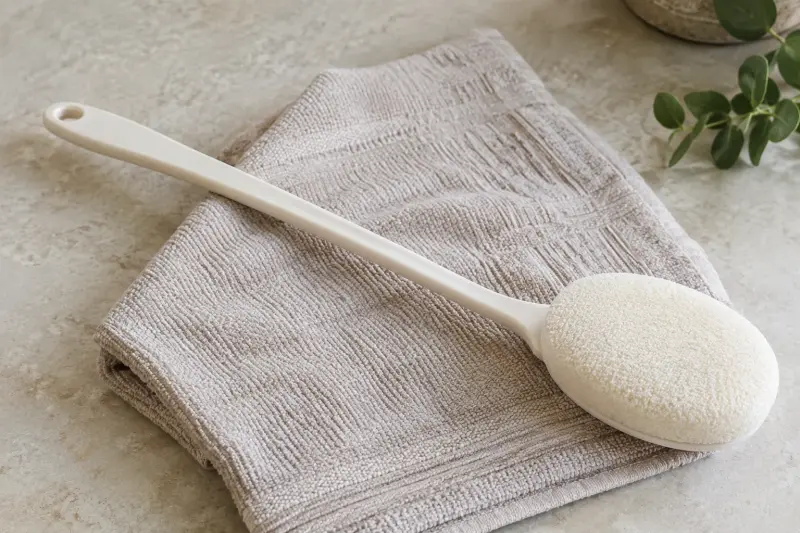
In a hypothetical comparison, one buyer is attracted to a longer tool but finds the cloth-changing action the unanswered question. Another prefers the body-washer format but wants the retailer to clarify the head’s orientation. Those buyers should receive different follow-up answers. Neither question can be resolved by ranking products solely by length or weight. Write the unresolved action beside each candidate instead of adding a generic comfort score that could conceal the reason the purchase is still undecided.
Keep marketing descriptions separate from observed handling and documented features. An ergonomic label describes the maker’s design claim; it does not establish personal suitability or a clinical outcome. Our generated lifestyle pictures likewise illustrate a setting and do not show an independently tested model or real user experience. If a shortlisted aid requires an altered handle, improvised grip or substitute attachment to seem useful, ask the manufacturer and relevant professional about the unanswered arrangement before treating that workaround as part of the order.
Understand detachable cloths, laundry and replacement before checkout
A detachable cloth creates an ownership task as well as a washing surface. Find out how the exact cloth is removed, cared for and attached again, and who will do those actions. A product can suit a handling preference while its maintenance remains impractical for the household. Discuss that before ordering several replacements. The useful question is whether the documented tool can be kept ready through an understandable care arrangement, rather than whether the product photograph shows a neat, clean head.
Etac’s body-washer page identifies spare wash cloth item 80210103 as a two-piece pack. Its back-washer page lists a different spare identifier, 80210104. Keep those records tied to their named tools. Different identifiers are a reason to request exact compatibility confirmation, not to assume every cloth in the family is interchangeable or definitely incompatible. Ask which part the local seller will supply and what its package contains. The international listing does not confirm present stock at a particular distributor.
The manufacturer’s machine-washable description concerns the replaceable cloths. It should not be expanded into permission to put the entire handle assembly through the same process. Obtain the current care information for the relevant parts, including any washing, drying or product restrictions. We do not invent a temperature, detergent, disinfection recipe or replacement interval from a material name. If the local package lacks a necessary instruction, ask the responsible supplier or maker for it before relying on a generic online cleaning tip.
Treat removal, laundry and reattachment as separate actions in the care discussion. The person who uses the tool may prefer someone else to help with one maintenance step, while doing another themselves. Write that arrangement accurately rather than calling the whole purchase independent use. If the assumed helper is not normally available, resolve the practical gap. Owning more cloths may reduce one laundry interruption, but it cannot explain an attachment action that nobody in the actual routine can complete as intended.

For a fictional household, the chosen tool’s handling is satisfactory but the retailer has not demonstrated how its cloth is restored after washing. A discounted refill pack becomes an attractive distraction. The household first obtains the exact attachment explanation and decides who can perform it. Only then does it consider whether a spare has a genuine laundry purpose. This example is about maintenance planning, not a claimed product trial or a promise that a particular head can be changed easily by everyone.
Plan a drying destination according to the actual instructions and the room’s existing arrangement. A product being washed or awaiting care needs a location distinct from the item that is ready for the next routine. Discuss the available space before buying another holder. An organizer’s shape alone does not establish that it supports the tool or permits the needed drying. Keep the care question with the manufacturer’s information and the storage question with the exact holder’s documented use rather than letting one photograph answer both.
Retain the tool identifier, compatible-part response and care information with the purchase record. When a head or component later changes, use those records to ask a precise question instead of searching by appearance. A missing retailer page need not erase the model information already kept privately. Conversely, an old saved page should not authorize a replacement with different instructions.
Give the useful aid a practical home in the existing routine
Describe the everyday washing station as a sequence of objects: the ready aid, the relevant washing product, the existing rinse arrangement and the towel. Identify which are needed during the task and which are occasional supplies. This list does not prescribe a reachable distance or a safe body position. Where personal reach is uncertain, obtain the appropriate assessment. For shopping purposes, it reveals whether the remaining problem is the tool itself, finding supplies or keeping the needed objects organized.
Give the ready aid a consistent home understood by the people who use or maintain it. The current shelf or other appropriate arrangement may already serve that purpose. A clearer organization of existing items can be considered before a new caddy. Check the exact storage product’s intended use if an accessory is needed, including what it is designed to hold and its placement requirements. Do not attach a washing tool to a support fitting merely because a hook happens to fit around it.
Keep bathing equipment’s roles explicit. A washer, caddy or towel rail is not a replacement for the appropriate support or seating arrangement. A matching collection can look coherent without its pieces having the same purpose. The household should not rely on a washing aid for body weight, pulling into position or transfer assistance. Resolve those questions through the relevant professional route. A modest storage purchase may improve organization while leaving an essential bathing or access question completely separate.

In a hypothetical routine, the user recognizes the washer but the selected washing product is routinely stored elsewhere. The household reviews whether an existing appropriate storage arrangement can make the supplies easier to find. Buying a second washer would duplicate the tool without answering that organizational gap. In another hypothetical routine, everything is organized but the chosen head remains difficult to handle. That enquiry belongs with the aid’s handling and relevant advice, rather than with a larger shelf or additional matching baskets.
For a shared bathroom, identify whose objects and care tasks belong to the arrangement. A helper should know which cloth is ready, which is awaiting its prescribed care and which exact tool the replacement belongs to. Use an understandable private household record when helpful. This is organization, not a hygiene protocol supplied by our site. Any personal care or infection-related instruction must come from the appropriate source; the guide does not establish that sharing a washing aid is suitable for particular people.
Check how storage affects ordinary doors, screens and the household route before selecting a new container. An empty-room product photo may conceal the way the room is normally used. Discuss the actual location with the relevant provider if equipment or assessed movement is involved. Avoid buying several inexpensive organizers to discover a workable place through repeated trial. A written description of the available storage and intended object can make the supplier’s answer more useful without a public photograph of private belongings.
If the tool or bathing arrangement changes later, revisit the affected task instead of replacing the entire station automatically. A different head may need its own replacement information; another holder may alter retrieval; a changed personal need may require further advice. Preserve the parts of the arrangement that still serve their documented purpose.
Compare one useful tool with a bundle and read the seller’s terms
Compare complete, relevant contents rather than the number of pieces in a package. A single appropriate aid, an aid with a compatible spare and a coordinated bathing set are different offers. List what each item would do for the stated task. An extra tool that answers no unresolved action should remain optional, even when the bundle reduces the advertised price per piece. Include delivery and any necessary compatible part in the comparison, using real current offers rather than an invented average saving.
Ask the seller which exact product and attachment will arrive, whether the product is supplied ready for its intended assembly and where the applicable instructions are available. Clarify any permitted inspection or demonstration before paying. A marketplace picture may show accessories outside the selected package. Keep the written contents with the order so a difference can be described accurately. This is particularly useful when a family member makes the purchase and another person will receive, identify or maintain the aid.
Editorial illustration
Read the actual seller’s inspection, hygiene and returns terms before opening or using the item. Do not assume all washing aids have identical rules or that a broad returns headline explains the selected order. Statutory rights and a seller’s voluntary change-of-mind policy are separate questions in the relevant market. Obtain suitable clarification where needed. This article promises no universal trial, refund or legal outcome; a clear seller response helps the buyer decide how much evidence is needed before accepting the order.
Does the longest handle make the best purchase?
No universal ranking follows from length. A head’s documented purpose, position, handling and care can matter differently to the stated action. Compare the exact model and preserve an unanswered personal movement question rather than choosing the largest number. If another task such as rinsing or retrieving supplies is the actual obstacle, investigate that task directly. A larger washer is not an automatic improvement to every part of the routine.
Can an ordinary cloth or similar-looking replacement be substituted?
Obtain the manufacturer’s answer for the exact attachment. Appearance or a shared product-family name does not confirm the proposed combination. Keep the documented replacement identifier and the seller’s compatibility response. Do not alter the head or handle to justify a part already bought. The cost comparison should use an appropriate documented replacement, if one is needed, rather than a cheaper assumed substitute whose connection and permitted use remain unanswered.
Is a spare or a full kit worth buying immediately?
Give the extra item a specific job first. A compatible spare may answer an understood laundry requirement once cloth changing is practical; several refills cannot resolve an unexplained handling action. A kit might contain a genuinely useful second aid, but each should have its own purpose and instructions. In a fictional shortlist, the buyer keeps one suitable aid and declines unrelated extras. Another buyer pauses because the care task needs a better answer.
Close the comparison with the chosen scope and its reason: one documented washing aid, an appropriate existing arrangement, a relevant storage change or further advice before ordering. Keep unresolved questions with their responsible source and retain useful product information privately. No purchase remains a valid outcome when the current routine already serves the task or wider needs are still unclear.
MAKE THE SPEND MEANINGFUL
Before adding to the basket.
- Review the existing handshower and washing tools before buying an additional aid.
- Choose one documented task-specific tool rather than an accessory bundle; add a replacement only when its use and fit are established.
How this guide was prepared
AI-assisted editorial research, checked against the linked primary sources. Product testing and a credentialed individual review are not claimed.
AI-assisted, source-checked editorial; no hands-on test, human expert review or personal suitability assessment claimed
How we use sources and AI assistance ↗Sources & fact checks
The guide separates sourced facts from editorial questions and examples. We have not claimed hands-on product testing. How we use sources and AI assistance.
- Etac: replacement cloth item and documented body-washer materials ↗
- Etac Beauty back washer: compatible spare-cloth identifier and product-specific care description ↗
Found an error or an outdated detail? Contact the editorial team.