
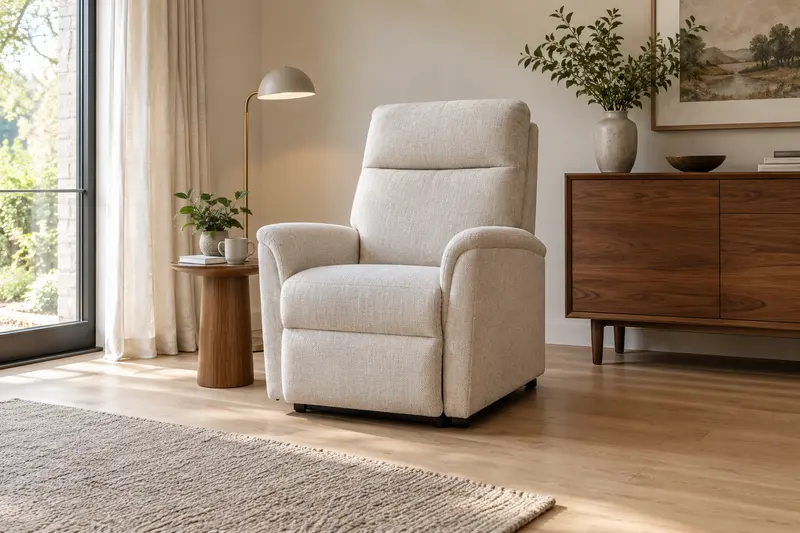
YOUR USEFUL STARTING POINT
Start with seat fit and the full sit-to-stand routine, then compare room clearance and controls. A tall back or premium fabric does not establish suitable seating. Check the exact size, movement envelope and local support. Try the chair where possible and seek appropriate advice when posture, transfer or medical needs are involved.
Begin with the seated position
Bring the person who will use the chair into the decision. Talk about where they spend time, which activities they want to do and how they currently sit and stand. An advertised height band can narrow a search, but it does not describe everyone’s proportions. Ask about seat depth, width, height and the support needed for the individual.
During a demonstration, take time with ordinary tasks such as reaching a book or operating the remote. If fit or transfer is uncertain, an appropriate professional can help assess it. Avoid buying a larger chair merely because it looks more generous. A large overall chair can still have an unsuitable seat, and extra upholstery does not resolve a functional question.
A useful first conversation sounds less like a furniture catalogue and more like an account of a normal evening. Is the chair used for reading, watching television, conversation or working on a puzzle? Does the person want a book beside them, somewhere to put glasses or a clear route to another room? Which parts of the present arrangement already work? Write those answers before introducing motor counts or upholstery upgrades. They give the showroom visit a purpose and help family members avoid buying for their own preferences.
Seat height, seat depth, seat width and back dimensions answer different questions. Overall chair width tells you about the room and delivery route; it does not tell you how much usable space is between the armrests. An advertised user-height range is a starting filter, rather than a fit assessment. Two people of similar height can have different proportions and different needs. Ask the supplier to show where each measurement is taken and whether it changes across sizes in the same collection. Keep the measurement sheet with the quote, rather than relying on a photograph of a generous-looking seat.
Consider a hypothetical household replacing a broad lounge chair. The user likes its fabric but cannot comfortably find the remote, while another family member assumes that a larger lift chair will improve everything. Their first comparison should separate three issues: usable seating, the routine of getting in and out, and storage for small objects. The storage issue may have a modest furniture solution. The transfer question needs an appropriate demonstration and, when uncertain, professional assessment. Making that distinction prevents an unnecessary feature purchase and also prevents an ordinary accessory being treated as a substitute for required support.
Arrange a demonstration without rushing the user through a sales script. Explain the usual tasks in advance, ask what support will be available, and bring the questions that could change the purchase. Record what was demonstrated and what remains unresolved. If the chair feels wrong, do not interpret an attractive finance offer as a reason to proceed. If circumstances make showroom attendance difficult, ask what an in-home demonstration actually includes and whether it creates an obligation. A decision can remain open while the person obtains advice about posture, transfer or a changing need; this guide cannot decide medical suitability.
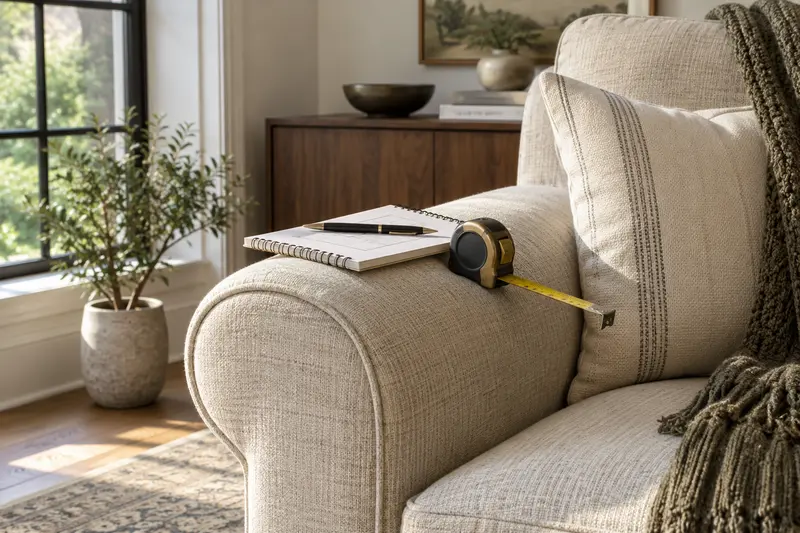
Keep measurements tied to the exact size
Pride’s VivaLift Radiance specification separates its chair sizes, seat dimensions and distance-from-wall figures. The differences make the exact size important when comparing models. The manufacturer’s Atlas Plus page, meanwhile, marks that collection as discontinued. An old review or familiar model name is not evidence that a current order is available.
Request the current model code, size, upholstery and options on the quote. Do not mix dimensions from one size with photographs of another. Ask about the full movement envelope, especially the extended footrest and raised position. Use the manufacturer’s clearance instructions, with the supplier explaining any room-specific issue.
The distinction between a product family and an orderable configuration matters most when two retailers seem to describe the same chair. One offer may name the collection only, while another gives a model code and size. Ask both sellers to specify the same level of detail: current code, size, fabric, control version and included accessories. If one quote substitutes a different size to reduce delivery time, compare that substitute as a new seating candidate. A shared collection name does not make its measurements or functions interchangeable.
The Radiance sheet is a useful example of a manufacturer separating seat-to-floor height, seat depth, seat width and overall dimensions by size. It also notes that specifications can change. Use the linked specification as a dated reference, then have the supplier confirm the current order. We have not tested the chair or verified local inventory. The discontinued Atlas Plus listing illustrates a different problem: an older article can remain visible after a product changes status. Ask whether a seller is offering current production, remaining stock or a used chair, and obtain the documentation appropriate to that exact item.
For a worked comparison, imagine candidate A has the seat dimensions that need further assessment but a footprint the room can accommodate. Candidate B looks narrower in a promotional image, yet the seller has supplied only its overall width. Mark A as awaiting a person-specific fit demonstration and B as awaiting a complete specification. Neither is the winner yet. Once both questions are answered, compare the chairs against the same task list. Do not award B a space advantage based on the image, or award A a suitability advantage simply because its measurements are available.
Keep wall clearance separate from the complete movement envelope. A published distance from the wall does not describe the entire space occupied by the footrest, the raised chair or adjacent furniture. Show the supplier a room sketch with the proposed position, door swing and walking route. Ask which dimensions and clearance instructions apply to the exact size. If the chair will sit on an uneven floor or beside an existing fitting, bring that condition to the supplier rather than improvising a correction. The aim is a documented room arrangement whose unanswered questions are visible before delivery.
Choose functions you will actually use
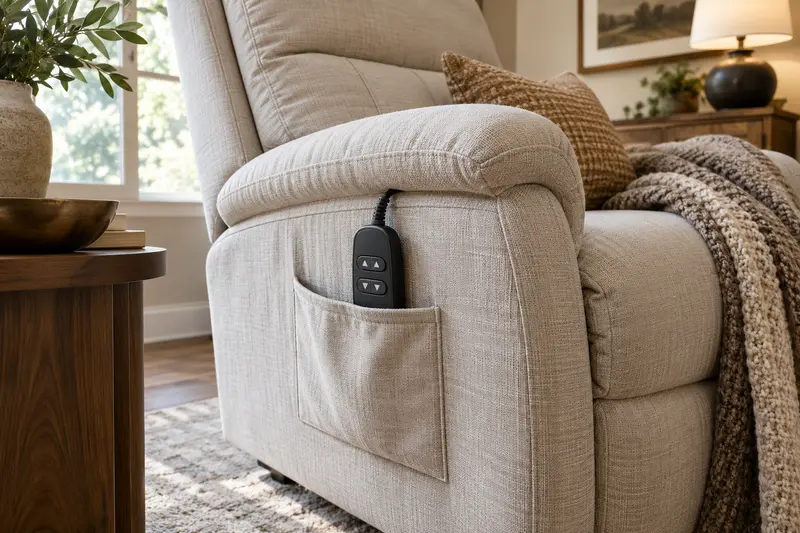
Test the remote with the intended user. Find out which buttons move the backrest, footrest, headrest or lift mechanism and whether a simple return function is available. More independent adjustments can be useful, but only when the controls remain understandable. Keep the required function list short enough to explain to another household member.
Ask about the exact battery-backup procedure, what it can operate and how it is maintained. Follow the chair’s instructions about moving parts, cords, children and pets. Added heat or massage should be evaluated as a feature preference, not as proof of treatment. A recliner demonstration cannot establish a medical outcome.
Build a function list with three columns: needed for the ordinary routine, useful if demonstrated, and unnecessary for this purchase. A lift function, independent back and footrest adjustment, memory buttons, a charging feature and decorative lighting belong in different rows. The list is personal; there is no universal hierarchy in which a chair with more motors automatically offers better value. A person who wants a straightforward routine may value understandable controls more than extra adjustments. Another may have a specific preference that an independent movement can address, subject to suitable assessment.
At the demonstration, ask the user to identify the function they want before a salesperson points to the button. Can they distinguish the control for the footrest from the one for the back? Is the remote easy to locate in the proposed room? Can the supplier explain how to stop movement and return to the intended position? These are questions for the exact chair and its instructions, not a universal operating lesson. If a memory feature is being considered, ask the demonstrator to explain what it stores, how it is changed and what happens when somebody else uses the chair.
A hypothetical buyer may shortlist one chair because its remote has an impressive array of functions. During a demonstration, they discover that only two functions are useful to their routine and that the extra buttons make the ordinary sequence harder to follow. A simpler option then deserves a fresh comparison on seating, movement, support and delivery. Conversely, a needed adjustment should not be discarded just because another model has a tidier-looking remote. Record the task that each feature serves. That makes a higher-cost choice explainable without relying on words such as premium or advanced.
Treat power backup as a maintenance and handover question. Ask which functions it supports on the exact model, how the system is checked, what replacement requirements apply and what the household should do if it fails. Do not connect a generic battery or follow an unrelated chair's procedure. Keep emergency arrangements separate from a feature promise. Heat and massage also need the maker's instructions and relevant individual advice when there is uncertainty. Their presence is a preference feature; it does not establish treatment effectiveness, improved circulation or a suitable position for a medical condition.
Plan the chair and its surroundings together
Measure the route from the delivery entrance to the room, including narrow doors and turns. Mark the chair position on a floor sketch and show the required movement area. Include a place for the remote, a useful light and any side table. Keep the standing and walking route clear instead of filling every nearby surface with accessories.
Ask who assembles the chair, removes packaging and explains its operation. Compare a curbside delivery with an installed handover as different services. Check whether the old chair is removed, whether stairs change the delivery scope and what happens if the new chair cannot enter the home. These details belong in the written offer before payment.
Walk through delivery as a route, beginning outside the home. Record the entrance used, any steps, the narrowest opening and the turn into the room. Ask whether dimensions refer to the assembled chair, separated components or the shipping package. A chair that can be assembled in the room presents a different delivery question from one that arrives fully assembled, but separation must be a supplier-approved procedure. Do not assume that removing a door, lifting over a banister or dismantling powered parts is an acceptable way to make an order fit.
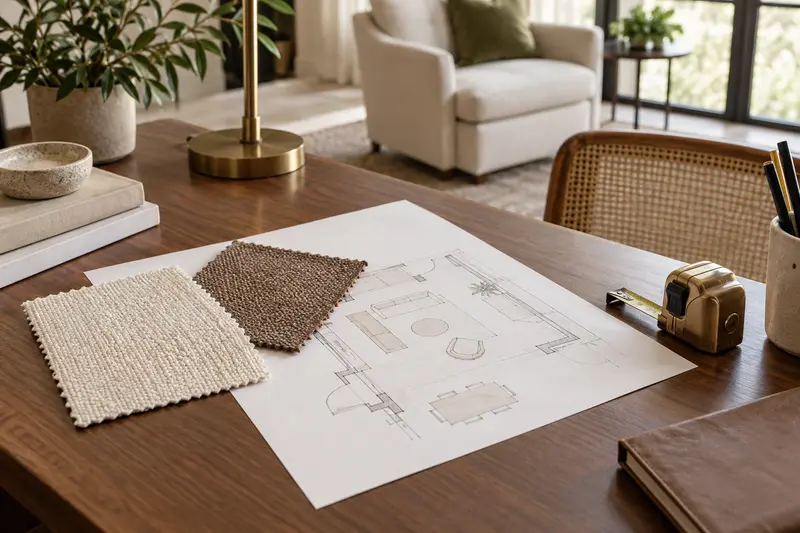
Make a simple floor sketch with the proposed chair, its required movement area, a side table and a lamp. Add the route the user normally takes when leaving the chair. The sketch need not look like an architect's plan; its purpose is to keep assumptions visible. For example, a table that seems convenient beside an upright chair may intrude once the chair rises or the footrest extends. A charging cable that looks unobtrusive against a wall may cross the route when another person moves the lamp. Ask about those interactions before adding accessories to the basket.
A useful hypothetical comparison is between two delivery offers with similar chair prices. Offer A leaves the item at a stated delivery point. Offer B includes entry, assembly, packaging removal and an operating explanation, but only within a defined access arrangement. Neither label tells you everything. Ask both suppliers who carries the chair, which stairs or difficult access are included, what preparation the customer must complete and what happens if entry is not possible. Then compare the complete services. A difference in scope can matter more than a small difference in the advertised chair price.
Arrange the room before the agreed appointment without turning it into a speculative installation project. Confirm the socket and cable requirements with the supplier, keep the delivery route available, and decide where existing furniture will go. Ask whether the old chair is collected and whether that service has conditions. At handover, keep the exact manual and model details together, ask for the promised explanation, and note any issue against the order. If the delivered configuration differs from the written offer, seek clarification promptly rather than accepting an undocumented substitution because the delivery team is already present.

Keep a person-and-room passport
Use separate rows for seat fit, transfer, controls, room movement and delivery. Record the demonstrated answer and anything still requiring advice. This approach lets you compare a simpler chair with a feature-rich one fairly. The better value is the arrangement that meets the necessary tasks with understandable controls and support, not the longest feature list.
Read the final return, cancellation and warranty terms for the exact order, particularly a made-to-order fabric or configuration. If an existing chair already meets the need, consider whether a well-placed table or reading light solves the remaining inconvenience. If a lift function is needed, an ordinary side table is not an alternative to suitable seating and transfer support.
The person-and-room passport is a short decision record, not a numerical score that pretends to measure suitability. Give each important question a status: demonstrated, confirmed in writing, awaiting advice or unresolved. Useful rows include seating dimensions, the ordinary control sequence, movement space, delivery access, power-backup explanation and local repairs. Add who supplied the answer and the date. A salesperson's verbal estimate belongs in a different status from an order-specific confirmation. If an important row remains unresolved, the comparison is unfinished even when the finish and fabric have been chosen.
Next, separate the chair's warranty from the seller's change-of-mind terms and from any service contract. A long warranty headline does not tell you which parts, labour, call-out or transport costs are covered. Ask where a fault is reported and how an in-home repair is arranged. In the United States, the FTC advises reading warranty coverage and exclusions before buying; state-law rights can also matter. In the United Kingdom, statutory consumer rights and any voluntary return offer are separate questions. A made-to-order description needs order-specific clarification rather than a blanket assumption that every legal right disappears.
For a hypothetical final shortlist, suppose both chairs have passed the necessary assessment and room checks. One includes several optional comfort functions with a remote the user understands; the other meets the required routine with fewer extras and clearer local repair arrangements. Compare the full written scope, not only the initial payment. Ask which option the person prefers after the demonstration and which extra function would actually be used. It is reasonable to choose either where the important questions are resolved. It is also reasonable to postpone a purchase when present seating remains suitable and the remaining issue is simply where to put a book.
Before placing an order, repeat the configuration back to the seller and obtain a matching written record. Keep the specification, demonstration notes, delivery scope, cancellation terms and warranty in one folder. Follow the exact instructions after delivery and contact the supplier when operation or fit is uncertain. Revisit the arrangement if the user's needs change. The purpose of this guide is to help a household ask better buying questions and avoid paying for an unexplained feature list. It is not a prescription for a chair, proof of a clinical benefit or an assurance that a linked manufacturer's product will fit the person.

YOUR DOCUMENTATION WORKSHEET
Person-and-room passport
Documented fit questions and exact-model comparison, without diagnosing seating needs.
Record a documented answer or an open question. These fields stay on this page; print it to keep a copy.
MAKE THE SPEND MEANINGFUL
Before adding to the basket.
- Compare a simpler chair with the required functions before paying for extra adjustments.
- If existing seating is suitable, a correctly placed ordinary side table may solve a reach or storage inconvenience at a smaller commitment.
DOCUMENTED OPTIONS TO RESEARCH
Compare the details behind a name.
These are research candidates, not hands-on rankings. Confirm the exact model, local availability and terms before buying.
Pride VivaLift Radiance collection
Size-specific dimensions and multiple adjustments provide a concrete demonstration candidate.
- Check before choosing
- Fit, control usability, clearance, current local supply and exact delivery terms must be confirmed.
- Market context
- US product information; verify regional versions and local support.
Sources & fact checks
The guide separates sourced facts from editorial questions and examples. We have not claimed hands-on product testing. How we use sources and AI assistance.
- Pride Mobility: Radiance size-specific specification sheet ↗
- Pride Mobility: Atlas Plus discontinued status ↗
- Pride Mobility: VivaLift Radiance collection ↗
- US FTC: understanding written warranties and service contracts ↗
- UK GOV.UK: consumer return and refund rules ↗
Found an error or an outdated detail? Contact the editorial team.