
In brief
A grab-rail decision needs both a personal placement assessment and an installation plan. Ask about the wall, approved fixing, exact product instructions and handover checks. A rail’s appearance or headline load figure does not establish the capacity of the completed installation.
IN THIS GUIDE
Describe where support is needed before choosing a rail
A grab rail purchase starts with a task, not a finish or length. Describe the bathroom moment that needs attention: approaching a shower, using the toilet, washing while seated or moving between parts of the room. Keep that description factual. You are preparing for an assessment and installation conversation, not diagnosing a problem or designing a transfer technique yourself.
Separate the person's support requirements from the wall's ability to accept a product. An assessor may help establish where support belongs in the routine; an installer must understand the exact mounting requirements and building context. The answers need to come together. A rail positioned where it is easy to fix may not answer the intended task.
Make a short routine note showing the relevant fixtures and equipment already in use. Include a proposed shower seat or toilet adaptation if one is being considered. A rail is part of an arrangement, so a later equipment change can affect the plan. Tell the people reviewing it about those proposals instead of treating each purchase as an isolated accessory.
If a needed support arrangement is uncertain, seek the appropriate professional advice before relying on a new product. An ordinary towel holder or shower-handset rail should not be assumed to provide body support because it has a graspable shape. Ask for evidence of intended use for the exact product rather than judging strength from its appearance.
Make a task-and-wall brief for the first conversation
Your brief can fit on one page. Draw the relevant wall, existing fittings and doors; identify the practical task; and mark the intended rail position as provisional. Include clear photographs without identifiable personal material. The brief helps a supplier understand the situation, but it should not present an unassessed placement as a specification to copy.
Ask what information the installer needs before recommending a product or fixing method. Useful questions include which wall construction matters, whether an on-site inspection is needed and whether the proposed rail's manual has been reviewed. If the answer is based only on a photo, clarify what remains unknown and when it will be checked.
Describe finishes and water exposure separately from structural information. Knowing that the wall is tiled does not identify everything relevant behind it. You do not need to remove coverings or drill exploratory holes yourself. Ask the responsible professional how they will establish the necessary facts and what happens if the initial assumption is wrong.
Keep a simple responsibilities list: who reviews personal placement, who checks the building, who supplies the exact rail and who completes handover. Where one company offers several roles, have the work described clearly. If nobody owns a particular question, it can otherwise disappear between a product salesperson and an installer.
Editorial illustration
Ask for the exact installation instructions
The manufacturer's installation document is the right starting point for the product's mounting requirements. Ask for the document covering the exact model, size and variant you intend to purchase. A general catalogue page describing 'strong support' is not a substitute. Keep the instruction identifier in the quote or written product record.
Moen's INS10840 sheet is a concrete North American example covering named grab-bar families and a specified mounting arrangement. Its wood-stud requirements illustrate why an installer needs the actual instructions. They are not a universal fixing recipe for every rail or wall, and this guide does not reproduce a do-it-yourself drilling procedure.
When another product is proposed, request its own instructions. Do not transfer a screw pattern, anchor choice or advertised load claim between manufacturers because the rails look alike. The complete installation arrangement includes the product, mounting components and relevant wall context. A familiar appearance does not establish that those elements are equivalent.
If an installer proposes something different from the manual, ask for clarification from the manufacturer and the responsible professional before proceeding. A verbal reassurance is not the same as a documented approved arrangement. Record who confirmed the solution and which product it applies to. This is especially valuable when a quotation lists a generic 'grab rail' without a model.
Keep the surface and the supporting construction distinct
A smooth tile surface is visible; the relevant supporting construction may not be. Ask the installer which parts of the wall and finish matter for the chosen mounting system. You need an explanation of how the proposed product can be installed as intended, not a claim that any tiled bathroom is automatically suitable.
The professional may need to consider a different location, additional work or another appropriate product after inspection. Ask how that decision will be communicated and quoted. It is better to discover an uncertainty before ordering than to have work continue with an improvised workaround because a rail has already been delivered.
A useful note says 'wall construction to be confirmed during visit', followed by the person responsible. It should not say 'solid wall' simply because tapping the tile produces a particular sound. Home observations can help explain the setting, but they do not replace the checks relevant to the selected product and installation.
Also ask how the agreed work will preserve the necessary finish and how any making-good is included. The cosmetic result and the functional mounting are different parts of the job. A clean-looking cover plate cannot tell you whether the concealed work matches the instructions. Keep the installation record rather than treating appearance alone as evidence.
No-drill options still need product-specific evidence
Some rail systems have distinct screw-mounted and adhesive-mounted variants. Etac Flex is a documented example, with separate product variants and manuals. That does not mean any glue can replace a specified fixing or that every bathroom surface is suitable. Ask the supplier which exact variant and approved components are proposed.
A no-drill preference may come from appearance, concern about the finish or tenancy circumstances. Explain the reason, then ask whether an appropriate system can meet the assessed task and installation context. Do not select a method solely because it avoids visible holes. Suitability and the instructions remain part of the decision.
Questions for an adhesive variant include permitted surfaces, preparation responsibility, any required waiting or handover conditions, maintenance and removal implications. Ask the installer to answer from the current manual. This article does not provide a surface-preparation recipe or timing that could be misapplied to another system.
Suction-mounted products are another category, not a synonym for a manufacturer's adhesive mounting. Their permitted use and limitations must be read separately. A product described for balance assistance should not be assumed to provide the support required by a different task. Compare intended uses before treating a removable accessory as an alternative to an assessed permanent arrangement.
Review placement with the whole bathroom arrangement
Ask how the proposed position relates to the person's routine and the other fixtures. A rail that looks neatly aligned with a tile joint may not be where the assessed support is needed. Personal placement questions deserve appropriate assessment, while the installer considers whether the proposed mounting can be achieved as intended.
Draw doors, the shower screen, controls, seating and storage near the proposed rail. Consider whether any of these are due to change. You are identifying interactions to discuss, not calculating a universal reach zone. A replacement shower seat or a moved control can make an earlier placement conversation incomplete.
Do not assume that the longest rail or the largest set provides the best arrangement. Length, shape and orientation belong to the specific product and task. Ask why each proposed item is included. A smaller appropriate installation may meet the established need, but fewer rails are not automatically better value if they omit a required part of the plan.
An illustrative buyer wants a rail beside a shower and also plans to add wall storage. The storage position might interfere with the proposed arrangement or make products harder to reach. The practical next step is to review both proposals together. Buying each separately and solving the interaction afterward can add unnecessary work and cost.
Understand what a compliance label does and does not answer
Product pages sometimes use an accessibility or standards label as a shorthand for quality. Ask which standard, version and market is meant, and whether the claim covers the product alone or a completed installation. Keep the answer with the relevant documentation. A broad badge is not an explanation of how a rail will work in your bathroom.
The US Access Board's ADA bathing-room guidance describes requirements within its applicable accessibility framework. Its diagrams and dimensions should not be copied as a universal personal-home prescription or treated as UK installation rules. Which legal standards apply is a jurisdiction and building-context question for the responsible professional.
Separate three questions: what the product is designed for, how it must be installed, and what the individual arrangement requires. A numerical capacity or conformity statement may answer part of the first or second question. It does not independently establish placement or suitability for a person. Avoid letting one impressive figure replace the remaining discussion.
If a supplier says 'ADA approved' or uses another broad phrase, ask for the precise supporting document. You can still prefer an attractive rail, but the evidence should be specific. Record an unresolved compliance question honestly rather than attempting to interpret a foreign standard from a social-media diagram or an unverified retail description.
Compare the full installation job
Ask for a quotation that names the exact product, quantity, configuration and mounting approach. Include inspection, any additional supporting work, installation, finishing, handover and the relevant aftercare contact. A rail-only price can be useful, but it is not the total for a complete installed arrangement.
Use the same work description when asking another supplier for a comparison. Otherwise one quote may include an assessment visit and making-good while another covers only labour after you supply the item. The apparent saving may be a difference in responsibilities rather than a cheaper equivalent job. Put missing items into an 'unquoted' column.
An illustrative comparison has Offer A listing product and mounting labour, and Offer B listing those services plus a wall review and finish repair. You cannot decide which is better value until you know whether Offer A requires those additional services and who would provide them. No actual market price is assumed in this example.
Agree the process for a changed finding on site. Ask whether the revised work requires a new written quote and what happens to an unsuitable product already purchased. A good quote explains the boundaries of the job. It should make it possible to pause and clarify an unexpected condition without relying on a vague promise that the installer will 'sort it out'.
Check the relevant property and local-service arrangements
If the bathroom is rented, shared or part of a managed building, ask which permissions or procedures apply to the proposed work. Record who needs to be involved and what evidence is requested. Do not assume that a small product automatically means no property approval is needed, or that every adaptation always requires the same permission.
For a UK reader who needs help with daily bathroom tasks, the NHS describes a local home-adaptation assessment route. That can be a useful starting point, separate from shopping for a named rail. Ask the relevant local service about the actual process and possible support. Do not infer an individual funding decision from a general information page.
Readers elsewhere should verify their local route and building requirements. The same product might be sold across markets while service access, legal rights and installation responsibilities differ. Keep regional information clearly labelled. A UK council pathway is not a United States benefit programme, and a North American installation sheet is not permission for work in another jurisdiction.
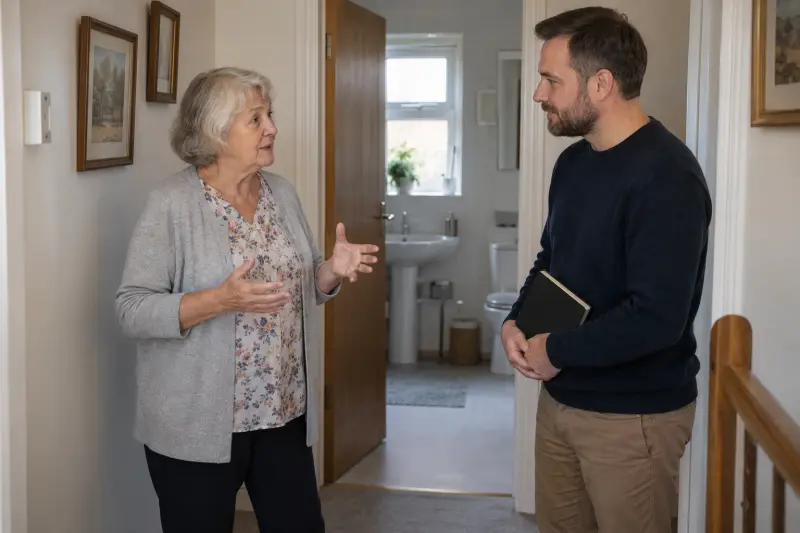
Where several parties are involved, keep one shared practical brief with only the necessary personal information. List the task, proposed work, outstanding questions and contacts. This can reduce repeated explanations and help distinguish an assessor's recommendation from a landlord's response or an installer's technical proposal. Those are different forms of evidence.
Ask what the completed-job record will include
Before work starts, agree what you will receive at handover. Useful items include the product identifier, applicable instructions, a description of the agreed work and the support contact. Ask the responsible professional to explain permitted use and any checks or maintenance required by the relevant documentation.
This guide does not tell you how to load-test an installed rail. Do not invent a test by pulling harder, hanging a weight or copying a demonstration from a video. Ask what verification the responsible installer performs under the applicable requirements and how that is documented. A handover should make responsibilities clear without turning the user into a testing technician.
Check the completed arrangement against the agreed specification: product, quantity, position and any discussed surrounding fixtures. Ask about differences before assuming they are harmless. A changed rail length or mounting approach may deserve clarification even if the finish looks good. Keep questions tied to the actual product rather than a general impression of workmanship.
Store the documents where you or someone helping can find them. If an issue is noticed later, follow the applicable instructions and contact the responsible provider rather than improvising a repair. Keep a factual note of the concern, model and date. Avoid using an uncertain arrangement while trying to obtain reassurance from unrelated online reviews.
Plan cleaning, ongoing questions and future changes
Ask for care instructions for the exact rail and finish. Bathroom products can have different surface requirements, so a cleaner used on the tiles is not automatically appropriate for every rail or mounting system. Keep any approved components and care information together. This is a documentation task, not an invitation to create a generic chemical-cleaning recipe.
Clarify who to contact about a changed feel, visible damage or another concern. An advertised warranty period does not answer every question about inspection, removal, labour or a changed installation. Ask the supplier which route applies and what information they need. Local consumer rights and commercial guarantees should be considered in their actual market context.
If the bathroom is renovated later, include the rail arrangement in the new planning discussion. A new wall covering, shower screen, seat or storage fitting can affect earlier assumptions. Reinstallation or removal needs its own appropriate review. Do not assume a previously useful product can simply be moved and will retain the same installation evidence.
The same applies if personal requirements change. Keep the original task note so a professional can see what the installation was intended to address. A support arrangement is not made permanently appropriate by its purchase date or by a positive review. Revisiting the relevant questions can help you keep useful equipment and identify when a different plan deserves assessment.
Build an installer brief with a clear decision trail
Use six headings: task, proposed position, product identity, wall and fixing evidence, quoted work, and handover. Add the name of the responsible person or service to each unresolved item. A blank field is a follow-up task. It is not a reason to invent a compatibility answer so that the shopping comparison looks complete.
For the product field, retain the model, length or variant, current manual and regional supplier confirmation. For the wall field, record what the professional has established rather than your own guess. For the quotation, identify all included work and unquoted extras. This makes the brief useful to another supplier without pretending that you have prepared a technical installation design.
A sensible outcome may be to request an assessment, choose an appropriate documented system, investigate a simpler configuration or postpone the order while property questions are resolved. Each can protect the budget by directing spending toward the task. An inexpensive unsupported workaround is not an equivalent alternative to the arrangement you actually need.
When ready to order, connect the brief to the final written specification and keep it with the handover documents. The purpose is a traceable decision: why this product and arrangement were selected, what was professionally confirmed and who supports it afterward. That is more useful than a shopping score built from finish, length and an unexamined load number.
MAKE THE SPEND MEANINGFUL
Before adding to the basket.
- Prepare the task brief and room sketch with existing paper and photographs before purchasing anything.
- Ask about a simpler appropriate arrangement after support and mounting requirements are established.
- Investigate the relevant local assessment service; provision or funding is not assumed.
How this guide was prepared
AI-assisted editorial research, checked against the linked primary sources. Product testing and a credentialed individual review are not claimed.
AI-assisted, source-checked editorial; no hands-on test, human expert review or personal suitability assessment claimed
How we use sources and AI assistance ↗Sources & fact checks
The guide separates sourced facts from editorial questions and examples. We have not claimed hands-on product testing. How we use sources and AI assistance.
- Moen grab bar installation sheet INS10840; exact listed product and market only ↗
- Etac Flex: screw and adhesive variants with separate manuals; international manufacturer page ↗
- US Access Board: ADA bathing-room guidance; application depends on facility and jurisdiction ↗
- NHS: UK home adaptation assessment pathway; eligibility is individual ↗
Found an error or an outdated detail? Contact the editorial team.