
In brief
Choose lift recliner upholstery using a real sample and its exact care instructions. Colour, a stain-resistant description and a generic fabric warranty do not show how the ordered covering will handle daily use.
IN THIS GUIDE
Choose upholstery for the actual household task
Lift recliner upholstery should be compared using everyday use and care, alongside colour and feel. Write down the practical concerns: ordinary spills, cleaning help, clothing, pets, sensitivity to texture and the room's lighting. Describe them to the retailer without assuming a premium fabric automatically solves every issue.
Keep the seat and device decision separate from the covering preference. A fabric the reader likes does not make an unsuitable chair appropriate, and an easy-care description does not replace personal advice where seating needs are uncertain. The cited US-published Pride manual carries a prescription-use sale caution and describes provider involvement. For other markets, obtain the local device documentation rather than infer the requirements from this US reference.
Ask for the exact fabric name, colour code and care instructions before ordering. A collection can offer several coverings with different requirements, and a retailer's generic “wipe clean” description may not identify the actual material. The order should state what will be supplied rather than relying on a photograph.
Begin with a short priority list. For one household, keeping a particular ordinary spill manageable may matter most; for another, texture and available cleaning support may be central. That helps compare suitable options without buying the most expensive covering by default or treating an attractive colour as evidence of practical care.
Match the sample to the exact fabric and colour code
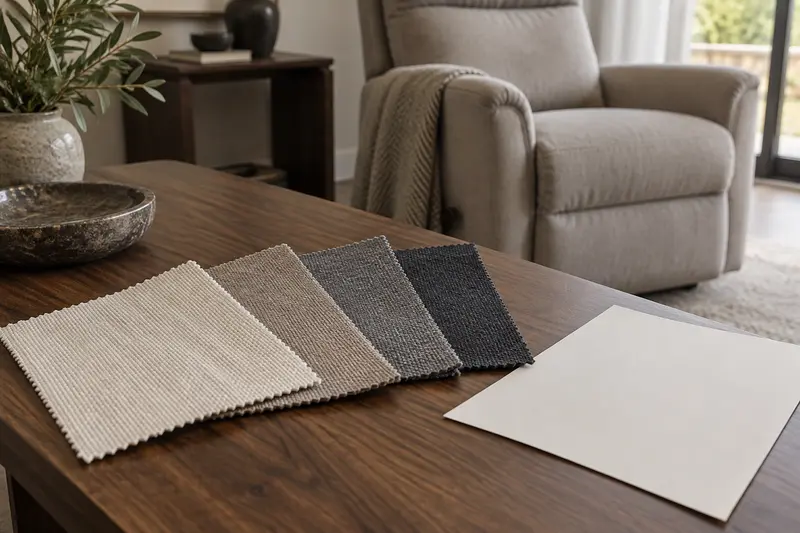
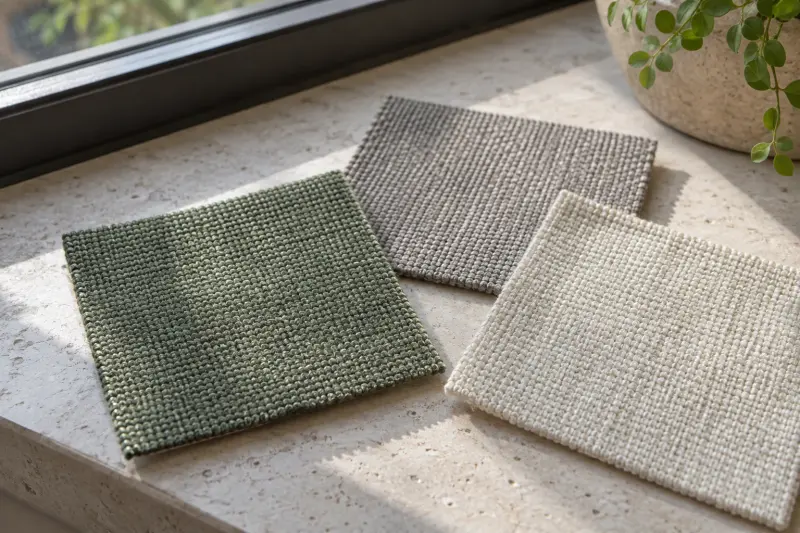
Request a physical sample of the covering being considered, where the seller can provide one. Record its name and code. A sample for another colour in the same range can help show texture, but it is not evidence of the chosen colour's appearance in the intended room.
Golden's fabric catalogue identifies named ranges and colour codes rather than one universal recliner fabric. For example, its Tucker range includes Calypso TCP and Sterling TST. Those references help make an enquiry precise; they do not establish that every chair, size or retailer can supply the selected covering.
Ask whether the chosen fabric is standard, optional or special order for the exact model. Confirm current availability and whether it changes lead time, return terms or the quoted price. An online palette may remain visible even when a particular local combination needs confirmation.
For a fictional shopper, a showroom chair looks like the preferred grey, but the seller identifies it as another fabric range. The buyer requests the actual intended sample before payment. That avoids comparing care instructions for one material with the appearance of another. Exact identity is the basis of both a design decision and a realistic cleaning plan.
View the sample in the ordinary light
Look at the sample in the room where the chair will sit, using the ordinary daytime and evening lighting where possible. Colour on a phone can differ from the physical covering, and a small sample does not show the whole chair. Golden advises viewing fabric colours in person for accuracy.

Consider neighbouring flooring, furniture and any bright light source. The purpose is not to select a supposedly scientific colour match, but to see whether the material suits the actual setting. Do not promise a sample will show every appearance change across all batches or lighting conditions.
Texture deserves its own question. A reader can describe whether a covering feels pleasant or whether a raised pattern is unwelcome. A short sample touch is a preference observation, not a hands-on durability test or evidence of comfort during extended use.
For a fictional room, the preferred dark swatch looks good by daylight but feels visually heavy beside an existing cabinet in the evening. Another suitable colour may be worth considering before an upgrade is ordered. That is a design decision, separate from the chair's personal suitability and care requirements. No additional protector or treatment is needed merely to complete that comparison.
Get fabric-specific care rather than a universal cleaning tip
Ask the retailer for the current care instructions for the exact covering and chair. Record permitted products, methods, restrictions and any conditions for professional cleaning. A cleaning code or water-resistant description is a useful clue, but it is not a complete procedure for the assembled powered chair.
Golden's catalogue lists cleaning code W for its Sinda range and describes a different named Tucker material with its own care information. This is a reason to identify the fabric correctly, not permission to apply one method to every material. Obtain the actual instructions before buying a cleaner.
Pride's manual addresses fabric care separately from electronics. That distinction matters because a surface-cleaning discussion must not imply that liquid can be used around controls, the transformer or electrical connections. The exact device instructions and provider advice apply to the complete chair.
For a fictional reader comparing two coverings, one has clear current care information while the other has only a retailer's “easy clean” phrase. The second remains pending. Asking for the missing sheet is more useful than purchasing a generic upholstery spray and hoping the advertisement means it is suitable.
Distinguish water-resistant from a complete liquid barrier
Resistance claims need careful reading. A material described as water-resistant is not necessarily a complete barrier against prolonged or heavy exposure, and it does not establish protection for the chair's electrical components. Ask what the exact covering claim means and which instructions apply.
Golden explicitly describes Sinda and Anli coverings as offering partial water resistance rather than a complete barrier, with possible saturation after prolonged or heavy exposure. That is a specific material limitation. Do not extend it to every covering or turn another range's marketing language into a whole-chair waterproof claim.
If incontinence or another personal care concern matters, discuss the appropriate arrangement with relevant professional advice and the provider. This guide does not recommend a fabric as a clinical intervention or prescribe an absorbent accessory. The concern may involve seating, hygiene and device requirements beyond a material label.
For a fictional household, a water-resistant finish looks appealing for ordinary spills, but the buyer also needs clear cleaning help. The comparison records both the claim's limits and the practical care arrangement. A premium description is not enough if nobody can follow the required instructions or if an essential personal need remains unaddressed.
Make the care plan realistic for the people involved
Ask who will carry out the permitted care and whether the routine is practical. A covering can have clear instructions yet require help the household has not arranged. Include access to the relevant area, ordinary cleaning supplies permitted by the manufacturer and any professional-service enquiry needed.
Do not assume the user can move or tilt a heavy powered chair to clean around it. Ask the provider which tasks are intended for the owner and when assistance is required. Cleaning the upholstery, accessing the mechanism and caring for electrical components are different activities.
For a fictional reader living alone, the preferred covering requires a task that is awkward to perform without help. The buyer asks about another suitable fabric and an appropriate support arrangement. That may change the choice more meaningfully than a small price difference or a stain-resistance slogan.
Keep the plan modest. An elaborate cleaning kit or paid schedule is not automatically necessary. Use the actual instructions to identify the required task and supplies. If ordinary permitted care can be performed with items already owned, that is a useful low-cost outcome. The aim is a chair the household can appropriately maintain, not a bundle of products selected before the fabric is confirmed.
Check a cleaner before buying it for the chair
Choose a cleaning product only after the exact care instructions identify what is permitted. An upholstery label on a bottle does not establish compatibility with every covering or powered recliner. Ask the retailer or manufacturer when the proposed product is unclear, and keep the answer with the fabric record.
Avoid presenting a household recipe as a universal budget cleaner. Mixing substances, using a solvent or applying a treatment can create problems for material, colour or device components. This guide does not provide a chemical recipe or a procedure that substitutes for the manufacturer's instructions.
If the instructions specify a provider-approved product or kit, ask what is supplied, how it is used under those instructions and whether a compatible alternative is permitted. Request an actual current quote if needed. Do not assume that the most expensive branded kit is necessary or that the cheapest spray is an equivalent.
For a fictional purchase, a retailer suggests a protection package before the buyer has selected the covering. The buyer asks whether it is permitted, what task it adds and what the terms cover. Until those questions are answered, the package remains optional or pending. A product sale should follow a demonstrated care need rather than a vague fear of ruining new furniture.
Review protectors without changing the seating blindly
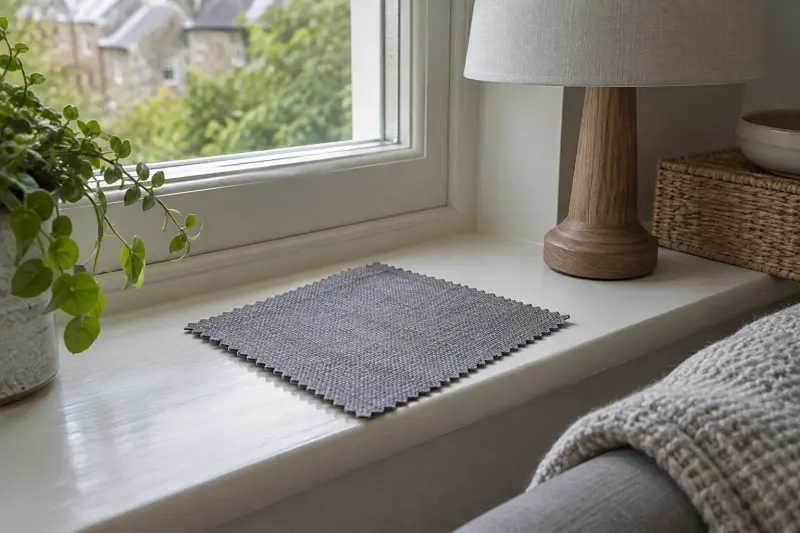
A throw, fitted cover or protector can change the seating feel, effective dimensions and access to controls. Ask about exact chair compatibility and the approved arrangement before using one. An ordinary sofa cover is not established as appropriate for a lift recliner simply because it fits the visible cushion.
Consider the chair's full movement and relevant instructions. Loose material should not be treated as harmless decoration near mechanisms, controls or power components. The provider can explain what is permitted for the actual device. This article does not supply an attachment method or a universal cover recommendation.
Where a protector is intended to address a personal care or support concern, obtain appropriate advice. Do not claim that an absorbent pad treats incontinence, prevents pressure problems or makes every seat safe. The material task and personal suitability task need separate answers.
For a fictional household, an already owned decorative throw looks attractive but has no confirmed arrangement for the powered chair. The buyer checks with the provider before deciding whether to use it or purchase an approved alternative. Spending nothing is reasonable when the accessory has no demonstrated purpose; spending on a permitted item can be reasonable when it solves a real task.
Ask how wear and accidental damage are handled
Before purchase, read the terms that apply to upholstery, not only the headline chair warranty. Ask what defects, wear, stains and accidental damage mean under the actual documents. A long mechanism warranty may not describe the fabric, and a fabric marketing claim may have its own conditions.
Golden's fabric catalogue presents material-specific warranty claims with qualifications. Do not treat those as unconditional cover for every incident or every chair. Obtain the applicable written terms for the exact range, model, market and purchase before relying on a lifetime or long-year headline.
Keep retailer protection plans separate from manufacturer cover. Ask whether the plan adds anything useful, which events are excluded, how a claim is made and who performs any work. This guide does not recommend a plan or promise a reimbursement result.
For a fictional comparison, a premium covering has an attractive warranty description but a particular accidental-spill concern remains excluded under the actual plan. The buyer records that gap and considers the practical care instructions. The right decision depends on the intended use and evidence, not on the number of years displayed beside a swatch.
Make the fabric part of the exact order record
Confirm the fabric name, colour code and exact chair variant in writing. Ask whether stitching, trim or other visible details differ from the display item. A colour name such as grey or walnut may be used in several ranges, so keep the material identity as well as the descriptive colour.
Clarify whether the selection changes stock status, lead time or return arrangements. A special-order covering may involve different seller terms, but do not assume every personalised selection has the same legal treatment. Read the actual order conditions and relevant local consumer guidance where needed.

Editorial illustration
For a fictional buyer, the desired colour is available only as a particular upgrade on the appropriate chair size. The seller quotes that complete configuration with delivery and setup. It would be misleading to compare the amount with a standard-fabric listing and call the difference merely a colour surcharge when other included items differ.
Save the sample reference, care sheet and seller's answers together. They give the household a practical record after delivery and help identify a mismatch. Do not rely on a screenshot alone when the actual selection can change with a website dropdown or an order substitution.
Compare a practical covering with optional upgrades
The most useful fabric is one that meets the reader's preferences and practical care requirements on an appropriate chair. It is not automatically the most expensive, the softest sample or the covering with the strongest marketing language. Compare exact instructions, availability and the household's ability to follow them.
Ask for actual quotations for standard and optional coverings on the same suitable configuration. Keep any service or delivery difference visible. This guide does not invent a typical upgrade price or promise that a stain-resistant material will repay its cost through fewer replacements.
A standard covering can be a sensible choice if it meets the established needs and has a workable care plan. An upgrade can be sensible when its documented properties and permitted care address an actual task. Explain that task clearly instead of calling the premium selection universally better.
A low-cost next step may be requesting samples, obtaining the missing care sheet or using already owned permitted supplies. Do not buy a protector, cleaner and service plan just because the chair is expensive. Each additional item should solve a defined problem with relevant compatibility and terms, leaving the reader free to decline purchases that add little value.
Check the covering and keep the current care instructions
At delivery, compare the fabric identity and chair configuration with the order. Look at the visible condition and report a concern through the seller's process. Do not perform a spill test or abrasive cleaning test to prove a marketing claim. That could damage the covering and is not evidence this publisher has gathered.
Keep the current care instructions where the people helping can find them. If a stain, tear or material change raises a question, contact the appropriate retailer or provider before experimenting. Describe the event and product accurately without assuming the cause or applying advice for another fabric.
Review the arrangement when an accessory, personal care need or room condition changes. A new protector may affect the seating or movement questions; another cleaner may not be permitted. The original care sheet remains useful, but it does not automatically approve every later addition.
A good upholstery choice records the exact material, real sample preference, permitted care, practical support and applicable terms. That makes the covering part of an informed purchase rather than a decorative afterthought. It also prevents a water-resistant or easy-clean phrase from promising more protection than the source and actual chair instructions support.
MAKE THE SPEND MEANINGFUL
Before adding to the basket.
- Request samples and care sheets before buying cleaner or protector bundles.
- Use already owned supplies only where the actual manufacturer instructions permit them.
- Compare a suitable standard covering with an upgrade by the care task solved, rather than assuming premium fabric is necessary.
How this guide was prepared
AI-assisted editorial research, checked against the linked primary sources. Product testing and a credentialed individual review are not claimed.
AI-assisted, source-checked editorial; no hands-on test, human expert review or personal suitability assessment claimed
How we use sources and AI assistance ↗Sources & fact checks
The guide separates sourced facts from editorial questions and examples. We have not claimed hands-on product testing. How we use sources and AI assistance.
- Pride US-published chair manual: fabric and electronics care are separate; exact provider and device requirements apply ↗
- Golden fabric catalogue: exact material identities, care distinctions and water-resistance limitations ↗
- Golden FAQ: fabric-specific instructions and retailer enquiries ↗
Found an error or an outdated detail? Contact the editorial team.