
In brief
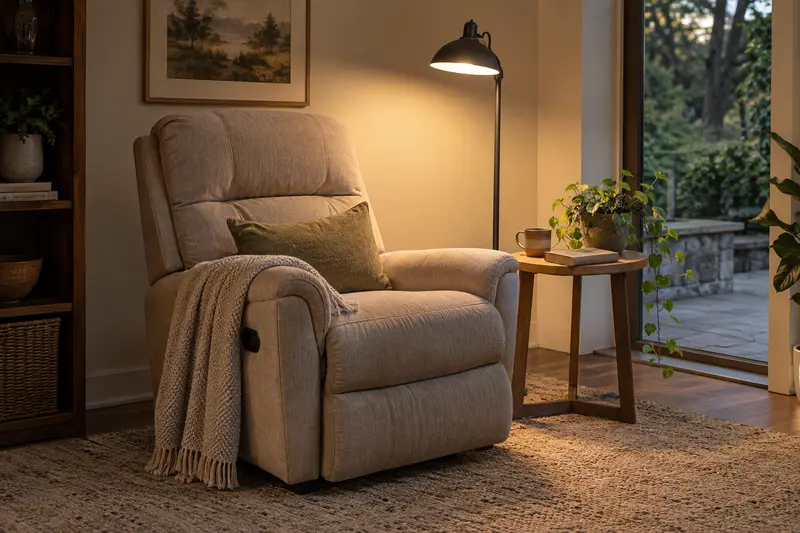
Choose a reading light by how it illuminates the page, how its controls are reached and whether it stays clear as the recliner moves. Try the arrangement with the reader before buying an extra lamp.
Documented options
A clearer comparison.
Research options based on manufacturer documentation. These are not results of hands-on testing. Manufacturer links are informational; no commission relationship is currently active.
IN THIS GUIDE
Choose a light for the reading task you actually enjoy
Start with the book, newspaper, magazine or craft task the reader normally uses. A lamp that looks impressive beside an empty chair may behave differently when a page is held at the usual angle. Record when reading happens, which chair positions are used under the applicable instructions and what is unsatisfactory about the existing arrangement.
Separate different problems. A shadow across the page, a reflection on glossy paper, an awkward switch and an obstructing base require different questions. “The room is dark” may describe several issues at once. A more powerful bulb does not automatically resolve direction, reflected light or difficulty reaching the control.
Try the existing setup before shopping, where ordinary use is appropriate. Observe the actual reading position without prescribing how a person should transfer, sit or operate a medically restricted product. The cited US-published Pride manual carries a prescription-use sale caution and describes provider involvement. For other markets, obtain the local device documentation rather than infer the requirements from this US reference. Those requirements remain separate from choosing a nearby lamp.
For example, an existing table lamp illuminates a paperback adequately while the chair is upright, but its light is behind the reader in a preferred reclined position. The task to investigate is direction and placement. Write that on the comparison sheet. It is more useful than searching for a generic “best lamp for seniors” and assuming every older reader needs the same product.
Make a simple page, shadow and reflection record
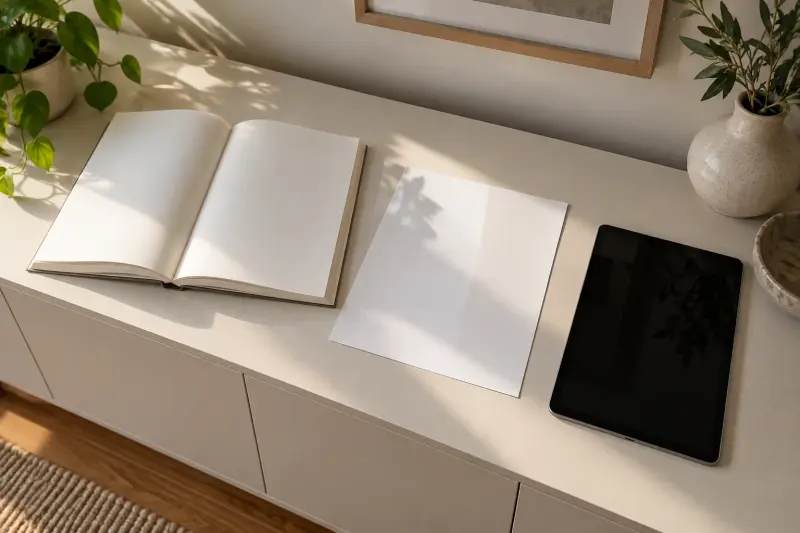
Use a few representative materials: ordinary paper, a glossy magazine and any screen normally used. Record the reader’s observations in the actual room at a relevant time of day. The aim is to describe preferences and visible problems, not to carry out a clinical vision test or a measured lighting survey.
A useful record has three columns: reading position, observed issue and possible arrangement to try. For a shadow, note whether it comes from a hand, the shade or nearby furniture. For a reflection, note whether changing the ordinary viewing angle or light direction changes what the reader notices. Do not force a position that conflicts with individual guidance.
Compare one change at a time. If you move a lamp and replace its bulb simultaneously, you cannot easily tell which change helped. Keep the first comparison modest: existing lamp position versus an appropriate alternative position, with the same reading material. This is a household observation, not a product performance claim.
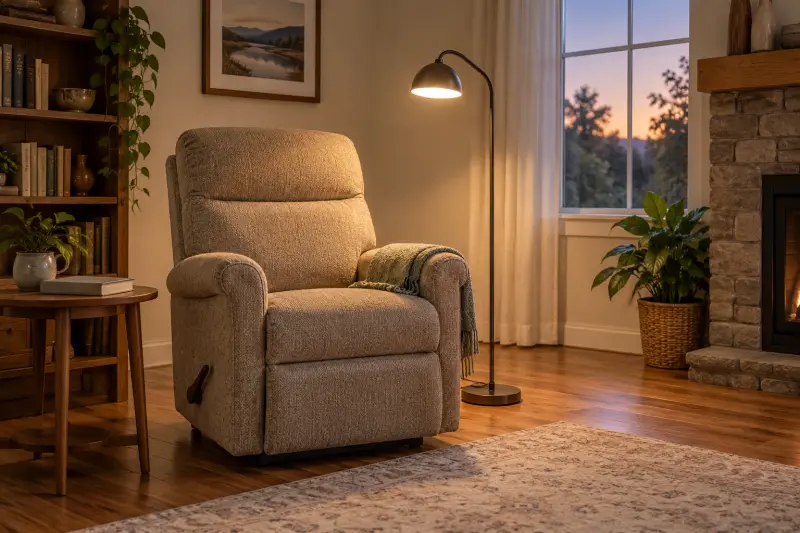
In a hypothetical comparison, a glossy magazine reflects a bright point of light while a matte paperback remains comfortable to read. The result need not be “buy the brightest lamp.” An adjustable direction, a different position or using an existing suitable light could answer the task. If difficulty remains unexplained or vision needs have changed, seek appropriate professional advice rather than relying on a lamp’s marketing claims.
Understand output without making a medical promise
Compare the information supplied for the exact light source. The US Department of Energy’s lighting guide explains the distinction between light output in lumens and energy use in watts. A lower electrical wattage does not by itself establish weaker illumination, and a permitted maximum wattage is not a promise about how well a particular reading task will be lit.
Record the available output information, the lamp’s permitted light source and any replacement requirement. If a bulb is separate, the complete arrangement depends on both the lamp and that bulb. Do not exceed the instructions or select an incompatible light source merely because its packaging displays a preferred lumen figure.
Brightness at the page also depends on placement, direction and the surroundings. This guide has not measured illumination or established an output target for older readers. Avoid converting a product’s advertised output into a health claim, a guarantee of comfort or a statement that it will correct a visual difficulty.
Consider two fictional options: a lamp with adjustable direction and a separately selected bulb, and one with an integrated source and several documented settings. Their information can support different questions about adjustment and replacement. The household still needs to try the actual task where possible. A number on a box is useful evidence, but it cannot replace a meaningful look at the whole arrangement.
Compare floor, table and other formats by their constraints
A floor lamp occupies floor space, a table lamp needs a suitable surface, and a wall-mounted option introduces an installation decision. Compare those requirements before focusing on style. The same room may accommodate one format comfortably and make another difficult to control or keep clear of the chair.
For a table lamp, include the table’s footprint and the position of its cable. Confirm that the table is appropriate for the intended use; an ordinary lamp table is not a support rail or transfer aid. For a floor lamp, draw the base, pole and projecting arm. A small base diameter does not describe the whole space occupied by an extended arm.
A clip-on or clamp lamp needs an approved attachment surface and the lamp manufacturer’s instructions. Do not attach one to the recliner’s upholstery or mechanism simply because the clip appears to fit. A wall lamp needs the appropriate mounting and electrical arrangements, handled by the relevant competent person where necessary. This guide gives no installation directions.
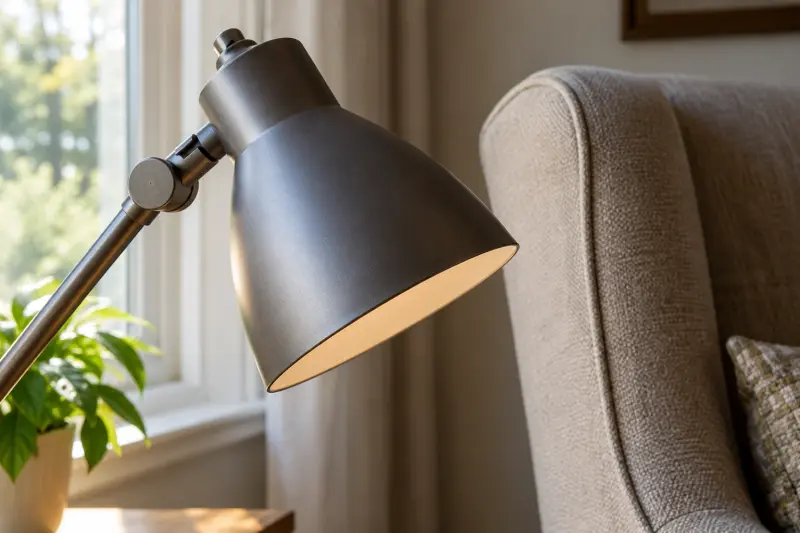
Imagine a narrow room where a floor lamp’s base fits beside the chair but reduces the ordinary passage. A table already in a suitable position might offer a better place for a lamp, or neither may work without changing the layout. There is no universal winning format. Compare the complete arrangement with the real reader and room.
Find out whether the actual control is convenient
Ask where the switch is located, how it operates and whether the reader can identify it in ordinary use. A tall lamp may have a switch on the shade, cord or stem; a photograph can hide that detail. Request the manual or a demonstration rather than assuming the control is reachable from the chair.
Observe the reader’s normal approved seating positions. A switch convenient upright may be farther away when reclined. Do not encourage leaning, reaching across an obstacle or using the lamp as support. If the control cannot be used comfortably, discuss another suitable arrangement rather than describing the inconvenience as a small detail the reader should tolerate.
Dimming adds another question. A dimmable bulb does not establish that the lamp, dimmer and complete electrical arrangement are compatible. Check the exact instructions for all relevant components. Avoid combining a generic smart accessory with a chair-and-lamp setup without resolving its operation, compatibility and power arrangement.
In a hypothetical store visit, a reader can direct the shade easily but struggles to find the switch without standing. The comparison sheet should record those as different results. Adjustable direction is a useful feature, yet it does not answer the control task. Another existing lamp or a verified alternative arrangement may be more practical than buying an additional remote simply to compensate for an unsuitable control position.
Keep the base, arm and cord clear as the chair moves
Use the exact chair instructions and provider’s guidance to establish the relevant operating area. Pride’s covered US and Canada products require attention to surrounding obstacles and moving parts. A lamp arrangement must be considered through the approved movement sequence, not just when the chair is upright for the product photograph.
Draw the base and the extended arm on the room plan. Show the cord and socket too. Ask the provider to review a conflict with chair movement or the reader’s routes. Do not reach beneath the mechanism or enter its operating area to inspect the lamp’s position. The sketch is a planning aid for appropriate review.
Include the position used when the lamp is not directed at the page. An adjustable arm can occupy another part of the room when somebody moves it aside. Consider where it will normally be left, and whether visitors or cleaning can change that arrangement. A practical setup should not rely on moving a lamp before every chair adjustment.
For example, a shade directs light well in a reclined position but the arm extends into the area used during another chair movement. More brightness would not resolve that conflict. A different approved lamp position or another format might. Keep illumination and operating space as separate criteria so a comfortable-looking reading scene does not obscure the equipment requirements.
Use the NYMÅNE floor lamp as a documented example
IKEA’s current US page identifies the white NYMÅNE floor-reading lamp as article 603.367.83. It describes an adjustable arm and head, with a recommended LED GU10 bulb sold separately. That makes it a useful informational example when comparing direction adjustment and the cost and practicalities of a separate replaceable light source.
The same page lists a maximum of 8 watts, a height of 67 inches and a base diameter of 10 inches for this US article. Use those as listed specifications for that exact regional product, not as measured findings from Live Hearthwell. We have not tested the lamp, checked its illumination at a page or evaluated its controls with an individual reader.
Record the missing decisions beside the documented features: appropriate bulb, actual control position, base and arm clearance, assembly, local product identity and current terms. A feature being present does not establish that it solves the reader’s problem. The adjustable head may answer a direction question while control reach remains unresolved.
If shopping outside the United States, use the local manufacturer page and instructions. Do not assume the same product name means the same regional article number, electrical supply or availability. This candidate is a starting point for a specific comparison, with its market boundary stated. It is not a tested winner, an affiliate-linked recommendation or evidence that another lamp in the range has identical features.
Compare the whole light source and replacement task
Ask whether the lamp uses a replaceable bulb or an integrated light source, and read the actual replacement and service instructions. For a separate bulb, note the fitting, permitted specification and whether it is included. For an integrated source, ask what happens when it develops a fault or needs service. Do not assume “LED” answers the replacement question.
Include who will handle that task in the household. A lamp may meet the reading need while its bulb replacement is awkward for the intended user. That does not establish a defect or make it unusable; it is a support question to resolve before purchase. Do not improvise tools or dismantle fittings from a web description.
Use a component checklist at checkout: lamp article, suitable light source if separate, any necessary documented accessory and the applicable instructions. Compare the combined quoted total, including delivery where relevant. Avoid recommending a premium bulb, spare pack or smart control without a reason connected to the reader’s actual needs.
A hypothetical shopper compares a low displayed lamp price with a complete integrated-light option. Once the required separate bulb is added, the totals are different from the headline figures, but replacement options also differ. Record both. Neither structure is inherently the better buy for every reader, and this article supplies no price or longevity forecast for either.
Check recalls by identifiers rather than a family name
Read current official recall information for the exact local article, including any affected date or supplier conditions. A collection name is too broad for that check. A recall can apply to specific products or batches while another item with the same family name has different identifiers. Conversely, an unfamiliar photograph does not establish that a product is outside the affected scope.

IKEA’s 2026 notice identifies particular NYMÅNE wall lamps: articles 203.569.09, 504.152.24 and 204.286.47, with specified date stamps and supplier number. The cited notice concerns those wall-lamp identifiers, not the US floor lamp 603.367.83 discussed above. This distinction prevents a shared name from becoming a false claim that every NYMÅNE lamp is recalled.
Check the official notice itself for the complete current scope and action. We do not reproduce inspection or dismantling steps here. If a lamp may match an affected product, follow the manufacturer’s notice and contact the relevant local service. Do not keep using a potentially affected product while trying to infer its status from a general shopping article.
Secondhand purchases deserve the same identity check. Ask for the article identification and appropriate documents rather than accepting a seller’s description of “the IKEA reading lamp.” This guide does not certify any item as recall-free. It provides a way to find and compare the identifiers that matter, with the current official manufacturer source near the claim.
Compare current terms and necessary items together
Before paying, confirm the seller, exact local article and what is included. Ask whether the lamp is supplied assembled, what ordinary assembly requires and what support is available if a part is missing. Do not assume a photograph of a finished lamp describes the delivered state. Keep the applicable product instructions accessible.
Check the current return conditions, including any effect of assembly, opened packaging or use under the seller’s actual terms and relevant local rights. This article does not give a universal cooling-off period. Store purchase, distance purchase and a product with a fault may involve different questions, depending on the market and transaction.
Record the combined quote for the lamp and necessary bulb or documented component. Keep optional additions in a separate row. A retailer’s “complete the look” bundle may introduce another light that the reading task does not require. Ask whether each item solves a specific problem before adding it to the basket.
A useful final comparison might contain two candidates and the existing arrangement. The existing lamp belongs in the same table with its known advantages and unresolved issues. If repositioning it appropriately meets the task, no transaction is necessary. When a new lamp is needed, the record explains why the chosen arrangement is worth buying without relying on promotional urgency or an invented limited-time bargain.
Use an ordinary evening trial, not a fake laboratory test
Where the seller or existing equipment arrangement permits an appropriate trial, use the usual material and relevant room conditions. Note direction, visible reflections, control convenience and how the arrangement fits normal chair use. Keep the observations descriptive. A household trial is not a measured brightness test, a medical assessment or evidence that a product works for all older adults.
Ask the reader which changes matter. Some may prefer a directional light for a book, while others use the chair mainly for conversation and occasional paperwork. The lamp should answer their actual use rather than a generalised idea of ageing. Do not infer personal needs from age alone.
Editorial illustration Record any problem that requires a professional or provider’s advice separately. Unexplained reading difficulty, altered vision, equipment restrictions or a movement conflict should not be solved through a lamp ranking. Similarly, a light that appears convenient in a brief trial does not override its manual or the chair’s approved layout.
For example, the reader reports that the page is easier to illuminate after moving an existing adjustable lamp to a suitable position, but the switch remains inconvenient. Keep both findings. The next enquiry might concern a verified alternative control arrangement, or a different lamp, rather than a claim that the first change completely solved the task. Honest partial results make the next purchase decision clearer.
Choose the smallest change that answers the task
Finish the comparison with five questions: does the light suit the actual material, can the reader use its controls, does it stay clear through approved chair movement, are its components and instructions verified, and are its current local purchase terms acceptable? Do not collapse those answers into an invented star rating.
Give each unresolved point a next action. A missing bulb specification goes to the manufacturer’s instructions; a chair-clearance conflict goes to the provider; a socket concern goes to an appropriate electrical professional. A preference about shade colour is a different kind of question. Keeping those tasks separate prevents style from concealing a functional issue.
The lowest-cost answer may be an appropriate change in position or using another lamp already owned. A new purchase may be justified by direction adjustment, reachable controls or a better fit for the available space, once those features are verified. There is no need to buy multiple accessories to make an unsuitable lamp seem like a bargain.
Keep the observation sheet after choosing. It can explain the arrangement to a helper and identify what needs reviewing if furniture or reading habits change. Our product candidate is source-backed and market-specific, with no hands-on testing claimed. The aim is comfortable, practical everyday reading arrangements and a clear buying decision, not a promise of medical benefit or pressure to upgrade a room that already works.
MAKE THE SPEND MEANINGFUL
Before adding to the basket.
- Try an appropriate position for a suitable lamp already owned.
- Compare another existing light before buying a premium or smart accessory.
- Resolve unexplained vision or chair-use questions with the appropriate professional rather than buying a lamp for a claimed health effect.
How this guide was prepared
AI-assisted editorial research, checked against the linked primary sources. Product testing and a credentialed individual review are not claimed.
AI-assisted, source-checked editorial; no hands-on test, human expert review or personal suitability assessment claimed
How we use sources and AI assistance ↗Sources & fact checks
The guide separates sourced facts from editorial questions and examples. We have not claimed hands-on product testing. How we use sources and AI assistance.
- Pride US-published Lift Chair Series owner manual, revision Y, June 2025; operating space and provider restrictions ↗
- US Department of Energy: Energy Saver lighting guide; lumens and lighting choices ↗
- IKEA US: NYMÅNE floor-reading lamp 603.367.83; adjustment, bulb and dimensions ↗
- IKEA Finland: specific NYMÅNE wall-lamp recall identifiers, 2026; not a floor-lamp recall notice ↗
Found an error or an outdated detail? Contact the editorial team.