
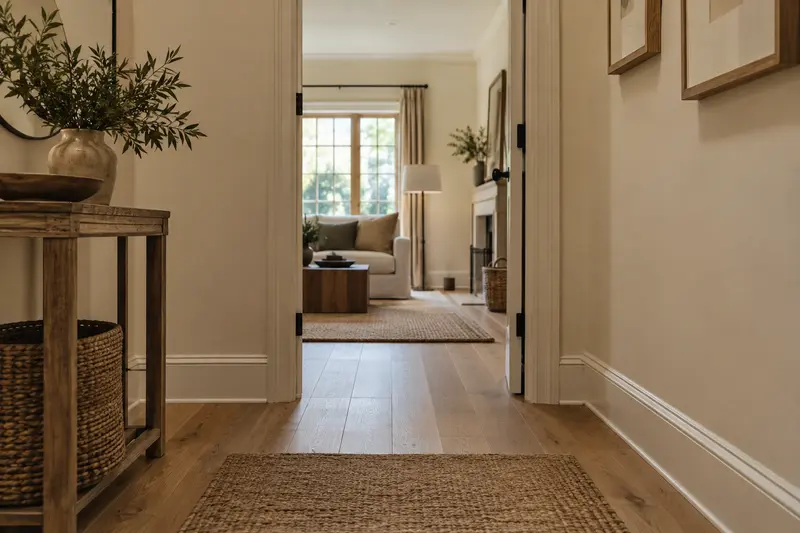
In brief
Compare doorways, approach turns and destinations as one route. An overall width or advertised turning radius does not prove that a scooter can navigate your home. Use exact model data and an appropriate demonstration to resolve the real spaces.
IN THIS GUIDE
Treat the home as a route between actual destinations
A scooter's overall width cannot tell you whether it serves the ordinary route through a home. Start with where the intended user wants to go, then describe every doorway, approach, turn and destination on that journey. An isolated generous room can sit behind a difficult entrance or an unresolved change of direction.
Choose one ordinary route for the first worksheet. It might run from the proposed storage area to a room used every day. Record why that destination matters and what happens on arrival. Do not create a route just to justify a compact scooter. The equipment should follow the person's actual task and appropriate suitability assessment.
Include current furniture, doors and assessed equipment rather than drawing an ideal empty home. A promotional image of a large hallway says little about a corner beside your doorway. Keep the sketch realistic, with the household arrangement you expect to retain. Uncertain access should become a provider question, not a promise based on optimism.
This guide prepares an indoor-space briefing document for an appropriate provider demonstration. It does not prescribe manoeuvring techniques, a universal clearance or an individual's device choice. Dimensional evidence can help exclude an obvious mismatch, but personal operation and the actual route need their own appropriate review before purchase.
Measure the usable opening, not the frame’s nominal width
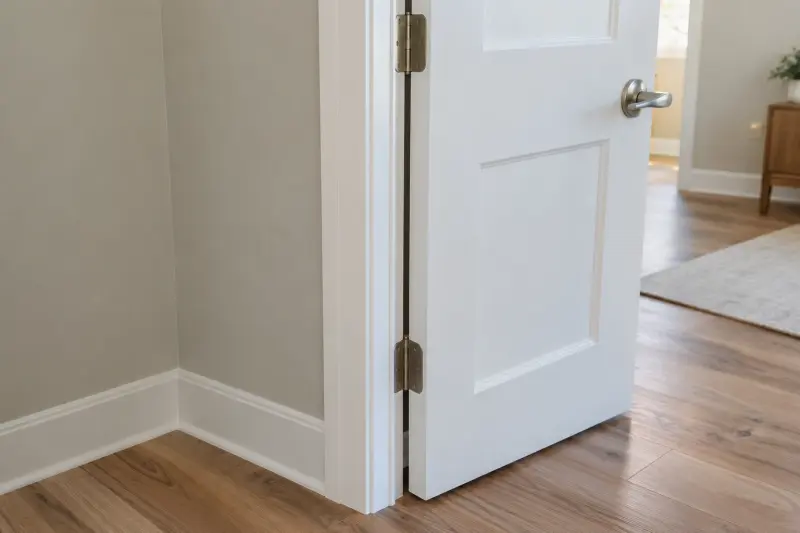
Ask the provider which doorway measurements matter for the proposed equipment and routine. A frame's nominal size may not describe the actual clear opening with the door in use. Handles, projections and the opening arrangement can affect the relevant shape. Record the measurement definition and any uncertainty beside the number.
If measuring is awkward, get appropriate help instead of leaning, climbing or moving heavy furniture. A household sketch should not become a challenge to collect every dimension unaided. Photos of empty spaces can help explain the layout, but they do not establish all relevant clearances or operating requirements.
Keep door operation in the task description. A scooter fitting through a static opening does not answer how the door is handled during the routine. Do not prescribe reaching, holding or reversing methods yourself. Ask the provider to review the real task and identify any appropriate support or layout requirement.
For shared spaces, record whether a proposed change affects another household member's ordinary use. Removing a door from a sketch can make a measurement look favourable while ignoring privacy, property and practical needs. The plan should represent the actual agreed home configuration, with any proposed alteration separately reviewed rather than assumed.
Separate a turning-radius specification from the whole manoeuvre
Pride's US Elite Traveller 2 SC442E page lists a 37-inch turning radius and a 19.45-inch overall width. Those are properties of a named product, not a statement that it can pass every 20-inch doorway or turn within every small room. The full occupied arrangement and actual approach remain relevant.
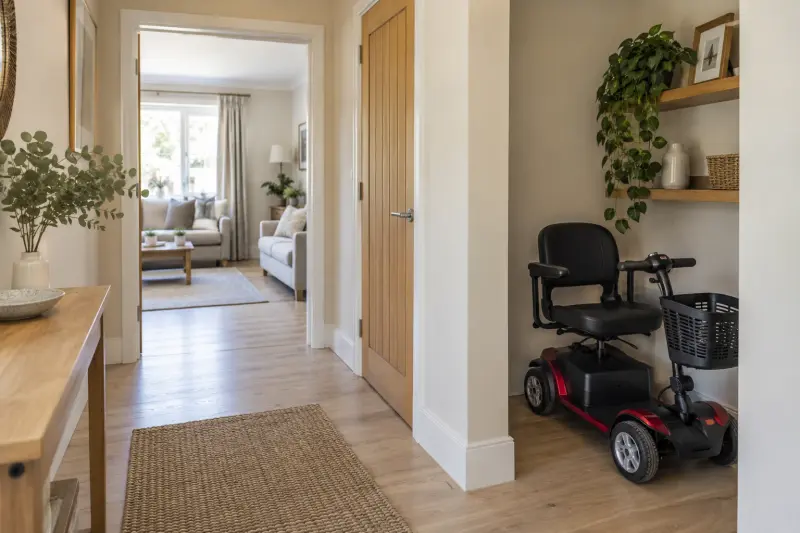
A turning radius describes a specified turning property. It should not be read as the full width of space required for every manoeuvre or as a generic room-size recommendation. Ask the maker or provider what the stated measurement means for the proposed model and how the actual indoor task should be reviewed.
Look at the approach as well as the corner itself. A doorway at the end of a narrow corridor is different from the same opening approached from an open room. A sofa or cupboard can limit the approach without changing the measured doorway. Put those features on the route sketch so the provider sees the complete question.
Do not infer an operating technique from a small turning number. We do not teach a sequence of turns or tell a user how close to pass furniture. An appropriately supported demonstration can reveal the actual arrangement and any limitations. Keep the result documented for the exact configuration rather than borrowing another model's claim.
Record the scooter in its approved occupied configuration
A bare equipment width is only one line of the comparison. Ask about the actual seat, approved arm supports, accessories and any carried items in the proposed arrangement. A personal-use configuration should not be reduced to the narrowest photograph online. The provider must establish the relevant setup and any permitted changes.
Keep personal fit and room fit separate. A narrower seat is not automatically a better choice because a corridor is small. Seat dimensions, control reach and the user's needs require appropriate assessment. Selecting a device solely to fit the room can leave the intended user with an unresolved operating arrangement.
Do not remove supports or alter components to make the worksheet pass. Pride's consumer safety information connects appropriate fitting and instruction with the supplied equipment and approved configuration. We use that boundary to keep the product and personal questions with the appropriate provider rather than suggesting household modifications.
Record what the user ordinarily wants to carry, and ask how approved storage affects the completed shape. A bag attached casually to the side can change the route question and introduce another unapproved arrangement. The actual configuration should be confirmed before it becomes the basis of a doorway or corner comparison.
Check the task at the destination, including leaving it
A route does not end when the scooter crosses a doorway. Describe where it is positioned for the intended task and how the person leaves that area under appropriate guidance. A room with enough empty floor space can still have an unresolved approach to a table, cupboard or other destination.
Ask which existing furniture needs to remain and what ordinary household movement shares the area. The plan should not permanently occupy a route another person needs. Keep any assistance requirement from the relevant assessment visible. Empty-space arithmetic does not establish a personal transfer arrangement or the right position for every task.
If the scooter is not intended to enter a particular room, record that boundary and discuss the complete routine with the appropriate professional. Do not invent an alternative unsupported movement to bridge the gap. A device may be useful for one route while another requires different advice or equipment.
Include the return route. A configuration that reaches a destination but leaves an unresolved exit is not a completed home-use plan. We do not recommend driving or reversing techniques; the provider should review those operating questions through the actual instructions and appropriate demonstration. The worksheet's job is to ensure the question is asked.
Describe thresholds, surfaces and level changes for review
Record visible changes along the route, such as thresholds, floor transitions or a ramp already present. Do not convert a catalogue obstacle or slope figure into permission for the person to attempt them. The actual product instructions, configuration and appropriate provider assessment are necessary.
A photograph can describe where a threshold sits, but it may hide height, surface condition or the approach. Ask the provider which information is needed and who can obtain it appropriately. Do not drive over an uncertain feature merely to see whether the model copes. A purchasing comparison should identify the concern before a trial.
Separate a building alteration from a scooter choice. Removing a threshold, adding a ramp or changing a floor can involve property, technical and personal requirements. We do not provide construction instructions or prescribe a generic accessory to overcome a feature. Put the task and existing condition into the relevant professional enquiry.
If the route changes between dry ordinary use and another condition, state that variation rather than assuming every day is identical. The provider can explain the equipment's applicable limitations. Do not recommend indoor modifications that bypass the manual or use a favourable demonstration on one surface as proof of all future conditions.
Plan storage and charging as separate indoor tasks
An indoor-use plan needs a relevant storage location as well as destinations. Record how the equipment reaches that location, whether the route remains available and who handles any transport configuration. A cupboard or corner may appear large enough but create another doorway or handling question.
Ask the maker and provider about the exact charging arrangement and permitted environment. Do not move a generic charger, add an extension lead or rely on an unapproved electrical accessory because the selected corner is convenient. Keep battery and charger compatibility with their appropriate documentation and support route.
Consider ordinary household access around stored equipment. The proposed location should not depend on blocking a necessary doorway whenever charging occurs. Do not solve that conflict by assuming the household will move the device repeatedly without reviewing the task. A practical location is one whose whole routine has been considered.
Storage, charging and operating space are related but not interchangeable. A folded model fitting a storage area does not establish that its occupied operating route works. Conversely, a suitable route does not settle the charging question. Keep separate worksheet entries and named confirmations so each requirement remains understandable.
Worked example: the doorway fits but the approach remains unresolved
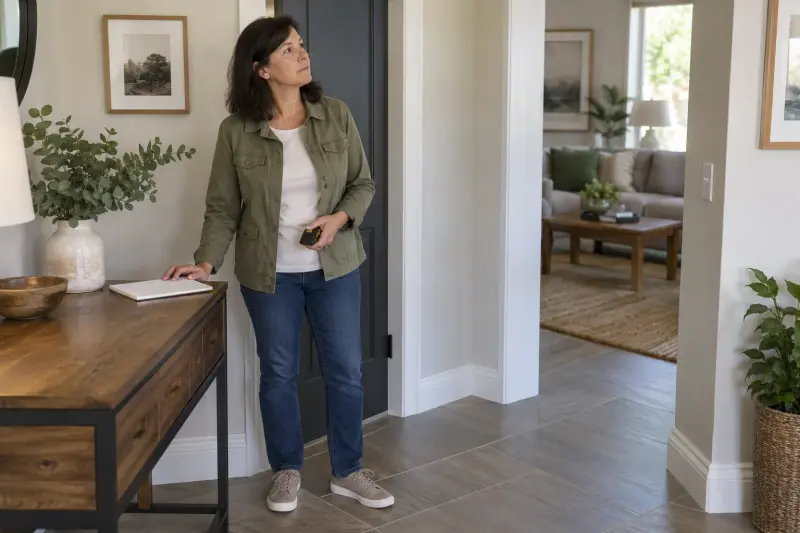
Imagine a fictional home where a measured opening appears wider than the published overall width of a compact candidate. The household initially records “fits the home.” But the doorway sits at a right-angle approach beside a fixed cupboard, and the published width says nothing about how the complete route will work.
The household draws the corridor, cupboard, door operation and destination. It asks the provider to identify the exact configuration used for a relevant demonstration. The intended user and necessary helper are included appropriately. The demonstration is not a challenge to squeeze through the smallest possible gap or invent a new technique.
The review reveals which task is confirmed and which needs another answer. The household keeps that wording precise rather than converting a single successful movement into approval for every room. If the approach is unsuitable, it asks about another appropriately assessed device or layout option instead of removing an approved support from the scooter.
This example does not endorse a candidate or define a universal indoor clearance. It demonstrates why a sequence of spaces matters more than one favourable dimension. The useful outcome is a route-specific decision with documented boundaries, including where the equipment is not intended to be used and what other arrangement needs professional attention.
Prepare a route-specific provider demonstration brief
Ask whether the relevant route can be reviewed in the actual home or how the provider handles a home-space enquiry. Explain the intended destinations and unresolved features in advance. A showroom's open floor can demonstrate controls but may not answer a corner or door task in a particular house.
Bring the sketch, defined measurements and exact configuration questions. Ask whether the demonstration model matches the proposed supplied variant, seat, battery and accessories. A different configuration can create a misleading impression of occupied shape or routine. Keep any difference visible in the notes.
Follow the applicable instructions and appropriate support during a demonstration. We do not prescribe a test route or driving technique. If the user has concerns about operation or personal suitability, bring them to the relevant professional rather than treating dimensional fit as permission to proceed.
Request a written summary of what was actually reviewed and what remains unresolved. Examples include a specified route, a particular doorway task or a storage question. Avoid broad phrases such as guaranteed indoor use unless the responsible source can define the actual scope. A careful demonstration can end with exclusion or another enquiry, which is valuable information before purchase.
Do not make a home alteration solely from a catalogue number
Moving furniture may be an ordinary reversible household choice, but it still needs to serve the whole routine. Make an agreed plan rather than permanently removing useful seating or storage just to make a compact device seem relevant. Keep the intended user's priorities and shared household needs visible.
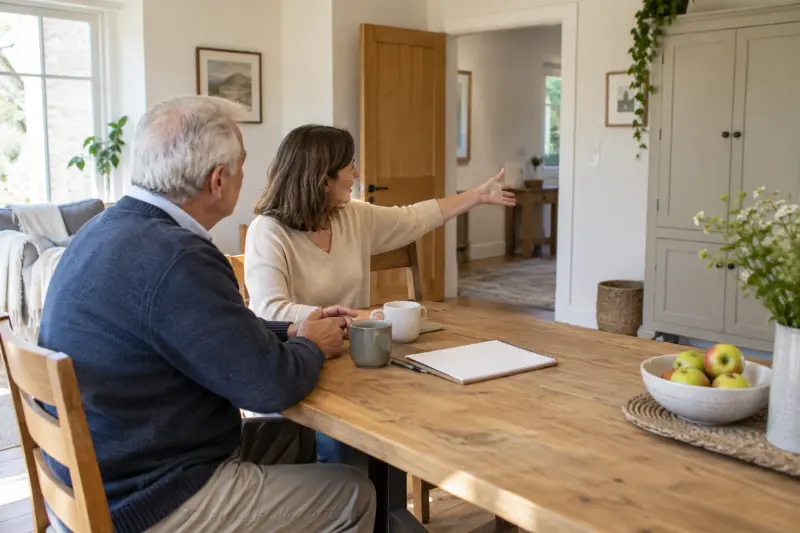
For structural or fixed-property changes, use the appropriate professional route. A doorway alteration, threshold change or ramp involves more than matching a scooter width. Personal tasks, property permission and technical requirements must be addressed together. This guide does not supply building specifications or assume that a private home follows another facility's accessibility standard.
If a proposed scooter needs several alterations, ask which actual mobility task it will serve afterward and what alternatives should be assessed. Do not assume that more modification proves a better solution. A different device or routine may be relevant under professional advice, and the complete scope should be understood before a substantial commitment.
Keep alterations separate in the budget record. Product price, home work, setup and support are distinct costs requiring current quotes. We do not invent a typical total or promise that the equipment's compact size avoids all work. The decision should follow confirmed requirements rather than using one attractive specification to justify the entire project.
Use a route matrix with an explicit boundary for each candidate
Create one row per route segment and destination task. List the exact candidate configurations across the top. In each cell, record the relevant dimension or evidence, the appropriate confirmation and any unresolved question. Do not average the entries into a score that declares the home suitable.
Use exclusions honestly. A candidate with an unresolved essential approach should not win because it has a favourite finish or smaller published radius. Once required tasks are confirmed, preferences can help distinguish relevant options. This keeps the decision grounded in the actual user and home rather than a catalogue ranking.
Record operating and storage boundaries. For example, a plan can identify a route under review while another room remains outside the intended use. That is different from claiming the scooter fits the entire house. Clear boundaries help prevent a future helper from assuming that a successful review covered every possible destination.
Connect the matrix with seating, controls, transport and service enquiries where they matter. Home-space questions do not replace the wider personal-use assessment. A useful shortlist may have one candidate awaiting a named answer or none that currently meet the confirmed requirements. Both are preferable to a rushed order based on a single favourable dimension.
Your indoor route and occupied-space decision card
Finish a one-page card naming the intended route, destination tasks and exact scooter configuration. Keep defined doorway, approach and room measurements attached to their sources. Add the appropriate provider contacts and any personal questions that belong in private assessment rather than a public product finder.
Use a clear next action for each unresolved requirement. It might be a route-specific demonstration, clarification of a documented dimension or review of another assessed arrangement. The card should explain why the purchase is ready, pending or excluded for that task without implying a personal safety certificate.
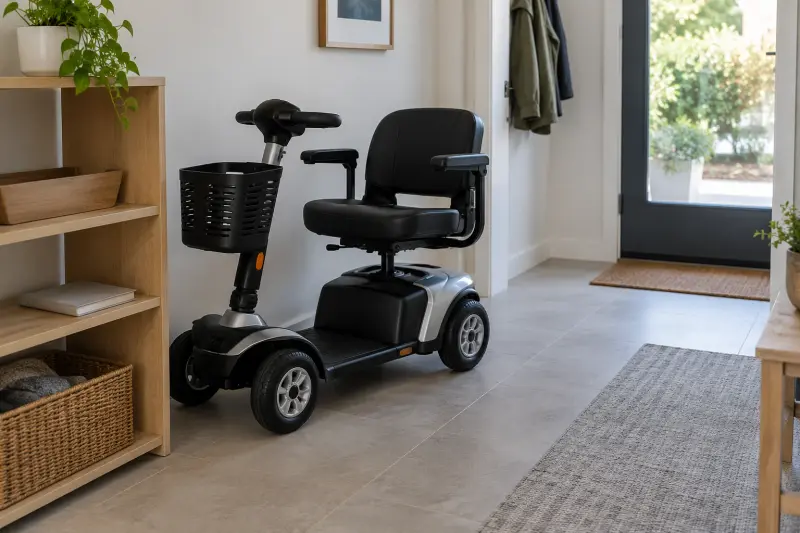
If the candidate proceeds, retain the supplied instructions and the provider's confirmed configuration. Review relevant changes to furniture, equipment or the person's practical needs through the appropriate route. An old favourable width comparison does not settle a newly altered routine automatically.
Our seating-and-controls guide develops personal operation questions, while the car-fit guide covers a separate transport route. Keep those documents connected to the same confirmed equipment identity. The best indoor choice is a relevant documented arrangement the household understands, including no new scooter when it does not answer the actual assessed task.
MAKE THE SPEND MEANINGFUL
Before adding to the basket.
- Prepare an agreed realistic sketch of existing rooms without buying planning software.
- Review ordinary storage and furniture allocation before proposing new fixed equipment.
- Ask about another appropriate assessed device or routine when a scooter does not answer the task.
- Retain the existing suitable arrangement when a new purchase is unnecessary.
How this guide was prepared
AI-assisted editorial research, checked against the linked primary sources. Product testing and a credentialed individual review are not claimed.
AI-assisted, source-checked editorial; no hands-on test, human expert review or personal suitability assessment claimed
How we use sources and AI assistance ↗Sources & fact checks
The guide separates sourced facts from editorial questions and examples. We have not claimed hands-on product testing. How we use sources and AI assistance.
- Pride Go Go Elite Traveller 2 US SC442E: overall width and turning-radius specifications; no home-fit guarantee ↗
- Pride Scooter Consumer Safety Guide: appropriate personal fitting, complete product instructions and approved configuration ↗
Found an error or an outdated detail? Contact the editorial team.