
In brief
Choose an electric trike around the route, your ability to handle it, storage and local service. Three wheels do not remove the need for controlled cornering, braking and a suitable riding environment. Compare the exact battery and configuration, not only a headline range. Confirm local riding rules and arrange an appropriate demonstration before buying.
Documented options
A clearer comparison.
Research options based on manufacturer documentation. These are not results of hands-on testing. Manufacturer links are informational; no commission relationship is currently active.
IN THIS GUIDE
Describe the rides you actually want
Choose a representative ride rather than beginning with the longest advertised distance. Describe the storage exit, route to the destination, narrow turns, parking and return. Identify any place whose access rules need checking. A scenic product video cannot establish permission for a local shared path. Keep the exact regional vehicle configuration beside the route enquiry so the provider and relevant authority are addressing the actual model rather than the general word electric.
For a hypothetical errand, the destination is nearby but the route includes a narrow entrance and a place where permitted vehicle categories are unclear. The buyer checks those questions before comparing batteries. Another household mainly wants recreational pedaling and has no need for a large cargo arrangement. The original task should determine which information matters. Extra capacity or range is not automatically a benefit when the storage exit or actual riding purpose remains unresolved.
Separate a recreational e-trike from a mobility-device enquiry. A low step-through or supportive-looking seat does not establish that an individual can use it appropriately. Involve the actual rider in the provider's supported explanation and seek appropriate professional advice where personal capability or suitability is uncertain. The website cannot assess handling from age, photographs or a questionnaire. A relative can help record questions and sources without selecting entirely on the rider's behalf.
For that Great Britain cycle-category enquiry, GOV.UK specifies working pedals capable of propulsion, a maximum continuous rated motor power of 250 watts and assistance that does not propel the cycle beyond 15.5 mph. Those fields should be requested for the exact supplied vehicle. A seller’s peak-power number is not automatically its continuous rating, and a menu setting is not a substitute for the documented configuration. Throttle arrangements can raise an approval question under the official guidance. Do not treat the US candidate in this article as an approved import simply because it has pedals and three wheels.

For a concrete market check, Lectric describes the cited US XP Trike2 with a 500-watt rear-hub motor and 1,092-watt peak output. Neither the peak figure nor a low-speed preset answers the Great Britain continuous-rated-power criterion. Request the exact locally supplied vehicle's documented continuous rating and other required details; do not relabel the US example as a qualifying 250-watt cycle. If the seller cannot establish the applicable category, resolve that question with the responsible local sources before choosing accessories for the route. This is also a reason to compare a locally documented alternative with an import on the permission row, even when the import's feature list looks more attractive. The US product page supplies equipment information, not global legal approval.
Keep the route and purpose brief private and update relevant changes. If the model, country or intended place of use changes, revisit the corresponding permission question. A previous approval for another journey is not global authorization. A useful research result may be a permitted-route answer, another supported option or a pause before purchase.
Use a demonstration to assess handling
Ask for a model-specific explanation of ordinary use before attempting unfamiliar operation. Mounting, assistance, braking, parking and cornering should be discussed under the actual owner's instructions and appropriate supported conditions. This article provides no riding or braking technique. A three-wheel layout is not a universal stability guarantee, and a short confident sales explanation is not the same as an appropriate review for the individual rider.
For a hypothetical demonstration appointment, the retailer explains a beginner setting on the proposed model but the order later changes generation. The buyer asks for the new control explanation and applicable manual. Another rider has a question about stopping or turning and chooses to seek further support rather than being pressured to continue. The record should identify the exact equipment and unresolved task. It is not a performance score that certifies a person's ability or compares accident outcomes.
Lectric's cited XP Trike2 page gives specific configuration and certification information, which is useful for exact-model questions. Its stated UL 2849 certification is an electrical-system claim, not proof of personal riding suitability or local road access. A beginner limit is a documented function to explain, not a medical assessment or promise that every older adult can operate the vehicle. Keep the manufacturer's scope attached to the claim and avoid turning product features into a universal recommendation.
Compare the controls the rider will ordinarily use before optional conveniences. Ask which assistance modes the supplied regional version actually offers and what a setting changes under the manual. Do not copy undocumented menu steps from another product or assume a software option changes legal classification. A familiar display photograph can conceal different behavior. The responsible supplier should explain the actual current setup and the appropriate instructions rather than leaving the household to infer operation from a feature list.

Ask the demonstrator to identify the actual mode as well as the displayed speed. Lectric describes a beginner setting that limits the XP Trike2 to five mph in Eco and Tour modes and slows acceleration. That wording has a defined scope: it does not say every mode is always limited to five mph. Write the exact model, mode and provider explanation in the handling enquiry, particularly if a delivered configuration differs from the demonstration. Avoid treating a beginner label as a personal suitability certificate, a braking result or permission to skip instruction. A buyer who only needs the ordinary supported setup does not need an accessory bundle to understand it. This guide gives no unlocking sequence; the appropriate owner instructions and supported explanation govern operation.
Retain a short task record with the correct manual and local support contact. Where personal questions remain unresolved, another assessment or demonstration may be the next useful step. An accessory should not be purchased to conceal an unexplained control or handling task. The guide has not tested the trike or declared any individual ready to ride.
Measure storage and transport realistically
Treat unfolding, folding, movement through the storage route and transport as distinct tasks. Published compact dimensions describe one specified arrangement, often with conditions about components. Ask what is required to reach that arrangement and which user actions or provider assistance are appropriate. Foldable does not mean lightweight, easy to lift or suitable for every vehicle. The actual doorway, opening shape and handling plan need review with the proposed model.
Use all three published states in a storage comparison. Lectric lists the XP Trike2 at 65 by 30 by 43 inches unfolded, 36.5 by 38 by 26 inches folded, and 36.5 by 30 by 26 inches folded with the front wheel removed; those figures are length, width and height. Folding reduces length but makes the ordinary folded width eight inches greater than the unfolded width. In an illustrative 32-inch straight opening, the listed 38-inch folded width exceeds the opening by six inches, even though the unfolded width is 30 inches. This arithmetic identifies a question rather than proving passage: the turn, opening shape, clearances and permitted handling still need review. Ask the supplier which documented arrangement, if any, fits the complete route and who handles the required actions. The front-wheel-removed size is a distinct specified state, not a website instruction to dismantle the trike unaided.
If transport involves a car, identify the proposed loading and securing routine through the responsible sources. Include the available appropriate help at both ends, any documented component removal and where loose pieces go. The article supplies no lifting technique or disassembly instructions. Another travel operator has its own acceptance conditions and should be asked about the exact battery and vehicle where relevant. A product's travel language is not verified rail, coach or airline permission.
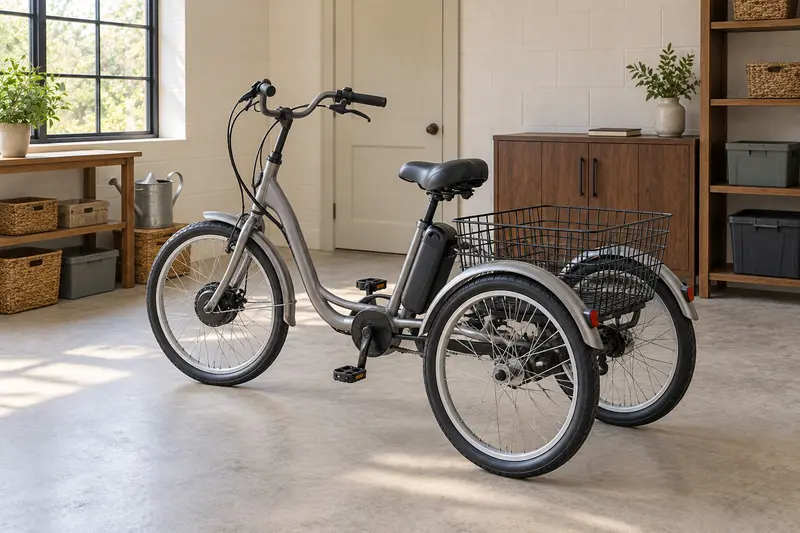
Plan ordinary storage, charging and maintenance access together without treating them as interchangeable. A secure-looking corner can still leave the approved charging question unresolved. Ask the manufacturer about the actual environment, and use its owner guidance. A cover or enclosed space is not automatically weatherproof protection. Local service availability should be checked for the exact model and work required, not assumed from a repair-shop directory entry or a general bicycle-service sign.
Clarify delivered assembly, damage-reporting and handover scope before comparing current purchase totals. A favorable online headline can omit a needed provider task. Existing suitable equipment or another configuration may serve the original ride with less unresolved handling. The useful outcome is a documented daily and transport routine, not the smallest catalogue number.
Buy the battery system as a documented system
Keep the exact battery, approved charger and owner document as one system. CPSC's micromobility guidance stresses manufacturer directions and attendance during charging, and its universal-charger warning addresses an important compatibility question. Do not infer approval from a matching plug or a marketplace battery description. Ask the maker about the proposed replacement or accessory for the precise trike and regional version rather than treating a higher rating as an upgrade.
For a hypothetical used-trike offer, the charger is described as compatible but has no clear manufacturer approval. The buyer requests the exact identities and documented answer before proceeding. Another offer changes the battery option while keeping the same family name, so range and ownership information need to match that actual configuration. The guide does not calculate a personal endurance guarantee, infer battery health from appearance or prescribe a do-it-yourself electrical inspection.
Read advertised range with its conditions. The actual ride, load and configuration can differ from a manufacturer's example. Ask the provider which data relates to the ordered version and keep unverified personal-range assumptions open. A longer headline cannot answer an uncertain charging location or service route. No measured battery-life ranking, cost forecast or comparative reliability result is claimed by this publisher. The buyer needs accurate current equipment information rather than a fabricated performance table.
Ask about approved replacement availability, local support and the actual warranty process. Separate battery coverage from frame or other equipment cover and request the document for the order. A service directory is a starting point for an enquiry, not confirmation of an appointment or every warranty repair. If a battery shows a concerning condition or an official recall applies, follow the maker and relevant authority's actual guidance rather than operating or repairing it to complete an informal test.

Use the battery numbers to check order identity, not to predict endurance. Lectric identifies the cited XP Trike2 battery as 48 volts, 13Ah and 624Wh. Multiplying the nominal 48 volts by 13 amp-hours gives 624 watt-hours, consistent with that description. It does not calculate the rider's distance or prove that another pack with the same nominal energy is approved. Record the exact battery and approved charger supplied with the order, and ask the manufacturer to resolve any mismatch in a replacement offer. Lectric states UL 2271 for the battery and UL 2849 for the complete trike's electrical system; keep the two scopes distinct instead of inventing a universal safety badge. A marketplace charger listing with a matching plug, voltage or impressive certification wording still needs the maker's exact compatibility confirmation. No spare battery is needed merely to complete this checklist.
Keep relevant local charging guidance alongside the exact owner instructions. Another country's cycling rules or battery information should not be imported without scope. Where the storage or charging arrangement remains unanswered, pause the accessory order and obtain the responsible source's clarification. A consumer backup or spare battery is not an automatic required companion to an electric trike.
Use a ride-and-ownership comparison record
Use the ride-and-ownership comparison record to preserve five distinct requirements: permitted route, handling enquiry, storage, charging and service. Add the exact source and next check beside each model answer. A completed dimensional row does not establish rider suitability or local permission. Avoid a universal fit score, safety badge or ranking derived from the number of answered questions. The article organizes research and has not tested the model or assessed the rider.
For a hypothetical final shortlist, one candidate has clear configuration information but no confirmed local repair route. Another has a promising service enquiry while its storage turn is unresolved. The buyer progresses those actual questions instead of adding more attractive models. A third decides to retain a suitable existing arrangement or delay while the essential handling enquiry is addressed. Those outcomes should remain available without a countdown or invented claim that a discount is the last chance to ride independently.
Keep the purchase scope on a separate page: exact trike, battery option, approved charger, required equipment, agreed assembly and delivery. Check what is already included before adding another container or visibility accessory. A helmet requires its own local-standard and actual-fit enquiry; price alone is not a safety ranking. Optional cargo or comfort items need exact manufacturer approval, load instructions and a clearly defined task. They do not automatically increase vehicle capacity or solve personal handling.
Confirm the selected configuration and actual seller terms at checkout, including current regional supply and support. A US manufacturer link is an information reference, representing no global legal permission, live stock, price or approved affiliate relationship. Keep private order details outside public comments. At handover, ask for the correct documentation and supported explanation against the final order, resolving discrepancies through the responsible provider rather than modifying unfamiliar equipment.

Editorial illustration
Cargo needs both individual and combined limits. Lectric lists a 415-pound total payload, a 330-pound maximum rider weight, a 30-pound front-basket limit and a 75-pound rear-basket limit. Adding all three individual maxima gives 435 pounds, twenty pounds above the total, so those maxima cannot all be used together as a single loading allowance. For an illustrative order question, a 300-pound rider plus 20 pounds in front and 60 pounds behind adds to 380 pounds. That arithmetic falls within the listed numerical limits but does not clear rider suitability, handling, load placement or the actual manufacturer's loading instructions. Keep any approved accessory weight and the maker's definition of payload in the enquiry. A larger-looking bag never increases a basket limit. Buy storage for a defined permitted task, rather than treating the most spacious cargo bundle as the best value.
Review the comparison record when a meaningful equipment or route change occurs. A new accessory, different battery or another destination can introduce a fresh question. Sales should follow a useful resolved need and an understood ownership scope, with no-purchase alternatives preserved. A well-informed rider does not need a large accessory bundle to count as a successful reader of this guide.
MAKE THE SPEND MEANINGFUL
Before adding to the basket.
- Compare the least elaborate configuration that meets the route and support needs, rather than adding an accessory bundle by default.
- Prioritize a suitable helmet and required equipment before decorative or duplicate accessories.
In brief
Questions worth answering
Does having three wheels remove the need for a test ride?
No. Handling, turning, route conditions and local rules still matter. Try the exact model in an appropriate setting and confirm a practical storage and support plan.
What belongs in the ownership cost comparison?
Include the complete model, delivery, assembly, charging, storage and service arrangements. Compare actual written terms rather than treating advertised range or an accessory bundle as the whole decision.
How this guide was prepared
AI-assisted editorial research, checked against the linked primary sources. Product testing and a credentialed individual review are not claimed.
source-checked editorial; no hands-on testing or expert suitability assessment claimed
How we use sources and AI assistance ↗Sources & fact checks
The guide separates sourced facts from editorial questions and examples. We have not claimed hands-on product testing. How we use sources and AI assistance.
- GOV.UK: exact electrically assisted pedal-cycle criteria and other categories ↗
- Lectric: exact US XP Trike2 configuration, dimensions and load limits ↗
- CPSC: micromobility riding and charging guidance ↗
- CPSC: universal micromobility charger warning ↗
Found an error or an outdated detail? Contact the editorial team.