

In brief
Separate the scooter purchase from required delivery, transport, approved batteries and service. Put optional accessories in their own column. Use dated actual quotes and an honest time horizon; a website should not invent your ownership cost or expected lifespan.
IN THIS GUIDE
Budget for a usable arrangement, not just a boxed scooter
A mobility scooter budget should describe the arrangement the reader can actually use. Start with the intended tasks and suitable equipment requirements. Then include the purchase, delivery, setup, storage, charging, transport and support needed to make that equipment practical. A low headline price is only one entry.
Keep affordability and suitability connected without pretending they are the same decision. A device within the spending limit can still be impractical to store or transport. A suitable model can still have unresolved costs. Identify both questions before placing an order, and seek appropriate individual advice where personal suitability is uncertain.
Choose a planning period and name it. It might be the first year or another period meaningful to the household. That is a budgeting horizon, not a predicted scooter lifespan. This guide does not provide an invented annual repair frequency, guaranteed battery replacement interval or resale value to make the calculation appear precise.
Divide the sheet into confirmed costs, possible costs and optional spending. A confirmed amount comes from an actual dated quote or bill. A possible cost is a question or scenario. An optional purchase has a task-based reason and can be omitted. Keeping those categories visible is more honest than adding guessed amounts and publishing one impressive total.
Make competing purchase quotations describe the same item
Identify the exact model, battery configuration, seat, standard accessories and locally supplied version in every quotation. Similar product names can cover different specifications. If one price includes a larger battery or another seat and the other does not, record that difference before calling one offer cheaper.
Ask what is included in delivery and setup. A boxed delivery, doorstep delivery and room placement with instruction are different services. Confirm whether the provider demonstrates approved handling and controls, and whether an additional visit would be charged. Include only the services actually required and actually quoted.
The FTC's US online-shopping guidance advises comparing the full cost, including shipping, delivery, tax and other fees, and keeping records of the seller's promises. Apply that sensible comparison structure to the actual offer, while remembering that legal rights depend on the relevant market and transaction.
For a fictional comparison, Offer A lists the scooter and standard delivery, while Offer B includes a setup visit. The reader asks A for the required setup cost and B to identify its visit scope. Only after those answers are available can the sheet compare equivalent arrangements. A missing service line is marked pending, rather than silently treated as free.
Include the car and outing arrangement where necessary
If ordinary use depends on travelling by car, include the actual handling and vehicle arrangement. A scooter described as portable may still require work or equipment the owner cannot manage. Confirm the approved transport method and exact dimensions and weights before paying for an accessory or vehicle adaptation.
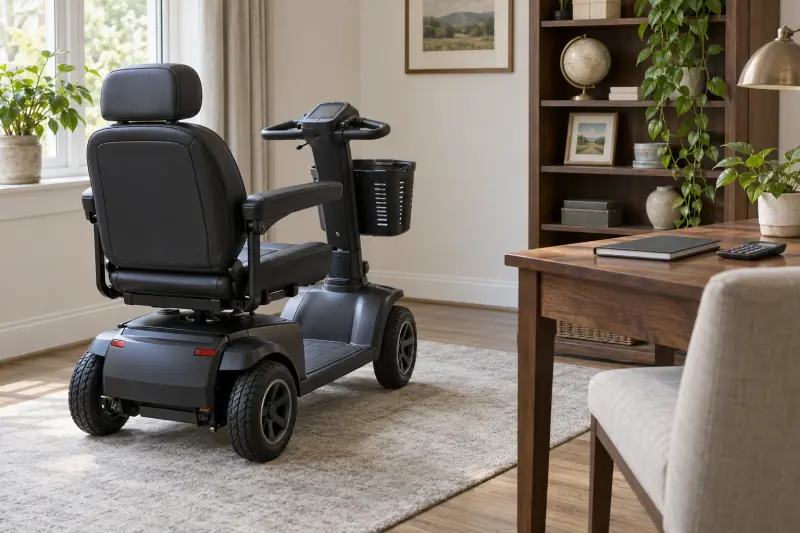
Separate routine family assistance from a quoted paid service. Someone may willingly help on some outings, but the budget should not assume unlimited availability. Write down who handles the equipment and whether the arrangement works for ordinary trips. If that is unresolved, a transport cost cannot honestly be entered as zero.
When a vehicle lift, ramp or other system is proposed, obtain an actual compatibility assessment and installed quotation through the appropriate provider. Include any required fitting, vehicle considerations, maintenance and removal questions. A low online accessory price is not the installed cost of an approved system.
In a fictional budget, a folding model is more expensive at purchase but could suit an existing confirmed transport arrangement. Another suitable model needs a separately quoted handling solution. The worksheet compares actual complete arrangements. It does not declare folding universally cheaper or assign a fictional value to unpaid lifting, assumed vehicle capacity or a future adaptation.
Count required storage and charging changes separately
Identify the actual place the scooter will be stored and charged under the manufacturer's instructions. Discuss shared-building or property requirements with the relevant responsible party. A cover is not a substitute for a permitted, appropriate storage location, and a spare room shown in a product photograph does not exist in every home.
If the location needs a change, get the appropriate advice and quote. That may involve an approved access arrangement or electrical work by a qualified person. Do not provide DIY wiring or use a cheap extension arrangement to make a budget balance. The correct requirements come from the actual equipment and property.
Distinguish necessary changes from preferences. Reorganising existing storage may solve a practical space issue without purchase. A decorative cabinet or additional cover may be optional, while a required suitable power arrangement is not. Put the reason beside each proposed cost so it remains understandable.
For a fictional reader, the initial storage plan relies on a communal corridor. The building's responsible party has not agreed to it, so the budget lists storage as unresolved rather than adding a cover and lock. That status can change the buying decision. A scooter that cannot be kept appropriately at home is not an affordable complete solution merely because checkout is inexpensive.
Treat battery replacement as an enquiry, not a timed promise
Obtain the exact battery identity and approved replacement route for the scooter. Ask the supplier what is supplied, what the current replacement quote covers and whether installation or checks are separate. Do not compare batteries solely by amp-hours, dimensions or a matching plug.
A replacement quote is a current possible cost, not evidence that the battery will need replacing on a particular date. Usage and equipment circumstances differ, and this guide does not assign a universal lifespan. Record any relevant manufacturer requirements and actual battery condition advice from the provider rather than inventing an annual allowance as a factual prediction.

If comparing battery configurations at purchase, ask what the difference means for the intended use, weight, charger and transport. More capacity is not automatically useful value. It can affect handling and travel questions, and advertised range is not a guarantee for the reader's journeys.
Keep spare and replacement batteries distinct. A spare is an additional purchase with its own compatibility, storage and transport requirements. It should not become an automatic part of every budget. A replacement is a response to an actual equipment need through the approved route. In both cases, a clear purpose and exact component evidence should precede the spending.
Add practical support using actual local offers
Ask who supports the exact scooter and how service is accessed. Include any relevant home visit, collection, return delivery or workshop transport quote. A maintenance price does not tell you how the equipment reaches the provider or whether the owner's location is covered.
Golden's official support page offers separate routes for field service, warranty information and manuals. These can help start an enquiry for its products, but they do not promise a particular local charge or response. Confirm the actual offer with the provider who would handle the appointment.
List routine maintenance, diagnosis and repair as different possible tasks. Do not use one quoted inspection charge as the expected total for every fault. If a provider proposes a plan, record exactly what it includes, its exclusions and how it relates to any current warranty arrangement.
A fictional comparison might show lower purchase spending for Candidate A but no confirmed collection route, while Candidate B has practical local service with a written visit scope. The sheet records both cost and access. It does not invent a monetary penalty for A's uncertainty; it identifies the unanswered question that must be resolved before the reader can depend on the equipment.
Give each optional item a job before giving it a budget
Create a separate accessory list. For every bag, cover, holder or extra basket, write the recurring task it solves, the evidence of exact compatibility and whether the equipment already supplies an appropriate solution. “Useful for everyone” is not a good reason to add an item to the cart.
A low-ticket accessory can still be poor value if it obstructs controls, changes handling or duplicates an existing feature. Ask the provider about the approved arrangement rather than relying on generic fit claims. Keep attachments and powered accessories especially tied to the actual model's instructions.
For a fictional shopping task, the supplied basket already holds the reader's ordinary essentials within the relevant requirements. A second bag is therefore optional, not an unavoidable ownership cost. For another reader, an approved holder may solve a genuine task. The budget should reflect those differences without pushing the same bundle at every visitor.
Use the confirmed suitable setup as the starting point, then add only demonstrated needs. An accessory can be bought later if the task becomes clear, subject to availability and compatibility. Delaying optional spending is often more sensible than choosing a less suitable main device to make room for a large initial accessory package.

Keep running-cost assumptions visible and modest
If estimating electricity cost, use actual information about the approved charger and the household tariff, or a suitable measured bill-based figure obtained without changing the equipment setup. Do not treat the battery's nominal capacity as the exact electricity taken from a wall socket. Charging losses and actual use are not established by that figure alone.
A transparent worksheet can use a reader-supplied energy amount E in kilowatt-hours and tariff T per kilowatt-hour, producing E multiplied by T for the chosen period. Label it an estimate based on those inputs. Leave E blank when it is unknown rather than inserting a generic scooter consumption claim.
Include only genuinely recurring charges relevant to the household. A separately selected insurance policy, paid storage or transport service has its own actual terms. Do not spread the purchase cost into a “daily cost” and present the small number as proof of affordability while hiding the initial payment.
For a fictional comparison, the reader knows the actual policy premium and paid transport charge but has no reliable electricity figure. The sheet shows a confirmed subtotal plus an unanswered running-cost line. That is a useful honest result. A calculator that displays precision beyond its evidence can make a weak buying decision look financially scientific.
Read the finance offer separately from the scooter price
A monthly repayment is not the same as the equipment's cash price or the complete cost of borrowing. Ask for the actual finance terms, total amount payable, fees, repayment schedule and conditions. Consider affordability using the household's real circumstances; this article does not recommend a loan or predict approval.
The CFPB explains that a loan interest rate and APR are different measures, with APR including relevant additional loan fees. The linked explanation is US consumer information and includes auto-loan context. Its useful lesson here is to compare like measures and read the actual agreement, rather than treating a low headline interest figure as the whole cost.
Pay attention to promotional conditions. Ask the finance provider what happens at the end of a promotional period, after a missed payment or if an early repayment is made. Do not interpret “no interest” or “from per month” without the exact written terms. The seller's product demonstration does not answer those finance questions.
Keep borrowing costs outside the product-performance comparison. Financing does not make a scooter more suitable, improve its warranty or resolve an inaccessible storage plan. If the complete arrangement exceeds what the reader can responsibly commit to, investigate appropriate alternatives and advice rather than using a smaller displayed instalment to conceal the mismatch.

Compare scenarios with reader-entered amounts
Use variables rather than published fictional prices. Let P be the actual device quotation, D delivery and setup, H required home or transport changes, S the quoted support spending in the chosen scenario, O chosen optional items and F the actual finance cost where relevant. Add R for actual recurring amounts within the chosen period that are not already counted in those lines: a relevant policy premium, paid storage, transport or a qualified charging estimate when its inputs are known. The scenario total is P plus D plus H plus S plus O plus F plus R. If an amount is unknown, keep that line pending and label the known sum a confirmed subtotal; do not silently enter zero or count a charge twice.
Define the scenario before doing the arithmetic. A first-year confirmed subtotal may include purchase and delivery but no repair prediction. A second scenario can add a currently quoted possible battery replacement, clearly labelled hypothetical rather than expected. Do not mix “certain this year” with “could happen sometime” and call the result a forecast.
In a fictional comparison, the reader creates a basic suitable setup and a separate optional-accessory version. The difference between the totals is the actual O selected. The reader can then ask whether each optional task justifies that spending. This is more useful than a universal bundle or a made-up average lifetime cost.
Keep all amounts in one currency and use current local quotes. Cross-border purchases may introduce additional questions about taxes, shipping, support and returns that need actual answers. An exchange conversion alone does not establish the delivered or usable cost. Mark missing items clearly so the final number cannot conceal unresolved commitments.
Compare alternatives without assuming they are always available
A purchase is one way to meet a mobility need. Using an existing appropriate device, considering a suitably assessed used option, hiring for a particular trip or investigating relevant local support may also be worth enquiring about. Each depends on suitability, condition, availability and actual terms.
For used equipment, include the appropriate inspection, approved parts, transport and service questions. A lower purchase price is not evidence of a lower complete cost. Do not assume that a warranty transfers, that a battery is healthy or that a missing charger is inexpensive to replace.
For hire, ask for the exact configuration, billing period, delivery, collection and support. A day or week headline rate may not describe the required arrangement. A short-term need can favour hire in some circumstances, but the equipment still has to meet the person's needs and the required dates.
A no-purchase next step can simply be a further demonstration or an accurate quotation. If the need is not yet understood, buying a cheaper device or several accessories is not automatically progress. Use the budget to expose the information required for a sensible decision, rather than forcing a sale because the worksheet contains a total field.

Keep the budget as a living purchase record
Before payment, check each amount against the actual order and terms. Save the dated quotations, agreed configuration, delivery scope and relevant support answers together. The FTC's record-keeping advice is a useful reminder to preserve promises and policies; local rights and procedures still depend on the relevant transaction.
After purchase, replace estimates with actual spending where it becomes known. Keep separate entries for required support, optional extras and repairs. That record can help a future comparison, but it should not be presented publicly as representative of every owner's cost or as evidence of product reliability.
Review the sheet when the intended task changes. A new vehicle, different storage location or additional travel can introduce new requirements. Ask the appropriate providers before assuming that a previously affordable arrangement remains practical. Do not add equipment automatically simply because the original budget allowed spare capacity.
The best budget explains what the reader is buying, why each required cost exists and which uncertainties remain. It also leaves room to decline optional purchases. An honest subtotal with clear pending questions supports a better decision than a confident ownership figure assembled from unverified prices, guessed lifespans and accessories the person may never need.
MAKE THE SPEND MEANINGFUL
Before adding to the basket.
- Delay optional accessories until a real task and exact compatibility are established.
- Reuse suitable existing storage and paperwork arrangements where permitted.
- Compare a suitable existing device, assessed used purchase or actual hire offer without assuming availability or cover.
How this guide was prepared
AI-assisted editorial research, checked against the linked primary sources. Product testing and a credentialed individual review are not claimed.
AI-assisted, source-checked editorial; no hands-on test, human expert review or personal suitability assessment claimed
How we use sources and AI assistance ↗Sources & fact checks
The guide separates sourced facts from editorial questions and examples. We have not claimed hands-on product testing. How we use sources and AI assistance.
- FTC US consumer guidance: compare total online purchase costs and keep seller terms ↗
- Pride scooter safety guide: exact equipment and approved-component requirements ↗
- Golden official support: separate service, warranty and manual enquiry routes ↗
- CFPB: interest rate and APR are different measures; cited explanation, not a scooter finance recommendation ↗
Found an error or an outdated detail? Contact the editorial team.