
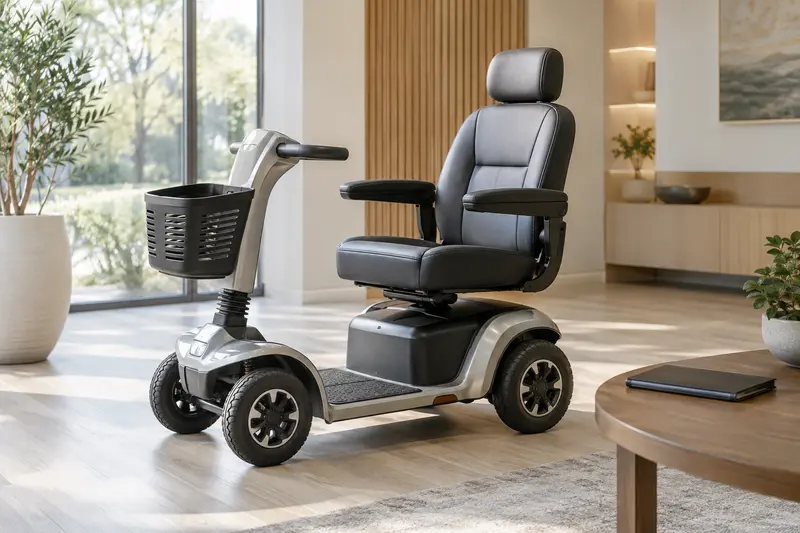
In brief
Compare seating and controls through the tasks the user needs to perform, with appropriate advice where suitability is uncertain. Seat width, an adjustable tiller or a large lever does not establish individual fit. Use a demonstration to understand the complete operation.
IN THIS GUIDE
Begin with the person and their ordinary tasks
A scooter seat comparison should begin with what the person needs to do, not with the largest available cushion. Write down the ordinary tasks: approaching the scooter, using the seat, reaching and understanding controls, steering during appropriate use and completing the journey. Include the storage or transport tasks the person would actually perform.
Keep personal preferences separate from unresolved suitability questions. Someone may prefer a wider-feeling seat, a particular arm arrangement or a less cluttered control panel. Those preferences help a provider prepare a demonstration. They do not establish that the device is appropriate for the person's posture, strength, vision or ability to operate it.
Where mobility, pain, balance or another health concern affects the decision, seek appropriate individual advice. Pride's safety guide places selection and instruction in the context of the user and relevant provider or professional input. A product list cannot replace that process, and a family member's successful showroom ride does not answer the intended user's needs.
Make the demonstration request specific. “Please show the controls and permitted adjustments on the exact configuration we would order” is more useful than “Is it good for older people?” The intended user should be involved as far as appropriate. The aim is to discover how the product works for the actual task, without turning a shopping visit into an improvised clinical test.
Compare seat width and depth using the same definitions
Record the manufacturer seat dimensions and ask how they are measured. Overall scooter width, width between arms and seat cushion width are different figures. A dimension described as seat depth may refer to a specified measurement origin; ask the provider to show it on the actual seating rather than guessing from a photograph.
Two current US examples illustrate why model identity matters. Pride lists a 17-by-17-inch standard seat for the Go Go Elite Traveller 2 SC442E. Golden lists 15-by-13.75 inches for the Buzzaround CarryOn GB120. Those are manufacturer specifications for the stated models, not a clinical recommendation or a verdict about which seat is more comfortable.
Do not select by the numerical difference alone. Cushion shape, back arrangement, arms, clothing and the person's experience during an appropriate trial can affect the useful comparison. A smaller travel seat might be a practical compromise for one user and an unsuitable choice for another. The provider needs the user's task and circumstances.
Put the dimensions beside the configuration demonstrated. If the display scooter has another seat or an optional component, note that difference before ordering. A successful trial of a larger showroom seat is not evidence that the standard compact seat supplied online will feel or function the same way.
Separate seat height from the measurement to the deck
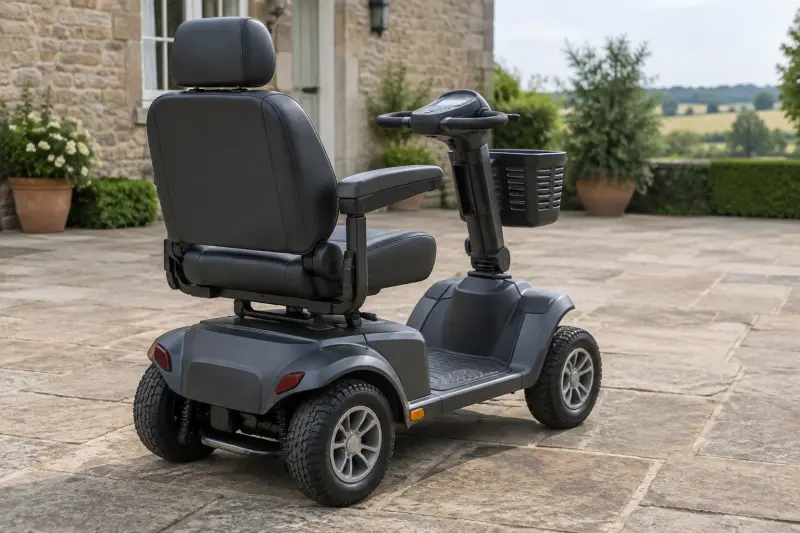
Seat height needs a clearly named reference point. A specification may describe ground to seat, deck to seat or a range from an adjustment. Those figures answer different questions. Ask the provider to explain the actual product measurements and demonstrate only the adjustments intended for that model.
Think about where the scooter will be used. The person may approach it from a room, pavement or another agreed location. A height that looks convenient in a photograph may not match their circumstances. The article cannot calculate an appropriate height from stature alone or prescribe a transfer technique.
Write down the setup demonstrated, including which adjustment position is used. Ask who is allowed to adjust it, which procedure applies and whether the supplier will deliver that configuration. Do not change the seat post or insert an unapproved cushion in an attempt to reproduce another scooter's dimensions.
If the reader notices discomfort, difficulty or uncertainty during a supported demonstration, record the task and seek the appropriate advice. “I cannot comfortably reach the control in the demonstrated position” is useful feedback. It is more informative than assuming that a height specification solves the issue or choosing a taller setting without considering the rest of the equipment.
Look at the back and arms as part of the complete seat
A seat is more than the cushion surface. Ask about the back's shape and adjustment, the arms supplied and their permitted movement. Confirm whether those components are standard on the ordered version. An image may show an optional headrest or another market's configuration, so identify the exact model before drawing conclusions.
Use the arms and back as questions for a demonstration rather than as universal promises. An adjustable arm can offer flexibility, but that does not establish that the range meets the individual's needs. A higher back is not automatically more supportive for every person or appropriate for every transport arrangement.
For a fictional example, a reader prefers a compact model's overall footprint but finds the displayed arm position inconvenient for a task. The provider checks which approved adjustments are available and whether they address the issue. If they do not, the next comparison is another appropriate configuration, not a homemade attachment.
Ask what changes when the scooter is prepared for storage or transport. A seat component that is convenient during use may require handling the owner cannot practically perform. Keep transport requirements visible alongside the seated trial. The appropriate purchase balances real use and real handling rather than optimising a single feature in isolation.
Try the tiller arrangement in the actual setup
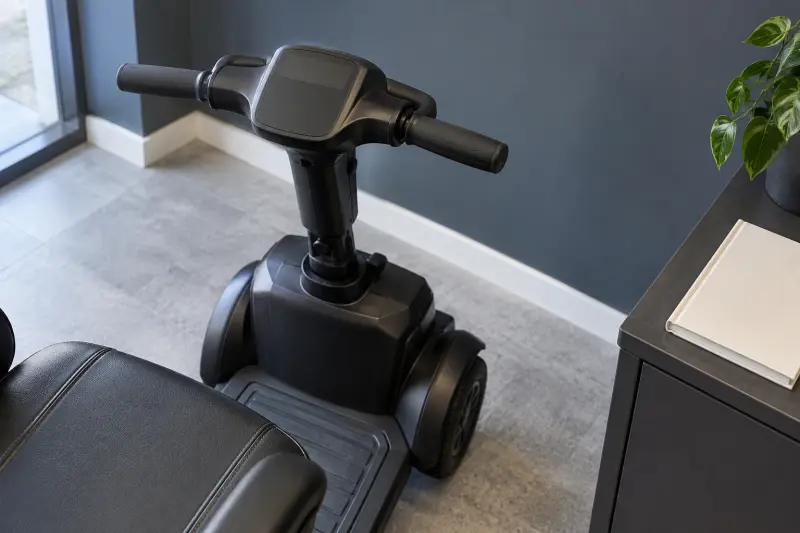
The tiller is where many day-to-day control tasks come together. Ask the provider to demonstrate its approved adjustments, explain how they are secured and identify the position used for the trial. Do not assume that a broad adjustment description tells you the person's useful reach range.
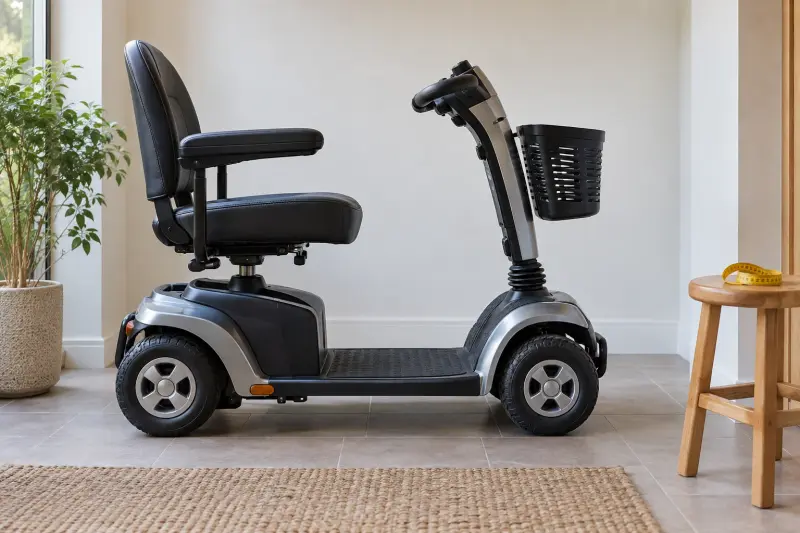
Look at the whole relationship between seat and tiller. Moving one can alter the experience of the other. Record any unresolved reach, visibility or movement concern rather than changing multiple settings by guesswork. Where personal suitability is uncertain, ask the appropriate professional or provider to advise.
A control style such as a delta tiller is a feature description. It does not prove that someone with a particular hand condition can use the scooter appropriately. Avoid broad claims such as “easy for arthritis” without individual evidence. The relevant question is whether the intended user can understand and perform the actual required control tasks.
Compare scooters in the setup that would be supplied, with any approved adaptations identified. A display model adjusted by staff can feel very different from a boxed device delivered without instruction. Include setup and instruction in the quotation so the final purchase matches the configuration and support on which the comparison was based.
Use a control-task record instead of a button count
Prepare a short task record for the demonstration. Ask the provider to explain the controls needed for ordinary use, the meaning of relevant indicators, how to stop movement through the approved method and what to do when a warning appears. Use the exact current manual, not a generic diagram of scooter controls.
For each task, record whether the user understood the instruction, could identify the relevant control and has an unresolved question. This is an enquiry record, not a home-administered safety test or a numerical aptitude score. Do not set unsupported thresholds such as completing every task in a fixed number of seconds.
A simpler-looking panel can still involve an unfamiliar sequence; a more detailed panel can sometimes have clearly separated functions. Compare actual understanding and permitted operation rather than assuming fewer buttons always means easier use. Consider whether labels are legible in the person's ordinary conditions without inventing a measured accessibility rating.
In a fictional comparison, one user understands Candidate A's indicator explanation but confuses two functions on Candidate B. That observation belongs in the discussion with the provider. It does not make A universally best or prove B is unsafe for every user. The purchasing question is which appropriate configuration the intended person can use with the required support.
Ask for a supported, task-specific demonstration
Arrange a demonstration that is appropriate to the user and equipment. Tell the provider in advance about the ordinary environment and any personal suitability concerns. Ask what can be assessed in the showroom and what requires another setting or professional input. A short open-floor ride does not represent every doorway, route or task.
Use a small number of important questions so the visit stays focused. Ask to understand the seat setup, reach the actual controls, see the approved storage or transport procedure and discuss the intended journeys. Do not create an obstacle course, test slopes or attempt risky manoeuvres to imitate online reviews.
Editorial illustration Keep observation and interpretation separate. “The person asked for the label to be explained twice” is an observation. “The scooter is unsuitable because of cognitive impairment” is a clinical conclusion the article cannot make. If the observation raises a concern, seek appropriate advice rather than assigning a diagnosis.
Allow time for the intended user to ask their own questions. A companion can help record answers, but should not complete every task on the user's behalf and then call the scooter easy to use. A purchase made for another person should be based on their needs and the appropriate assessment, not on the shopper's experience of the controls.
Remember the clothes, belongings and ordinary environment
A demonstration is more useful when it resembles the intended task in reasonable ways. Discuss ordinary clothing, footwear and essential belongings with the provider. Ask how any needed item is carried using approved arrangements. Do not add a bag to the controls or load the scooter beyond the stated requirements for the sake of a comparison.
Consider where the user needs to see indicators and reach the key or approved control. A task that feels straightforward in bright showroom lighting can raise another question at home. Record that question; do not assume a photograph of a large display proves its legibility in every condition.
Keep indoor and outdoor use distinct. A compact seat-and-tiller relationship that suits a short indoor task may not decide comfort or operation for a longer outing. Ask about the intended use and limits, and avoid giving a duration recommendation based on the number of centimetres in a seat specification.
For a fictional reader, the ordinary journey includes a shopping list, phone and small bag. The provider explains the approved storage options and the user checks how those affect access to controls. A bag already owned may work if the arrangement is approved. Buying another accessory is justified only by a task that remains unsolved.
Do not use accessories to bypass an unresolved fit issue
Seat cushions, back supports, control aids and attachments should not be automatic purchases after an uncertain trial. Ask the manufacturer or provider about compatibility with the exact equipment and seek personal advice where needed. An add-on may change the seat height, reach, control access or transport arrangement.
Avoid presenting a generic cushion as a solution for pain, posture or pressure concerns. Those require appropriate advice, and a product's material description does not establish individual suitability. The relevant comparison is an approved arrangement for the actual person, not an attractive accessory photograph.
Separate comfort preferences from equipment changes. The user might prefer another original seat option, a different scooter or a better-supported demonstration. A retailer should identify what is actually available and included. Do not pay for a modified configuration until its compatibility and purpose are understood.

Editorial illustration Keep essential and optional items in different columns. If a component is required for the appropriately advised setup, it belongs in the full equipment quotation. If it only serves a preference or storage task, compare its value separately. This prevents low-priced extras from hiding an unresolved main purchase decision or making an unsuitable scooter look affordable.
Make the order describe what was actually tried
After the demonstration, write down the exact model, seat reference where available, adjustment setup, arms, tiller and any approved options. Ask the seller to confirm that the ordered configuration matches the one relied on for the decision. Colour alone is not enough to identify equipment with several versions.
Record any differences that cannot be matched. The showroom seat may be an optional size, the display may have a different control or the available stock may be another product revision. Ask what those differences mean and whether another demonstration is needed. Do not accept “similar” as proof of the same seated experience.
For a fictional example, the buyer prefers a demonstrated scooter but the quoted item is supplied with another seat. The next step is to confirm the actual seat and, where useful, try it. A lower price for a different configuration is a different offer; it cannot be compared as though nothing changed.
Confirm setup, instruction, returns and support with the exact order. A useful trial can still lead to an impractical purchase if the equipment arrives with no help to reproduce the agreed setup. Keep the purchase evidence in one place so the user or a supporting family member can identify what was promised and what was delivered.
Compare useful capability rather than prestige
A seating and controls decision can be influenced by travel claims, large weight capacities and premium names. Return to the person's tasks. A high capacity is a product limit, not evidence of an appropriate seat. A luxury-looking chair is not proof of usable controls. A folding feature does not settle ordinary comfort.
Compare complete appropriate configurations with actual delivered quotations. Include setup and necessary instruction, but do not invent a value for features the user does not need. If a more expensive model offers an important approved seat option or usable control arrangement, describe that particular benefit rather than calling it generally superior.
A less expensive model can be a sensible choice where it meets the established requirements and has practical support. Conversely, a price reduction does not resolve an unanswered personal suitability concern. A good guide helps readers distinguish spending that serves a task from spending driven by a broad promise.
There is also a no-purchase result. A further assessment, a different demonstration or using an existing suitable device may be the right next action. An unanswered question does not by itself create a need for another accessory. Keep each proposed purchase tied to a confirmed task and an appropriate, usable equipment decision you can explain in ordinary language.
Keep the setup record for delivery and later changes
At delivery, ask the provider to identify the actual equipment and demonstrate the agreed setup and instructions. Check whether the seat and controls match the order. If something differs or the user experiences a new difficulty, record it and contact the appropriate provider before improvising an adjustment.
Keep current instructions and the setup record accessible. That record can help when another family member supports the user or when service is arranged. It should state what was supplied and which questions were resolved, without becoming a substitute for the manufacturer's procedures.
If the user's needs, equipment or environment change, review the arrangement through the appropriate advice route. A past demonstration is not permanent proof of suitability for every future condition. Do not respond to a changed need by automatically ordering a cushion, replacement lever or larger seat online.
The final decision sheet should make three things clear: the configuration compared, the tasks discussed and the status of any personal suitability questions. It should also explain why an accessory was included or excluded. That gives readers a practical purchase record while respecting the limits of specifications, showroom experience and this source-based guide.
MAKE THE SPEND MEANINGFUL
Before adding to the basket.
- Arrange a focused demonstration or further advice before buying accessories to fix an uncertain fit.
- Use a simple task sheet and existing document folder rather than a paid product-selection app.
- Compare a suitable standard configuration with optional features only when the optional feature solves a demonstrated need.
How this guide was prepared
AI-assisted editorial research, checked against the linked primary sources. Product testing and a credentialed individual review are not claimed.
AI-assisted, source-checked editorial; no hands-on test, human expert review or personal suitability assessment claimed
How we use sources and AI assistance ↗Sources & fact checks
The guide separates sourced facts from editorial questions and examples. We have not claimed hands-on product testing. How we use sources and AI assistance.
- Pride current scooter safety guide: selection, instruction and provider involvement ↗
- Pride Go Go Elite Traveller 2 SC442E: US seat specification and adjustment features ↗
- Golden Buzzaround CarryOn GB120: US seat dimensions and model-specific features ↗
Found an error or an outdated detail? Contact the editorial team.