
In brief
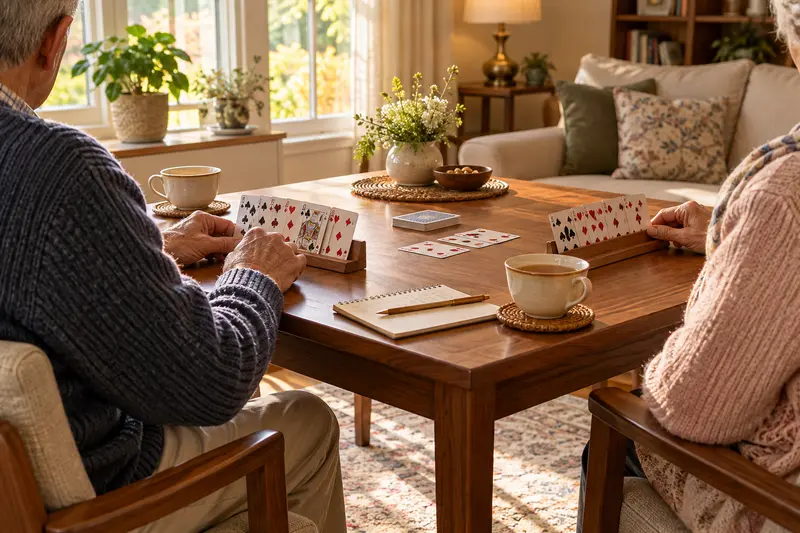
A playing card holder is a small rack that stands on the table and holds your hand of cards upright, so you do not have to grip a fan of cards for an hour. A standard wooden rack suits games with smaller hands, such as bridge or whist. An extra-wide rack suits rummy and canasta. Check the card capacity and your table space first.
Shortlisted for this decision
Affiliate-
Shortlisted
YMI standard card holders, 2-pack
For bridge, whist and small hands
Solid beechwood racks with four rising slots and room for up to 40 cards, a steady choice for bridge and whist.
Check price on AmazonCheck first: Short racks fill quickly in canasta or rummy; check the size shown.
Affiliate links: we may earn a commission from qualifying purchases at no extra cost to you. Prices are shown only on Amazon. Amazon.com (US listing). See the full comparison ↓
Documented options
Playing card holder guide: options compared
Options based on manufacturer documentation. Retailer links are affiliate links: we may earn a commission from qualifying purchases.
Affiliate retailer links
-
Yellow Mountain Imports YMI Beechwood Playing Card Holders
Exact variant: 2-Pack, 5.9 in
View product details on Amazon — United States -
YMI Beechwood Playing Card Holders
Exact variant: 2-Pack
View product details on Amazon — Germany -
YMI Beech Card Holder
Exact variant: Pack of 2, 6 in
View product details on Amazon — France -
YMI Beechwood Playing Card Holders
Exact variant: 2-Pack
View product details on Amazon — Spain
Affiliate retailer links
-
YMI Beech Extra Large Card Holder
Exact variant: Pack of 2
View product details on Amazon — France -
YMI Beech Extra Large Card Holder
Exact variant: Pack of 2
View product details on Amazon — Spain
IN THIS GUIDE
Who a playing card holder helps
Holding a fan of cards looks easy, but it asks a lot of the hand. The fingers pinch the cards together and the thumb holds them spread, often for a whole evening. Mayo Clinic advises people with hand arthritis to avoid tightly pinching with the fingers, and a long card game is exactly that kind of task.
Say your mother has played bridge every Thursday for forty years, but lately she puts her cards face down between turns because her hand aches. A card holder lets her set the whole hand in a rack, read it at a glance and pick a card with a light touch. She stays in the game, at her own table, with her own friends.
Card holders also help people who use only one hand well, people with a tremor, and grandchildren whose small hands cannot hold a full hand yet.
- People with sore, stiff or swollen finger joints
- Anyone who tires or drops cards during a long game
- People who can use only one hand well, for example after a stroke
- Players with a tremor who find a fanned hand hard to steady
- Children learning family card games alongside grandparents
Playing card holder types and what each one asks of your hands
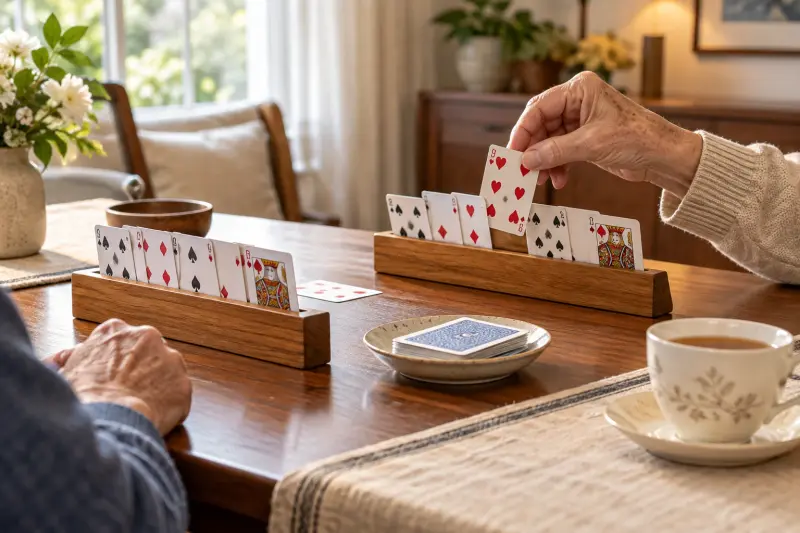
Most card holders work in one of two ways. A rack has slots cut along its length, and the cards stand upright in them like books on a shelf. A round or fan-shaped holder grips the cards at the bottom so they spread out in a circle.
Wooden racks are heavier, so they stay put when you pull a card out. Lighter plastic stands are easy to carry to a club or a holiday, but they can slide on a smooth table. Racks with several slots at rising heights let you sort a hand by suit, with each row visible behind the one in front.
- Slotted wooden rack: stands on the table, steady, needs table space
- Plastic stand: light and portable, may slide on a polished surface
- Round or fan holder: held in the hand or set down, still needs some grip
- Several slots at rising heights: easier to sort and read a large hand
- Felt or rubber base: protects the table and reduces sliding
How the two Yellow Mountain holders compare
Yellow Mountain Imports sells two solid beechwood racks in sets of two. Both have four slots at ascending heights and a felt-lined bottom, and the maker describes both as ideal for small hands and those with arthritic conditions. The main difference is length, and so how many cards each one takes.
The points below use the same facts for each, taken from the maker's pages. Measure the table space at each player's seat before you choose the wider one.
- Standard set: each rack 15.2 x 5.8 x 5.8 cm (6 x 2.3 x 2.3 in)
- Standard set: holds up to 40 cards, suits bridge, whist and similar games
- Extra-wide set: each rack 35 x 5.6 x 5.1 cm (13.8 x 2.2 x 2 in)
- Extra-wide set: holds up to 120 cards, suits rummy, canasta and hand-and-foot
- Both: solid beechwood, four slots, felt-lined base, sold as a pair
Setting up the table so the holder really helps
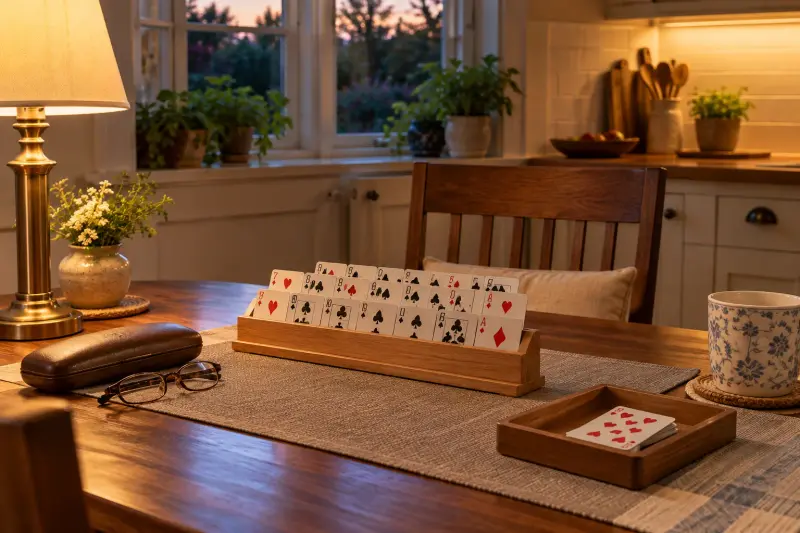
A card holder helps most when it sits where the player can see every row without leaning forward. Put it a hand's width from the table edge, straight in front of the player, with good light falling on the cards rather than behind them.
Imagine your father plays rummy at the kitchen table in the evening. A lamp to one side, a rack he can reach without stretching and a small tray for the discard pile can make the difference between an hour of play and giving up after one round.
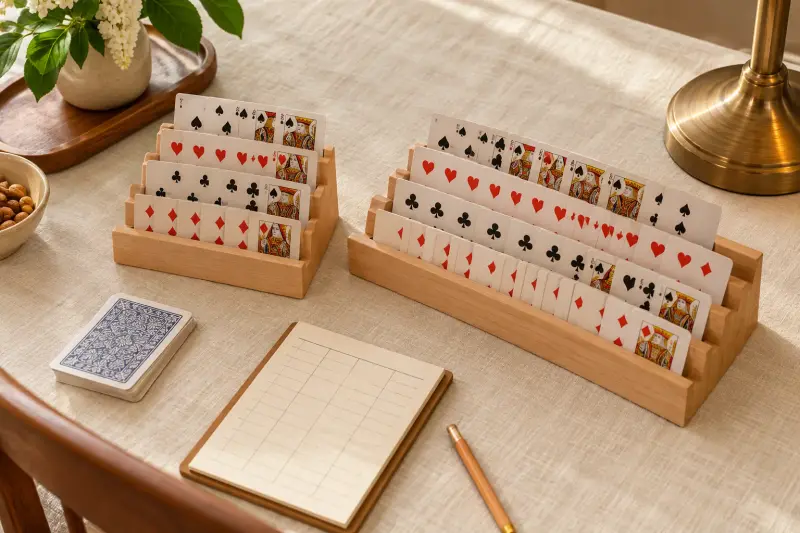
Large-print cards pair well with a rack, because the cards stand upright and face the player. Cards with a smooth finish slide in and out of wooden slots more easily than worn, bent ones.
- Place the rack straight in front of the player, not off to the side
- Light the cards from the front or side, not from behind the player
- Use a non-slip mat under the rack on a glass or polished table
- Try large-print cards if reading the corners is part of the trouble
- Keep a spare rack in the games box for visitors
When to ask an occupational therapist
A card holder is a simple tool, and most people can choose one themselves. If hand pain, weakness or a tremor is getting worse, or if many everyday tasks are getting harder, an occupational therapist can look at the whole picture.
InformedHealth.org, run by a German public health institute, notes that occupational therapists can advise on the devices available and show you how to use them. It also notes that what works for one person might not suit someone else, so trying an aid first is a good idea.
A useful question to ask is: "Which hand positions should I avoid during long games, and is there a holder or grip aid you would suggest for me?"
- Ask if pain lasts after a game or wakes you at night
- Ask if a hand is getting weaker or a tremor is getting stronger
- Ask about other leisure tasks too, such as writing scores or shuffling
- Ask a local club or day centre whether you can try a holder first
Common mistakes when buying a card holder
The most common mistake is buying for the wrong game. A short rack fills up fast in canasta, and a long rack can crowd a small bridge table where four people sit close together.
The other is forgetting the table. Four extra-wide racks at 35 cm each need a large table. Count players and measure before you order.
- Check the largest hand your usual game reaches, not the starting hand
- Measure the space in front of each seat
- Buy enough for every player who wants one, sets come in pairs
- Check that the cards you use fit the slot height and depth
BEFORE YOU DECIDE
Playing card holder guide: buying checklist
These checks organize the decision.
MAKE THE SPEND MEANINGFUL
Playing card holder guide: low-cost alternatives
- A clean shoebox lid with a few slits cut along one side can hold cards upright for a trial evening
- A book laid open and propped on a tray can hold a small hand against its spine
- Ask a local bridge club, day centre or library games group whether they keep spare holders to borrow
In brief
Playing card holder guide: questions answered
What is a playing card holder for seniors?
It is a small stand, usually wood or plastic, that holds your cards upright on the table. You set your hand in the slots, read it at a glance and lift out the card you want. It removes the need to pinch and hold a fan of cards for a whole game, which helps sore, weak or shaky hands.
How many cards does a playing card holder hold?
It depends on length. The Yellow Mountain standard rack, about 15 cm long, holds up to 40 cards according to the maker, enough for bridge or whist. The extra-wide rack, about 35 cm long, holds up to 120 cards, which suits games where hands grow large, such as canasta. Check the stated capacity before you buy.
Do card holders help with arthritis?
A card holder cannot treat arthritis, but it changes the task. Mayo Clinic advises people with hand arthritis to avoid tightly pinching with the fingers, and a holder means you no longer pinch a fan of cards for an hour. If pain or stiffness is getting worse, ask your doctor or an occupational therapist.
Can I make a card holder at home?
Yes, for a trial. Cut a few slits along one long side of a sturdy shoebox lid and stand the cards in them. It is lighter than wood and may slide, but it shows whether a rack suits the player before you buy one. A non-slip mat underneath helps it stay put on a smooth table.
How this guide was prepared
AI-assisted editorial research, checked against the linked primary sources.
Written with AI assistance from the sources listed below and checked against them. We have not tested these products in person.
How we use sources and AI assistance ↗Sources & fact checks
The guide separates sourced facts from editorial questions and examples. How we use sources and AI assistance.
- Mayo Clinic: joint protection for people with hand arthritis, including avoiding tight pinching ↗
- Yellow Mountain Imports: Standard-Size Solid Beechwood Playing Card Holders, set of 2 ↗
- Yellow Mountain Imports: Extra-Wide Solid Beechwood Playing Card Holders, set of 2 ↗
- InformedHealth.org (IQWiG): daily living aids for people with rheumatoid arthritis ↗
Found an error or an outdated detail? Contact the editorial team.