
In brief
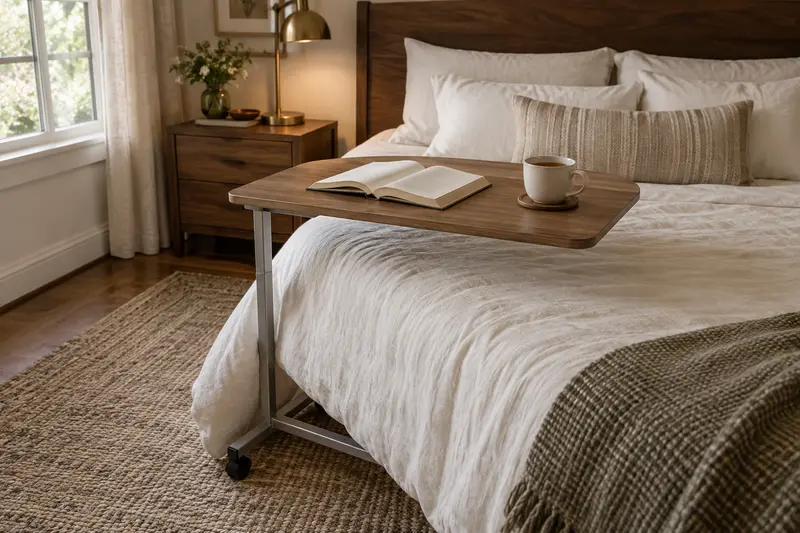
An overbed table for elderly users at home is a rolling table on a C-shaped or H-shaped base that slides under a bed or chair so the top sits over your lap. Check two numbers first: the height range against your bed or recliner, and the base width and depth against the space underneath. Then check the weight limit for what you will set on it.
Shortlisted for this decision
Affiliate-
Shortlisted
Drive Medical overbed table
For use over beds or recliners
A 28 to 45 inch height range covers most beds and recliners, and the stated 26.5 inch wide base lets you check fit under the frame.
Check price on AmazonCheck first: Rated 40 lb and does not tilt; measure the space under your bed for the base.
Affiliate links: we may earn a commission from qualifying purchases at no extra cost to you. Prices are shown only on Amazon. Amazon.com (US listing). See the full comparison ↓
Documented options
Overbed table for elderly users: options compared
Options based on manufacturer documentation. Retailer links are affiliate links: we may earn a commission from qualifying purchases.
Affiliate retailer links
-
Drive Medical Overbed Table with Wheels
Exact variant: Woodgrain top, Silver Vein
View product details on Amazon — United States -
Drive Medical Overbed Table with Wheels
Exact variant: Woodgrain top, Silver Vein
View product details on Amazon — Germany
IN THIS GUIDE
Who needs an overbed table at home?
An overbed table gives you a steady surface for meals, books, a tablet or a water glass while you sit up in bed or in a recliner. It can help during recovery at home, for someone who spends long hours in one chair, or for a caregiver who needs a clean surface beside the bed.
It is not a support to lean or push up on. The top rolls and adjusts, so treat it as a table, not a grab bar. If getting in and out of bed is hard, ask an occupational therapist about rails or other aids.
Think about who will move it, too. A table that rolls easily for a caregiver standing beside the bed may be harder to pull close for someone who is already sitting, so picture the daily routine before choosing.
- Meals and drinks in bed or in a recliner.
- Reading, puzzles, tablets and video calls.
- A clean surface beside the bed for daily items.
- Not a support for standing up or leaning.
How to measure a bed or recliner for an overbed table
Start with height. Sit where you will use the table and measure from the floor to a comfortable working height above your lap. For an adjustable bed, measure in the raised sitting position you use most.
Next, measure the clearance under the bed or chair. The base must slide underneath, so check the gap under the frame, the space between bed legs, and anything stored underneath. Recliners often have a footrest mechanism that needs room too.
Finally, check the floor. Casters roll easily on hard floors and less easily on thick carpet, so look at the route from the bed to where the table is stored.
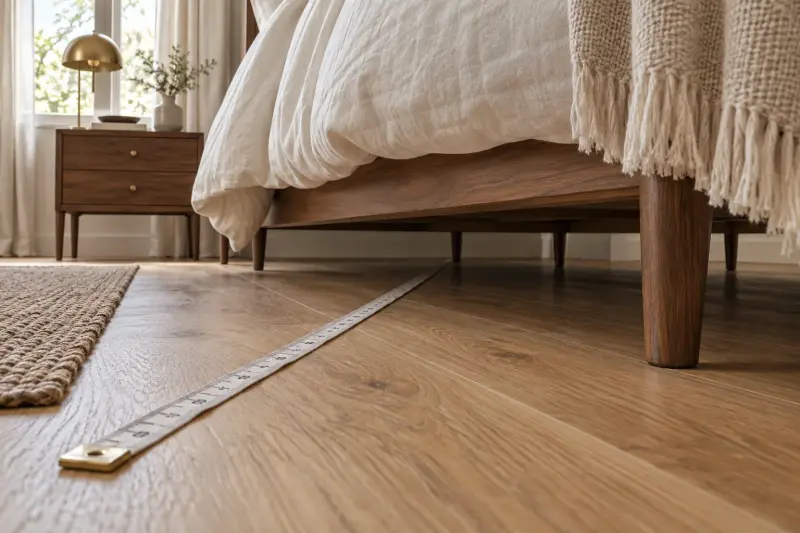
- Floor to comfortable top height, seated.
- Width and depth of space under the bed or chair.
- Height of the gap under the bed frame.
- Footrest or lift mechanism clearance on a recliner.
- Floor type along the rolling route.
Drive Medical overbed table: the specs at a glance
We list one named table whose maker publishes the key fit numbers. The Amazon listing is the Silver Vein finish, which Drive Medical sells as item 13067. The Drive Medical page does not state the tabletop size, so read that from the listing before you order.
We have not tested this table. The table below only lines up what Drive Medical publishes, so it cannot tell you how smooth the lever feels or how the casters behave on your floor. Compare any other table you consider on the same rows.
| Spec | Drive Medical figure | What to compare it with |
|---|---|---|
| Height range | 28-45 in (71-114 cm), lever adjusted | Your comfortable top height, seated |
| Weight capacity | 40 lb (18 kg) | What you will place on the top |
| Base | H-shaped, 15.5 in deep x 26.5 in wide (39 x 67 cm) | Space between the bed legs and under the frame |
| Casters | 2 in (5 cm), swivel | The gap under the bed frame and your floor type |
| Top | Walnut wood grain laminate; does not tilt | Whether you want a tilting top for reading |
| Table weight and warranty | 21 lb (9.5 kg); limited lifetime warranty listed | Who will move it each day |
Using it for screens, meals and reading
For tablets and laptops, a taller table can keep the screen closer to eye level. Mayo Clinic's ergonomics guide says the top of a screen should be at or slightly below eye level, with wrists straight and shoulders relaxed.
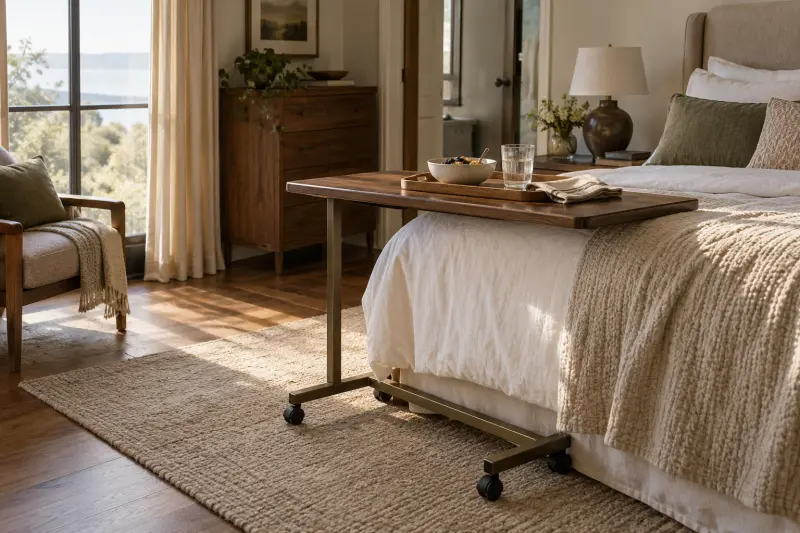
For meals, set the top a little above your lap so plates are easy to reach without leaning. Keep hot drinks near the center of the top, not at the edge. Move the table away before you get up so it cannot roll as you stand.
Change position often. Mayo Clinic also advises moving around rather than staying in one static position, which is just as true in bed as at a desk.
- Raise the top for screens, lower it for meals.
- Keep hot drinks near the center.
- Roll the table clear before standing.
- Take breaks from long sessions in one position.
Setup and care
Follow the maker's assembly sheet closely. Drive Medical's instructions note not to remove the bottom screw shown in its assembly figure, so read every step before you start.
Wipe the laminate top with a damp cloth and mild cleaner, and dry it. Check the casters every few weeks for hair or carpet fibers, and check that the height lever still locks firmly.
Keep the assembly sheet and warranty details together in a drawer near the bed. If a part loosens or the lever stops holding, you will have the model and item number ready when you contact the maker.
- Read all assembly steps before tightening anything.
- Clean spills promptly so they do not reach the frame.
- Clear fibers from casters so they roll smoothly.
- Stop using it if the top drops or wobbles.
Common mistakes
The most common mistake is buying a table whose base does not fit under the bed. Low bed frames, storage drawers and bed rails can all block the base.
Another is overloading the top. A 40 lb (18 kg) limit is plenty for a meal and a book, but not for leaning, sitting or stacking heavy equipment.
A third mistake is choosing the height range without trying the position. A table that tops out just below a comfortable height for screens, or will not go low enough for meals over a low bed, ends up in a corner unused.
- Not checking the gap under the bed frame.
- Leaning or pushing up on the top.
- Setting heavy items on one edge.
- Forgetting carpet can make casters hard to roll.
MAKE THE SPEND MEANINGFUL
Overbed table for elderly users: low-cost alternatives
- A sturdy bed tray or lap desk costs less and needs no space under the bed.
- A stable side table pulled close to the bed may be enough for drinks and a book.
- Ask a local loan closet or equipment library whether an overbed table is available to borrow.
In brief
Overbed table for elderly users: questions answered
Will an overbed table fit under a low bed frame?
Only if the gap under the frame fits the base and casters. Check the height of that gap and the open space between the bed legs. The Drive Medical table here has an H-shaped base 26.5 inches (67 cm) wide and 15.5 inches (39 cm) deep on 2-inch (5 cm) casters, so the space below the bed needs to fit both. Low bed frames, storage drawers and bed rails can all block it.
Can I use a bed table with wheels over a recliner?
Often, yes, if the base fits under the recliner or alongside it and the height range reaches above your lap. Measure in the position you use most. Lift recliners and footrests move, so make sure the mechanism will not hit the base, and roll the table away before the chair moves.
How much weight can an overbed table hold?
It depends on the model, so read the maker's figure. Drive Medical lists 40 lb (18 kg) for its deluxe non-tilt table. That is meant for meals, books and devices placed evenly on the top. Do not lean, sit or push up on any rolling table, whatever its rating.
Do I need a tilting top?
A tilting top can angle a book or tablet toward you, which some people like for reading. It also means items can slide if the top is tilted. A flat, non-tilt top, like the Drive Medical model here, is simpler for meals and drinks. Choose based on what you will do most.
How this guide was prepared
AI-assisted editorial research, checked against the linked primary sources.
Written with AI assistance from the sources listed below and checked against them. We have not tested these products in person.
How we use sources and AI assistance ↗Sources & fact checks
The guide separates sourced facts from editorial questions and examples. How we use sources and AI assistance.
Found an error or an outdated detail? Contact the editorial team.