

In brief
Adaptive utensils have wider, softer or bendable handles that make eating easier with weak grip, stiff joints or tremor. Lightweight foam-grip sets suit tired hands, bendable sets help when the wrist cannot turn far, and weighted utensils for tremors add mass some people find steadier. Match handle width and weight to the hand, and ask an occupational therapist when tremor is the main problem.
Shortlisted for this decision
Affiliate-
Shortlisted
Vive Adaptive Utensil Set
For stiff wrists or limited reach
Wide textured handles and bendable stainless steel necks let the angle be set for a stiff wrist or limited reach.
Check price on AmazonCheck first: Check the listing matches Vive's spoon, fork and knife set; it is not sold as a weighted set.
-
Shortlisted
BunMo Lightweight Utensils, 4pc
For weak grip, lightweight foam handles
A lightweight 4-piece set with wide foam grips, suited to weak grip where heavier cutlery is tiring.
Check price on AmazonCheck first: Lightweight handles do not add tremor-steadying weight; BunMo's page gives no weights.
Affiliate links: we may earn a commission from qualifying purchases at no extra cost to you. Prices are shown only on Amazon. Amazon.com (US listing). See the full comparison ↓
Documented options
Adaptive utensils guide: options compared
Options based on manufacturer documentation. Retailer links are affiliate links: we may earn a commission from qualifying purchases.
Affiliate retailer links
-
Vive Adaptive Utensil Set
Exact variant: Regular
View product details on Amazon — United States -
Vive Adaptive Utensil Set
Exact variant: Regular
View product details on Amazon — Germany -
Vive Adaptive Utensil Set
Exact variant: Regular
View product details on Amazon — France -
Vive Adaptive Utensil Set
Exact variant: Regular
View product details on Amazon — Spain
Affiliate retailer links
-
BUNMO Adaptive Utensils, 4pc Lightweight Assistive Silverware Set
Exact variant: 4 pieces, foam easy-grip handles, canvas travel wrap
View product details on Amazon — United States -
BUNMO Adaptive Utensils, 4pc Lightweight Assistive Silverware Set
Exact variant: 4 pieces, foam easy-grip handles, canvas travel wrap
View product details on Amazon — Germany -
BUNMO Adaptive Utensils, 4pc Lightweight Assistive Silverware Set
Exact variant: 4 pieces, foam easy-grip handles, canvas travel wrap
View product details on Amazon — France
IN THIS GUIDE
Who adaptive utensils help
Standard cutlery has thin, hard handles. Holding it needs a tight, steady grip, and tilting a spoon toward the mouth needs a turning wrist. Adaptive utensils change one or more of those demands.
They can help people with arthritis, weaker grip after a stroke or injury, reduced reach to the mouth, or a hand tremor. The goal is simple: eating with less effort, fewer spills and more independence at the table.
Meals are also social. Being able to eat at the family table without help, or without long pauses, often matters as much to people as the food itself.
- People who tire or ache partway through a meal
- Anyone who struggles to keep food on a spoon or fork
- Those with limited wrist turn or elbow bend
- Family members who want a parent to keep feeding themselves
The main kinds of adaptive utensils
Most adaptive utensils change the handle, the neck or the weight. Built-up or foam handles make the grip wider and softer. Bendable necks let the head of the spoon or fork be angled toward the mouth.
Weighted utensils add mass to the handle, and lightweight ones remove it. Some sets combine features, so read the listing for handle width, weight and whether the neck bends.
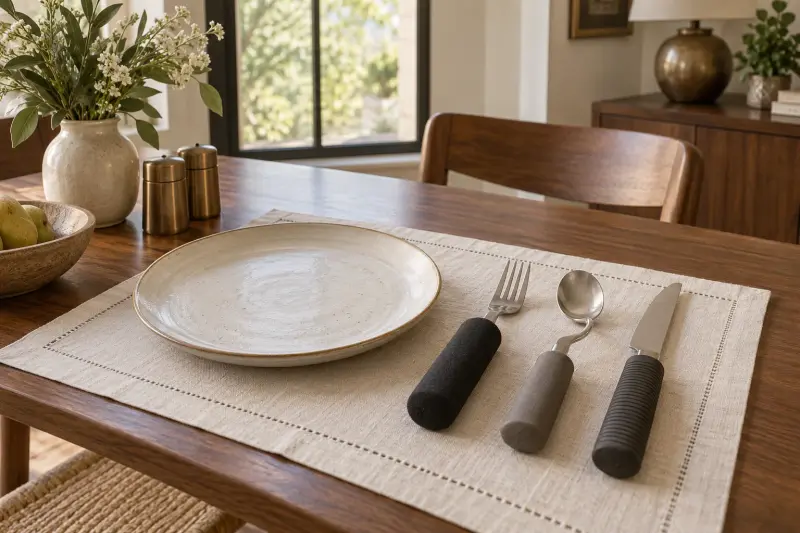
Arthritis Society Canada notes that enlarged handles put less strain on the joints. That is why a wider grip is often the first change worth trying for stiff or sore hands.
- Wide or foam handles: less squeezing for stiff or weak fingers
- Bendable necks: a set angle for limited wrist or arm movement
- Weighted handles: more mass, which some people with tremor find steadier
- Lightweight handles: less effort for weak or tired arms
How the two adaptive utensil sets compare
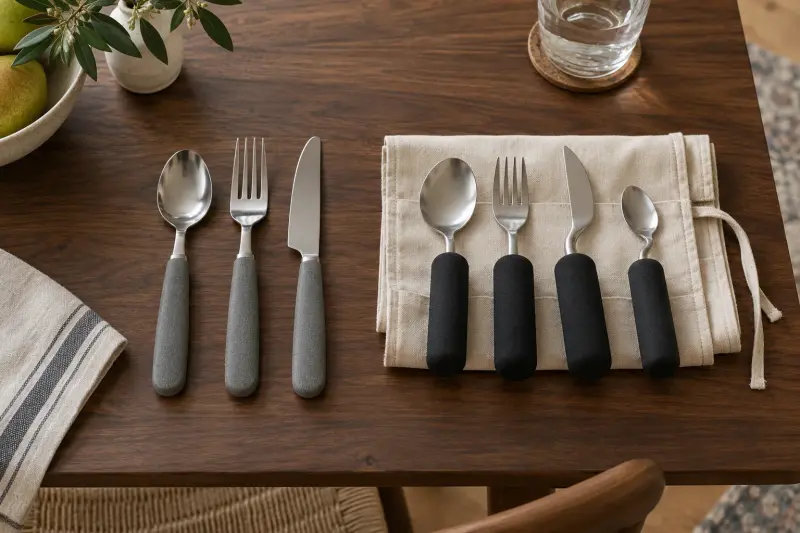
The two picks take different approaches. Vive's set is stainless steel with wide textured handles and bendable necks, while BunMo's set is lightweight with wide foam grips.
The facts below come from each brand's page and the verified Amazon titles. The brand pages and listings do not give identical details, so check the exact pieces and care notes on the Amazon listing.
In short, Vive suits someone who needs an adjustable angle and steel cutlery, while BunMo suits someone whose arm or hand tires quickly. Neither replaces advice on tremor or swallowing.
- Vive Adaptive Utensil Set: spoon, fork and knife; stainless steel tips; wide textured, latex-free handles with hanger holes
- Vive: bendable for a personal angle; dishwasher safe; Vive lists a 3.2 oz shipping weight, though the Amazon title calls the spoon heavy
- BunMo Lightweight Adaptive Utensils: 4 pieces with wide foam grips and a canvas travel wrap, per the Amazon title
- BunMo: lightweight handle; the Amazon title says dishwasher safe; BunMo's page lists no weights
Weighted utensils for tremors: what to know
Some people with a hand tremor find extra weight in the hand feels steadier. MedlinePlus suggests utensils with larger handles that are easier to grip, and notes that a heavier bracelet or watch may reduce a hand or arm tremor.
Weight is a trade-off, though. A heavier utensil can tire a weak arm before the meal ends. Neither set in this guide is sold as a weighted set, so look for a separate weighted option if a clinician or therapist suggests one.
If a weighted set is suggested, ask what weight to start with and whether the knife, fork and spoon should match. A trial at home over a few meals shows more than a single try.
- Try a heavier household spoon first to see whether weight helps
- Notice whether the arm tires faster with more weight
- Use deeper bowls and plates with a raised edge to catch spills
- Ask about other tremor aids if spills continue
Setting up meals for an easier grip
Utensils work best when the rest of the table helps too. A non-slip mat keeps the plate still, and a plate with a raised rim or a scoop dish gives food something to push against.
MedlinePlus also suggests half-filled cups and straws, so you do not have to lift a full glass. Sitting upright at a table of comfortable height shortens the reach to the mouth.
Give meals enough time, too. Rushing adds strain and spills, and a calm pace makes new utensils easier to learn.
- A non-slip placemat under the plate and cup
- A plate guard or scoop dish for one-handed eating
- Half-filled cups, lidded cups or straws for drinks
- Chair and table heights that keep the elbow near the side
When to ask an occupational therapist
Adaptive utensils make eating easier, but they do not treat tremor, arthritis or weakness. If shaking, weakness or swallowing trouble is new or getting worse, speak to a doctor.
An occupational therapist can watch a meal and suggest handle size, angle and weight, along with seating and plate changes. A speech-language pathologist is the right person for coughing or choking during meals.
Ask a doctor or local health service how to reach either professional. Bringing the utensils you use now to the visit makes the advice more practical.
- New or worsening tremor
- Coughing, choking or a wet voice during meals
- Weight loss, or meals taking much longer than before
- Questions about splints or utensil cuffs
MAKE THE SPEND MEANINGFUL
Adaptive utensils guide: low-cost alternatives
- Ask an occupational therapist about foam tubing that slides over existing cutlery handles to build them up.
- Try a heavier household spoon to see whether extra weight helps before buying a weighted set.
- Use a damp cloth or non-slip mat under the plate, and half-fill cups to reduce spills.
In brief
Adaptive utensils guide: questions answered
What are adaptive utensils?
Adaptive utensils are spoons, forks and knives changed to be easier to hold and use. Common changes include wide or foam handles, bendable necks that set an angle toward the mouth, and extra weight in the handle. They help people with weak grip, stiff joints, limited reach or tremor eat with less effort and fewer spills.

Do weighted utensils help with tremors?
Some people with a hand tremor find weighted utensils steadier, and MedlinePlus notes a heavier bracelet or watch may reduce a hand or arm tremor. Weighted utensils do not stop a tremor, and extra weight can tire a weak arm. An occupational therapist can help decide whether weight, handle size or other aids suit the person.
Are adaptive utensils dishwasher safe?
Many are, but not all. Vive lists its adaptive utensil set as dishwasher safe, and the BunMo Amazon title says the same for its lightweight set. Foam handles can wear over time with heat and water, so check the care notes on the exact listing and replace handles that split or stay damp.
What is the difference between bendable and built-up utensils?
Built-up utensils have wide handles that need less squeezing. Bendable utensils have necks that can be shaped so the spoon or fork reaches the mouth at a comfortable angle, which helps when the wrist or arm cannot turn far. Some sets, such as Vive's, combine wide handles with bendable necks.
How this guide was prepared
AI-assisted editorial research, checked against the linked primary sources.
Written with AI assistance from the sources listed below and checked against them. We have not tested these products in person.
How we use sources and AI assistance ↗Sources & fact checks
The guide separates sourced facts from editorial questions and examples. How we use sources and AI assistance.
- Arthritis Society Canada: enlarged handles put less strain on joints ↗
- Vive Adaptive Utensils: set contents, materials, bendable necks and care ↗
- BunMo Lightweight Adaptive Utensils: lightweight handle and wide foam grip ↗
- MedlinePlus: Tremor self-care, including larger-handled utensils and half-filled cups ↗
Found an error or an outdated detail? Contact the editorial team.