
In brief
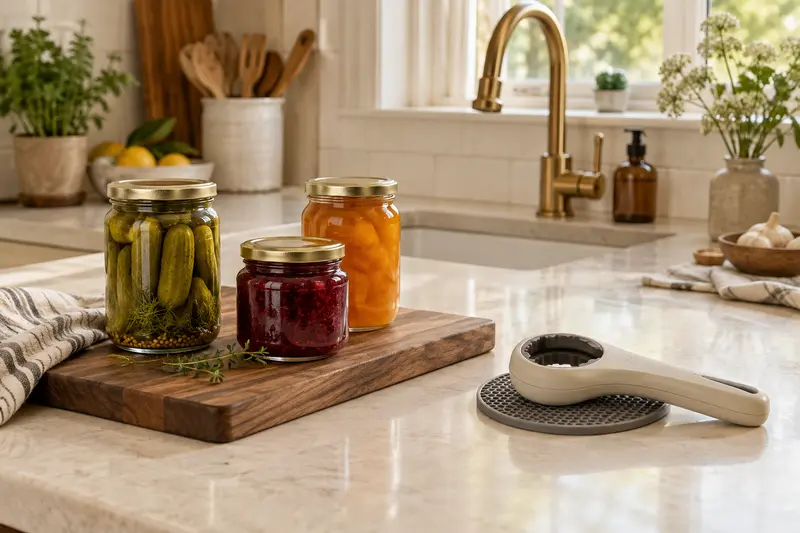
The best jar opener for arthritis or weak hands depends on your grip. A handheld jar opener with a non-slip base pad suits people who can still twist with both hands, an under-cabinet opener suits one-handed use, and an electric jar opener does the twisting for you. Measure your smallest and largest lids, then compare them with the stated size range.
Shortlisted for this decision
Affiliate-
Shortlisted
OXO Good Grips Jar Opener
For various lid sizes, no mounting needed
Graduated teeth for a range of lid sizes plus a separate non-slip pad, with no mounting or batteries needed.
Check price on AmazonCheck first: Still needs some twisting strength in both hands; very weak grips may need an under-cabinet or electric type.
Affiliate links: we may earn a commission from qualifying purchases at no extra cost to you. Prices are shown only on Amazon. Amazon.com (US listing). See the full comparison ↓
Documented options
Jar opener for arthritis: options compared
Options based on manufacturer documentation. Retailer links are affiliate links: we may earn a commission from qualifying purchases.
Affiliate retailer links
-
OXO Good Grips Jar Opener with Non-Slip Base Pad
Exact variant: Handheld manual opener with base pad
View product details on Amazon — United States -
OXO Good Grips Jar Opener with Non-Slip Base Pad
Exact variant: Handheld manual opener with base pad
View product details on Amazon — Germany -
OXO Good Grips Jar Opener with Non-Slip Base Pad
Exact variant: Handheld manual opener with base pad
View product details on Amazon — France -
OXO Good Grips Jar Opener with Non-Slip Base Pad
Exact variant: Handheld manual opener with base pad
View product details on Amazon — Spain
IN THIS GUIDE
What a jar opener does, and who it helps
Many jar lids are held by a vacuum seal as well as the thread. Breaking that seal takes a firm grip on a small, smooth lid, then a twist through the wrist. That is a hard combination for hands with arthritis, weaker grip or reduced feeling.
Every jar opener does one of three jobs. It adds grip and leverage on the lid, it holds the lid still so you turn the jar, or it does the turning for you. Knowing which job you need narrows the choice quickly.
A good opener also brings back a little independence. Opening a jar of jam or sauce without waiting for help keeps everyday cooking in your own hands.
- People with sore or stiff finger and wrist joints
- Anyone with weaker grip after an injury or illness
- People who can use only one hand well
- Households where one person used to open every jar
Which jar opener type needs the least hand effort?
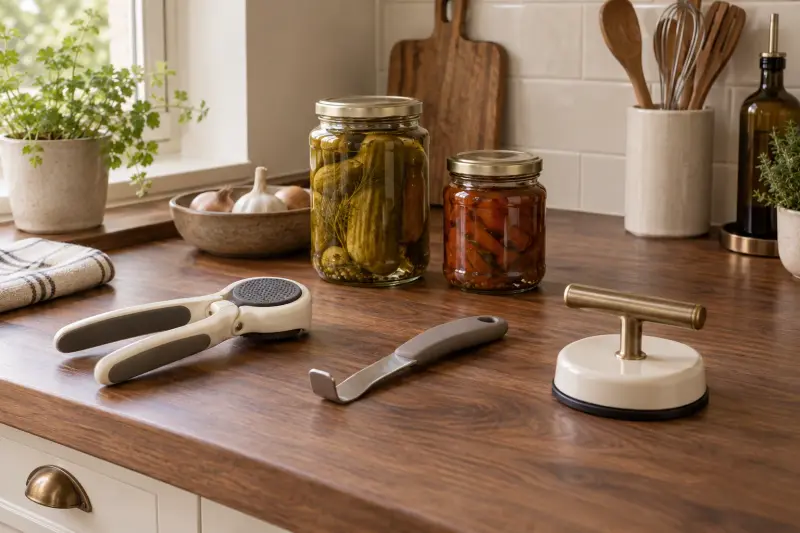
The main types differ in how much hand work they still need. The table compares them on the same four points: hand effort, setup, power and where they can be used.
Mayo Clinic notes that jar openers with larger, cushioned grips ease stress on hand joints, and that a mounted opener is another option. Match the type to what your hands can do on a bad day, not a good one.
Some kitchens keep two tools: a small seal breaker in the drawer for quick jobs, and a larger opener for stubborn lids.
| Type | Hand effort | Setup | Power | Where |
|---|---|---|---|---|
| Handheld with grip pad | Two hands and some twist | None | None | Anywhere |
| Under-cabinet | Holds the lid while one hand turns the jar | Screwed in place | None | One spot only |
| Electric jar opener | A button press and a steady hold on the jar | No mounting | Batteries | Counter |
| Jar key or lid lifter | A small lever breaks the vacuum seal | None | None | Fits a drawer |
| Rubber grip pad | Adds friction only | None | None | Anywhere; the cheapest start |
What lid size does a jar opener fit? Measure before you buy
Most product listings state a lid size range, but few buyers check it against their own jars. A two-minute measuring step avoids the most common mismatch: a tool that cannot close down on spice jars or open wide enough for pickle jars.
Measure straight across the top of the lid, edge to edge, with a ruler or tape. Write down the smallest and the largest lid you open in a normal week, and note any flat, very shallow or plastic lids, which some openers grip poorly.
Then compare your numbers with the stated range. If your largest lid sits right at the upper limit, expect a tighter fit and check the listing photos for how the tool closes on a lid.
- Measure the smallest and largest lids you open each week
- Note flat, shallow, plastic and pop-top lids separately
- Bottle caps and pull-tab cans often need a different tool
- Check space and permission before planning an under-cabinet mount
- For electric models, check battery type and how the cover opens
The OXO handheld jar opener in detail
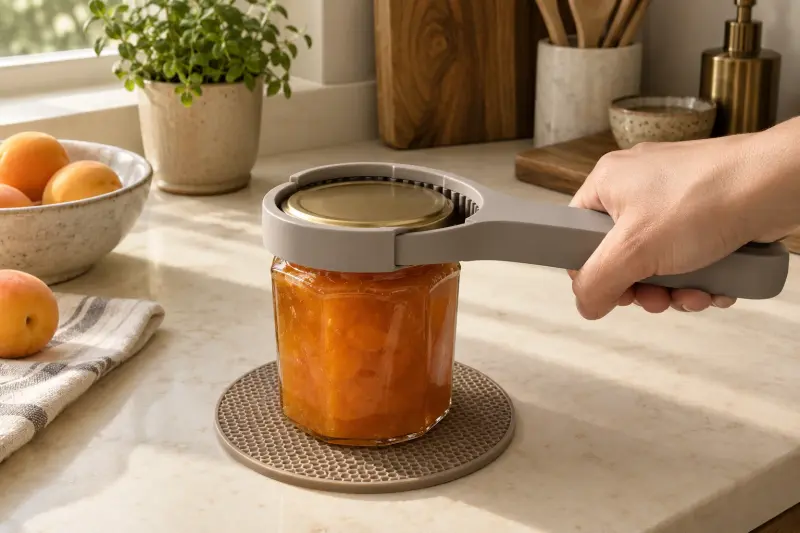
The OXO Good Grips Jar Opener with Base Pad is a handheld opener with graduated teeth and a separate non-slip pad. OXO's page says the teeth fit all size jars and the base pad reduces the force required.
The pad sits under the jar so it does not spin on the counter, while the opener grips the lid. That suits kitchens where mounting a tool is not an option, such as rentals. OXO's page does not list dimensions or care steps, so check the Amazon listing for those details before buying.
- Type: handheld manual opener with a separate base pad
- Grip: graduated teeth to fit a range of lid sizes
- Power and mounting: none needed
- Check first: it still needs some twisting strength in both hands
How to open a stuck jar with less force, step by step
A few steps reduce the force needed, with or without a tool. Breaking the seal first often matters most: Arthritis Society Canada notes that a jar key breaks the vacuum seal, so you do not need as much force to open the lid.
Then use the larger joints. Mayo Clinic advises using large joints as much as possible, and an NHS hand therapy leaflet suggests using the palm rather than the fingers and keeping as much of the hand in contact with the object as you can.
Store jars you use often at counter height, so you are not lifting them from a high shelf before you start. When you close a jar again, turn the lid only until it is snug.
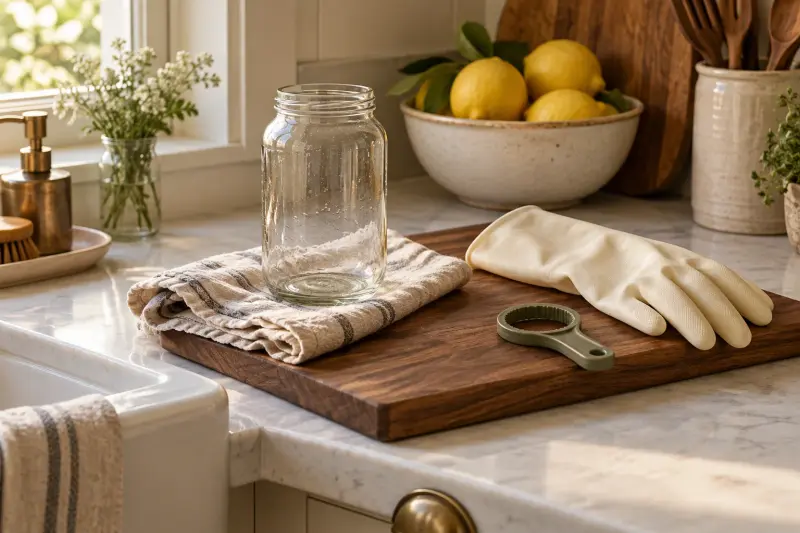
- Step 1: set the jar low on a damp cloth or non-slip mat
- Step 2: break the seal with a jar key or lid lifter
- Step 3: wear a rubber dish glove or use a grip pad on the lid
- Step 4: turn with the flat palm and arm, not the fingertips
- Step 5: stop if a twist causes sharp pain, and ask for help
Jar opener for arthritis: who should get advice first
A jar opener for arthritis can make the kitchen easier, but it does not treat joint pain. If hand pain, swelling or weakness is new or getting worse, speak to a doctor before working around it with gadgets.
An occupational therapist can look at kitchen tasks as a whole, from lids to kettles and pans. They may suggest joint-protection methods and a small set of tools that work together, rather than many single gadgets.
Ask a doctor or local health service how to reach an occupational therapist. A short visit can also cover safe ways to lift pans, pour from a kettle and carry items around the kitchen.
- Pain that lasts after the task is done
- Dropping jars, cups or pans more often
- Numbness or tingling in the fingers
- Trouble with several kitchen tasks, not only lids
- Questions about splints or hand exercises, which need a clinician
MAKE THE SPEND MEANINGFUL
Jar opener for arthritis: low-cost alternatives
- Use a rubber dish glove or a flat silicone grip pad, which many kitchens already have.
- A simple jar key or lid lifter breaks the vacuum seal for very little money.
- Choose foods in squeeze bottles, pouches or flip-top containers where you can.
In brief
Jar opener for arthritis: questions answered
What is the easiest jar opener for weak hands?
The easiest jar opener is the one that removes the movement your hands find hardest. If you can twist but slip, a handheld opener with a grip pad is often enough. If twisting hurts, an under-cabinet opener lets you turn the jar with the arm, and an electric jar opener does the turning for you. An occupational therapist can help match the type to your hands.
Can you open a jar with one hand?
Yes, an under-cabinet jar opener is the usual one-handed option. It is screwed under a cabinet or shelf and holds the lid, so one hand pushes the jar up into it and turns the jar. Check that you are allowed to mount it, that the spot is at a comfortable height, and that your lids fit its stated range.
Do electric jar openers work on every lid size?
No jar opener fits every jar. Electric jar openers state a lid size range, and very small or very large lids, flat lids and some plastic caps may fall outside it. They also need batteries and a steady hold on the jar. Measure the lids you open most and compare them with the stated range before buying.
How do you open a jar without a jar opener?
Break the vacuum seal first, for example with a jar key or a spoon edge slipped under the lid. Then set the jar on a damp cloth or non-slip mat, wear a rubber dish glove for grip, and turn with the flat palm and arm. Stop if a twist causes sharp pain, and ask someone for help instead.
How this guide was prepared
AI-assisted editorial research, checked against the linked primary sources.
Written with AI assistance from the sources listed below and checked against them. We have not tested these products in person.
How we use sources and AI assistance ↗Sources & fact checks
The guide separates sourced facts from editorial questions and examples. How we use sources and AI assistance.
- Mayo Clinic: joint protection for hand arthritis, including jar openers with cushioned grips and mounted openers ↗
- OXO Good Grips Jar Opener with Base Pad: graduated teeth and base pad features ↗
- Arthritis Society Canada: top assistive devices, including the jar key ↗
- St George's University Hospitals NHS: joint protection techniques for hand and finger arthritis ↗
Found an error or an outdated detail? Contact the editorial team.