

In brief
A bath board and a bath seat place the person differently and have different compatibility requirements. Start with the washing and transfer task, then check the bath edge, fixing, support and instructions. An online format comparison cannot select a safe transfer method for you.
Documented options
A clearer comparison.
Research options based on manufacturer documentation. These are not results of hands-on testing. Manufacturer links are informational; no commission relationship is currently active.
IN THIS GUIDE
Begin with the bathing task, not the product shape
A bath board and a bath seat answer different positioning questions. Start by describing the washing routine you want to achieve: a seated wash above the bath, a different supported position within it, or an arrangement suggested after an assessment. The correct choice depends on the person and the actual bath, not which shape looks easiest in an online photograph.
Write down what happens before washing as well as during it. Include getting into the room, approaching the equipment, reaching the controls, using washing items and finishing the routine. If a family member helps, include their task and available space. Do not stage an uncomfortable or unsafe transfer to make the description more detailed.
There is a practical distinction between wanting a bath and wanting to keep an existing bathroom. A person may prefer a quicker shower routine while the household wants to avoid major building work. Both preferences belong in the brief. Buying a board without understanding that distinction can leave the main problem unresolved.
Use this comparison to prepare questions for an occupational therapist or another appropriate equipment professional. It does not teach a transfer technique or certify a product for an individual. Keep any medical or personal details within that professional conversation. For the shopping record, ordinary task descriptions and confirmed equipment requirements are generally more useful than a public diagnosis.
Understand what board and seat descriptions leave unanswered
A board typically spans the bath using its specified supporting and securing arrangement. A product described as a bath seat may place the sitting surface differently, and different seats have different mounting systems. Do not assume that a seat is simply a smaller board or that two products share a fixing method because retailers place them in one category.
The name also tells you little about how the person reaches the washing position. That is why a side-by-side photograph cannot settle transfer suitability. Ask the assessor to explain which format is relevant to the person's task and which requirements must be met before the equipment is considered. Keep that explanation separate from the seller's feature list.
A handle can be an approved part of a particular board, but its presence is not permission for every movement you might imagine. Nor does a textured surface replace the need to understand instructions, positioning and compatibility. Compare the complete configured product, including any support or accessory that the assessed arrangement requires.

Etac's Fresh international page provides a concrete board example with multiple lengths and versions with or without a handle. We use it to show why variant identity matters, not as a recommendation that it suits your bath. A local supplier must confirm the appropriate documentation, regional configuration and the individual arrangement before an order is placed.
Record the bath as a set of distinct measurements
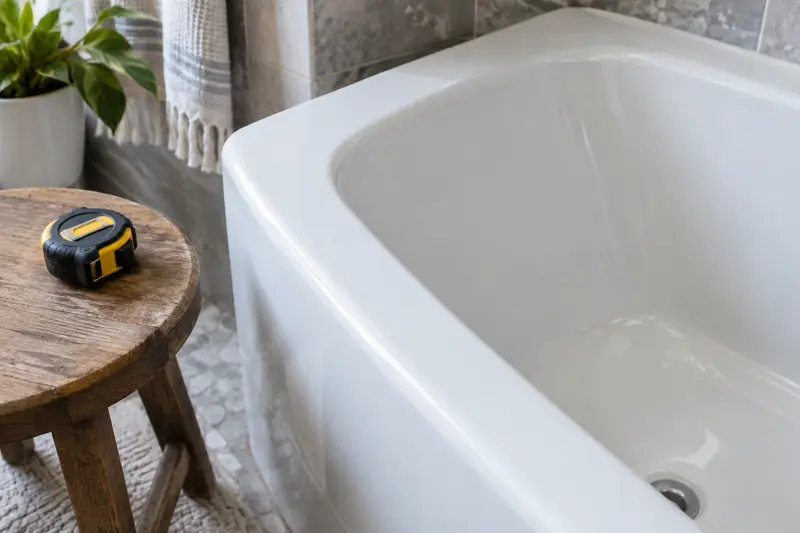
A bath has more than one width. The outside width, the opening, the supporting edges and the distance relevant to a fixing system are different measurements. Ask the supplier which measurement the exact product needs and where it must be taken. A broad tape measurement across the room or the bath's marketing size will not answer that question.
Record the bath's shape and any unusual edge arrangement. Include curves, surrounding tiling, fittings, a shower screen or other features that may affect the equipment's permitted support area. Photographs can help a provider understand the layout, but do not send private paperwork or a person bathing. A simple annotated picture of the empty bath is enough for an initial question.
Get appropriate help if measuring would involve awkward leaning, climbing or moving equipment. The aim is useful information, not a test of ability. If a measurement cannot be obtained comfortably, mark it as unconfirmed and ask whether the provider can survey it. Guessing a difficult dimension just to complete an online form creates false confidence.
Write units beside every number. A measurement of 62 centimetres must not be compared casually with a range shown in millimetres. Conversion is straightforward arithmetic, but it cannot determine whether you measured the correct supporting dimension. Keep a column for the measurement definition and who confirmed it, alongside the number itself.
Keep overall length separate from the securing range
The Fresh variant table illustrates an important purchasing distinction. Its 69-centimetre board has an edge-stop adjustment range of 390–636 millimetres; the 74-centimetre board lists 432–686 millimetres. Those figures refer to different properties. They do not say that every bath within an overall board length is compatible, or that a bigger board is always the better choice.
For a purely arithmetic example, imagine the provider has confirmed that the relevant measured distance is 620 millimetres. That number falls within both quoted adjustment ranges. The worksheet should therefore say “range comparison passed, other requirements unconfirmed.” It should not select either board or announce that both installations are suitable.
Now imagine a confirmed relevant distance of 420 millimetres. It falls within the shorter board's stated adjustment range but below the longer board's stated minimum. Choosing the longer product because it appears more substantial would not solve that mismatch. The example demonstrates how a minimum can matter just as much as a maximum.
These are illustrative calculations, not instructions for installing Fresh. Ask the supplier to confirm the exact item, current manual, allowed bath surfaces and all relevant fit conditions. A number inside a range is one piece of evidence. Shape, support, setup and personal suitability remain separate questions, and regional product data may require an additional check.
Discuss the occupied position and everything within reach
Once a format is relevant, consider its occupied position as part of the routine. Ask what the person needs to reach while seated and whether controls, soap, towels and the shower handset are arranged appropriately. A board that fits the bath can still leave everyday items in an inconvenient place. That is a layout issue requiring attention before purchase.
Describe current difficulties concretely. “The shampoo is behind the screen” gives a provider more useful information than “the bathroom is inaccessible.” Do not prescribe a new reaching movement yourself. If a position or reach raises concern, put it on the assessment list rather than trying it repeatedly to see whether it becomes easier.
A holder or organizer may solve a confirmed item-placement problem, but treat it as a separate accessory with its own mounting and load instructions. Storage fixtures must not become improvised body supports. Keep any assessed rail, approved handle or other support available rather than placing bottles where they interfere with its use.
For a shared bath, record what another household member needs and how the equipment affects them. The right arrangement might require a documented removal and replacement routine, or a different solution entirely. Do not assume that “removable” means every family member can handle and reset the equipment correctly without instruction. Shared use is part of the buying brief.
Identify who configures the equipment and confirms the arrangement
An online order may supply a product in a box while a local service supplies equipment, setup and instruction. These are different scopes. Ask what the quote includes before comparing totals. A lower product-only amount is not automatically a cheaper complete solution if essential assessment, fitting or instruction must be arranged separately.
Name the person or service responsible for configuration. Ask whether they will confirm the bath measurements, supplied components and final arrangement. If the product comes through a service, check whether it remains service-owned and who may change it. A household should not modify provided equipment just because an accessory appears interchangeable.
Keep the current applicable instructions with the equipment record. Ask the provider to explain any steps that the user or helper is expected to carry out, and how to obtain further help. This article does not reproduce assembly sequences, prescribe tightening methods or suggest a body-weight test. Those belong to the exact documentation and appropriate professional support.
At handover, record which setup is approved and what remains unresolved. A message such as “bath compatible, personal assessment pending” is different from “ready for the agreed routine.” Clear wording prevents a family member from assuming that delivery itself completed every necessary check. The purchase should follow confirmed responsibilities rather than fill a gap in them.
Use a three-column comparison instead of a best-product ranking
Make three columns headed task, product evidence and confirmation needed. Under task, write the relevant bathing position and any assistance requirement. Under evidence, record the exact variant, required fit measurement, supplied parts and applicable manual. Under confirmation, list the named provider question that remains. This format makes a mismatch visible before cost or appearance dominates.

For candidate A, a complete manual and appropriate adjustment range may be available while the transfer question remains open. Candidate B may have a tempting photograph but no documented supporting range. Those candidates are not tied. The first has a specific outstanding assessment question; the second lacks basic purchasing evidence and needs supplier clarification before it belongs on the shortlist.
Avoid awarding points for handles, slots or a high load figure without understanding their purpose. A maximum-user-weight specification is a limit of a named product under its instructions, not a score for comfort, transfer suitability or bath compatibility. A product with a larger number does not automatically offer a better arrangement for the person.
Finish with one of three outcomes: relevant and confirmed for the next purchasing step; relevant but waiting for a named answer; or excluded because a requirement is not met. This is a decision record, not a safety certificate. The value lies in showing exactly why you are buying, waiting or choosing a different assessed solution.
Worked example: the handle question changes the shopping brief
Consider a fictional household shopping for a board to use with an existing bath and shower. The family initially writes “buy the longest board with a handle.” The intended user instead says that reaching washing items is the main frustration and that they want to understand the supported position before choosing equipment. That changes the brief immediately.
The household prepares an empty-bath photograph and asks the provider which dimensions to collect. They record a confirmed relevant distance and the bath-edge details, then request exact variant documentation from two suppliers. One quote includes only the board. The other includes the confirmed configuration and a stated setup appointment. The totals cannot be compared fairly until the scopes are aligned.
During the assessment conversation, the provider addresses the user's position and the role of any handle. The household does not decide that the handle is optional merely because a version without it costs less. Equally, it does not add an unrelated rail or cushion to make the order feel more complete. The configuration follows the assessed requirement.
The final worksheet also places washing items in a separately reviewed arrangement and identifies who will manage care. This example does not show a transfer technique or conclude that a board was selected. It demonstrates a better purchasing process: listen to the user, obtain relevant measurements, establish configuration, align quote scope and resolve the routine before paying.
Check cleaning and replacement parts before buying
Care is part of suitability for a household. Ask how the exact board or seat is cleaned, inspected and stored under its current instructions. Consider who can perform those tasks comfortably. If the routine depends on removing equipment that the household cannot manage, explain that before purchase and ask the provider about the appropriate arrangement.

Use the named manufacturer's care information only for the covered product. A cleaning method for one plastic component must not be transferred to another seat, fixing or coating. Avoid homemade combinations of chemicals or a general internet disinfecting recipe. Where a supplied service gives care instructions, keep those instructions alongside the product manual and ask about any apparent conflict.
Find the replacement-part route while the model is easy to identify. Record the exact item number and approved configuration, not just “white bath board.” A worn or missing component should prompt a manufacturer or provider enquiry. A similar-looking stop or handle from another product is not an established substitute, even when a marketplace listing says it fits many models.
Keep a short care record with date, observation, advice and action. Do not invent a universal weekly replacement interval. The applicable instructions and provider determine the routine. If damage, movement or an unexplained change is suspected, stop using the questionable arrangement and seek guidance rather than continuing while comparing replacement offers.
Compare the complete order and avoid unnecessary extras
Create separate lines for equipment, approved components, assessment or survey, setup, delivery and any agreed follow-up. Ask which amounts are firm and which depend on further confirmation. We do not publish assumed prices: the relevant seller, region and service scope need a current written quote. A cost table is useful without pretending that one universal price exists.
Check the included handle or other named component against the agreed configuration. Product images sometimes show accessories while the chosen item description covers a different version. Ask for the actual item number on the order confirmation. Avoid paying twice for a component supplied in the selected configuration, and do not remove a required component to reduce the headline total.
Read return conditions before opening or using equipment. Ask how hygiene restrictions, customization or service-provided items affect returns in the seller's actual market. Do not assume that another retailer's policy or a general consumer guide guarantees a refund after installation. Save the written terms and ask the seller about uncertain wording before proceeding.
The low-cost alternative may be to retain an existing appropriate assessed arrangement, seek service provision, or solve a separate storage issue without replacing bathing equipment. A board is not a budget substitute for a bath lift or building adaptation where those answer a different assessed need. Saving means buying the smallest suitable scope, not buying an unsuitable category.
Useful questions when a retailer answer is vague
If a seller says “fits standard baths,” ask what standard means for the named item. Request the actual supporting and adjustment requirements and the manual that applies to the supplied variant. The phrase may be convenient sales language, but it does not replace a bath-specific answer. An unresolved fit question should remain unresolved in your worksheet.

If the answer is “everyone uses it this way,” bring the discussion back to the permitted arrangement and your appropriate assessment. Popularity, photographs and customer reviews cannot establish your transfer requirements. Ask who can address the personal question and whether the seller offers a suitable assessment or refers to a qualified local service.
If a seller recommends additional equipment, ask which recorded task it addresses, whether it is approved with the main product and who confirms its positioning. An accessory may be useful, but it should have a reason. “You may need it later” is not enough to order a bundle that changes the routine or occupies already limited space.
Finally, ask how the seller will document any important answer. An email identifying the model, variant and specific question is more useful than a broad chat reassurance. Keep those records privately with the order. If the response contradicts the current manual, ask the manufacturer or responsible provider to clarify before purchase rather than choosing the more convenient explanation.
Your final bath-equipment decision card
Finish a one-page card with six entries: desired washing routine, relevant assessed format, confirmed bath requirements, exact equipment configuration, setup responsibility and care plan. Add the date and the person or service supplying each confirmation. This gives a new helper or supplier enough context to understand the decision without collecting unnecessary private health details.
For measurements, retain both the value and its definition. For product evidence, keep the document or manufacturer link and the item identifier. For personal suitability, retain the appropriate professional advice privately. Separating those evidence types stops a product specification from being mistaken for personal assessment, or a survey measurement from being mistaken for completed setup.
Use a clear next action at the bottom. It might be “ask supplier to confirm the supporting surface,” “arrange assessment,” or “order the documented configuration.” If several essential questions remain, choose the first one that unlocks the others. A long shopping shortlist is less useful than one well-framed question about an unresolved requirement.
After the arrangement is supplied, keep related accessory shopping tied to the confirmed routine. Our shower-handset and bathroom-storage guides can help organize separate purchasing questions, but they do not upgrade or certify the bathing arrangement. The best outcome is a documented solution the household understands, including when no new purchase is appropriate.
MAKE THE SPEND MEANINGFUL
Before adding to the basket.
- Retain an existing appropriate assessed bathing arrangement if it meets the task.
- Ask the relevant service about assessment and provision before paying privately.
- Solve a confirmed item-reach issue with suitable existing storage when equipment replacement is unnecessary.
- Buy only the documented format and approved components; a cheaper category is not a substitute for another assessed need.
How this guide was prepared
AI-assisted editorial research, checked against the linked primary sources. Product testing and a credentialed individual review are not claimed.
AI-assisted, source-checked editorial; no hands-on test, human expert review or personal suitability assessment claimed
How we use sources and AI assistance ↗Sources & fact checks
The guide separates sourced facts from editorial questions and examples. We have not claimed hands-on product testing. How we use sources and AI assistance.
Found an error or an outdated detail? Contact the editorial team.