

In brief
Plan the approved power connection and the visible cable route before placing a lift recliner. Cables must remain clear of the moving mechanism and everyday routes, with any socket changes handled by a qualified electrician.
IN THIS GUIDE
Plan the room before choosing cable accessories
A lift recliner’s electrical arrangement starts with its intended position and the actual product instructions. A neat-looking cable is not necessarily an approved cable route. Before delivery, draw the chair, nearby furniture, available sockets and the household’s normal passages. Leave equipment-specific routing and connection decisions to the supplier or responsible provider.
The cited US-published Pride manual carries a prescription-use sale caution and describes provider involvement. For other markets, obtain the local device documentation rather than infer the requirements from this US reference. Those restrictions concern the applicable equipment and market; they are not a universal classification of every chair sold worldwide. Resolve personal suitability and product selection separately from this room-planning exercise. A clear cable route does not establish that a chair suits its user.
Write down the location of the chosen chair’s power connection and any separate external power unit from the supplier’s documentation. Ask how the proposed room position will meet the instructions. Do not order a longer lead, replacement transformer or generic battery simply because a photograph makes the setup look straightforward.
For example, a household likes a chair beside a window but the available socket is across the everyday route to the kitchen. The first planning question is whether a different approved chair position or an assessed electrical installation change can resolve that conflict. Covering a lead after it has crossed the passage does not answer whether the underlying arrangement is appropriate.
Draw mains, chair and control cables separately
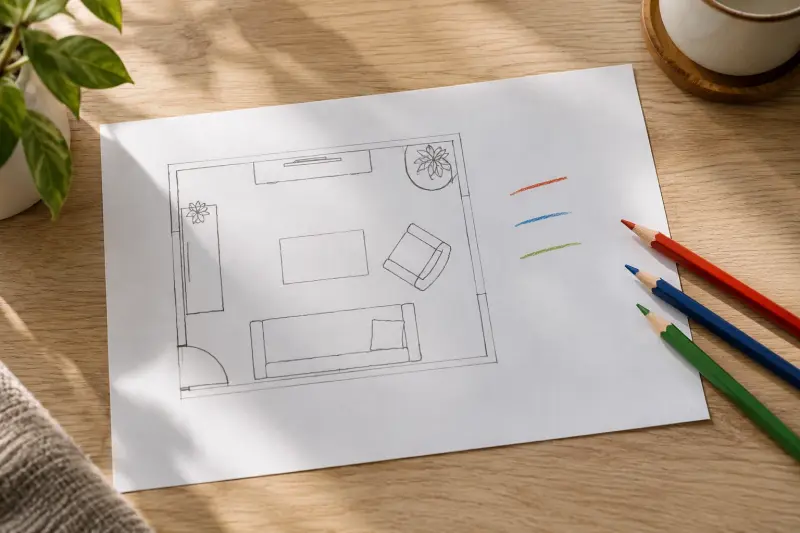
Make a simple three-part sketch: the mains supply to the power equipment, the supplied connection from that equipment to the chair, and the chair’s hand-control cable if one is present. Other models may have additional connections or a different arrangement. Ask the provider to identify the actual components rather than transferring a diagram from a different chair.
Use different colours on the sketch so a proposed route is easy to discuss. Mark where the provider says each component belongs and which parts move during approved operation. Record any slack or support requirements as supplied instructions, not measurements you have invented. Do not enter the underside of the mechanism to discover connections yourself.
Add furniture legs, radiator positions, rug edges and the ordinary direction of travel. Include the route used by someone assisting the reader. A drawing that shows only the chair and a socket misses the places where a foot, vacuum cleaner or moving table may meet the cables during daily use.
In a hypothetical room, the power unit can sit near the wall under an approved open arrangement, while a hand-control cable needs a different path beside the chair. Treating both as one bundle could obscure their different jobs. Use the sketch to ask better questions at delivery, then retain the provider’s final instructions for the installed product.

Check the exact supply instructions and market
Read the manual for the ordered model and regional version. Pride’s current US and Canada VivaLift insert prohibits extension-cord use for the covered equipment. That instruction is a product-family example, not permission to create a substitute arrangement for another model. Ask the supplier to confirm the approved setup for the chair actually being delivered.
Record the manual title, revision where available and model identifiers. The supply requirements should refer to the same equipment as the order. If an online document describes a different market or older configuration, ask which instructions apply. Similar upholstery and controls do not prove that electrical components or connection requirements are identical.
Do not modify plugs, splice cables, open a power unit or attach a generic transformer to solve a room-layout problem. A connector that appears to fit is not evidence of compatibility. Any proposed replacement part or separate power accessory needs the responsible supplier’s confirmation and the exact applicable documentation.
If the approved arrangement cannot reach an appropriate socket, pause that placement plan. Ask whether another chair position works or whether an electrician should assess a suitable installation change. This article does not provide wiring instructions, component ratings or a do-it-yourself conversion. The buying decision is about obtaining the correct arrangement before spending on accessories that may never be usable.
Check the complete movement area with the provider
The cable route must be considered alongside the chair’s full approved movement, not just its upright outline. Ask the delivery or service provider to check the installed configuration through the relevant positions, with appropriate attention to the reader and any helper. Do not put yourself beneath a moving chair or reach into its mechanism to watch what happens.
Mark the movement area on the room plan using confirmed product information and the provider’s guidance. Include the footrest, back movement and lift position where applicable. A cable, table or lamp that clears the upright chair may enter the movement area later. Avoid declaring a route safe because the chair has moved once without an obvious problem.
Keep movable objects on the drawing. A laundry basket, newspaper stack or visiting chair can change the arrangement even when the recliner remains in the same position. Ask the household to keep the provider-established area clear, and store objects somewhere that does not depend on remembering to move them before every operation.
Imagine a lamp base sits outside the chair footprint but its cord loops toward the footrest. The useful correction is an approved layout that keeps the cord outside the relevant area, not repeatedly pulling it aside by hand. This is an illustrative planning conflict, not a tested installation or a suggested universal clearance measurement.
Keep power equipment accessible as instructed
Ask where any external power unit is intended to sit and how its location should be maintained. Pride’s general US and Canada manual calls for an open, ventilated transformer location clear of pinch points. Follow the exact instructions for the supplied equipment rather than concealing it under upholstery or placing it inside a decorative container.
Furniture styling can accidentally conflict with those requirements. A basket that hides cables may also hide equipment, a throw can cover a component, and a side table may be moved against it. Record the provider-approved location in a simple photograph or sketch so the household knows which area should remain available.
Ask who should be able to access the equipment for routine instructions or a service visit. Accessibility does not mean the reader should handle electrical components during chair movement. It means the agreed arrangement can be understood and maintained without improvised relocation or climbing over furniture. Confirm any user actions through the actual manual.
For example, a family prefers a clear floor and considers putting the power unit in a lidded box. Before buying the box, they ask the provider whether the proposal meets the instructions. If it does not, another furniture arrangement may solve the appearance concern. The accessory has no value if it creates a new conflict with the approved equipment placement.
Include walking, assistance and cleaning routes
Trace the routes people actually use: from the chair to the door, around a side table, toward a walking aid and along the route used by a helper. Include the movements involved in reaching a light switch or retrieving something from storage. This planning exercise does not prescribe transfers or determine a safe walking route for an individual.
Ask the provider or relevant professional to review any conflict involving the reader’s movement or support needs. A household may notice that a cable crosses a passage; deciding how a particular person should move around equipment can require individual guidance. Avoid using this guide to replace an assessment or to encourage someone to step over a lead.
Cleaning adds another practical question. Can the ordinary cleaning route remain clear without dragging cables, pushing the chair or disturbing its approved layout? Ask which visible areas can be cleaned under the supplied instructions and what needs provider help. Do not treat an accessible floor as permission to dismantle components or clean beneath the mechanism.
Consider a hypothetical room with a narrow passage beside the chair. Routing another device’s cable through that passage to preserve a tidy wall may simply transfer the problem from the recliner to the lamp. Draw the whole arrangement. A useful solution addresses the reader’s actual room, rather than tidying one cable at the expense of another route.
Plan the other powered items beside the chair
List the lamp, phone charger, heated accessory or other electrical items intended near the chair. Each has its own instructions and cable route. Do not assume that a chair’s USB port, nearby adapter or available socket makes every combination suitable. Ask about the exact devices rather than counting only how many plugs physically fit.
For a phone, consider where it rests and whether its lead can pull across the chair’s movement or the route used to stand. A shorter ordinary charging session in another appropriate location might remove a daily cable conflict. This article does not specify replacement cables, electrical ratings or permitted charging arrangements for unverified equipment.

For a lamp, draw the base and cord as well as the beam direction. A useful reading position should not require the lamp to enter the chair’s operating area. Confirm the lamp’s own instructions and the chair’s layout together. A conveniently placed switch does not compensate for an unsuitable cord route.
If multiple items depend on one wall socket, ask an electrician or responsible provider about the actual installation and approved connections. Electrical Safety First’s UK guidance warns against overloading sockets and chaining extension leads. That is general UK guidance, not an exception to a recliner manufacturer’s extension prohibition. A product-specific restriction remains a separate requirement to resolve.
Buy a cable organizer only for a confirmed purpose
Define the task before shopping: keeping an approved stationary cable visible and orderly, protecting an appropriate route or storing an unrelated charger when it is not in use. The provider must confirm whether a proposed organizer suits the chair’s arrangement. A generic product description cannot establish that it belongs on a moving mechanism or around the supplied wiring.
Avoid bundling different cables together simply for symmetry. Ask whether they need to move separately, remain accessible or avoid a particular part of the chair. Do not attach a clip to upholstery, a frame or a component without the applicable instructions and approval. “Removable” and “no drilling” do not prove compatibility.
Floor covers create their own physical shape. Mark the proposed cover on the room plan and ask whether it interferes with movement, cleaning or the reader’s route. Do not describe a cable cover as eliminating a trip risk or making any crossed passage suitable. If the route itself is inappropriate, a tidy accessory does not resolve it.
A hypothetical household finds that changing the side table’s position allows the approved route to remain against the wall. They may no longer need the organizer in their shopping basket. That is a successful outcome. Compare an accessory with no purchase and with a suitable furniture change, rather than treating every powered chair as a reason to buy a cable-management bundle.
Give an electrician the problem, not a guessed solution
If the room needs a different socket arrangement, describe the proposed chair position, supplied equipment, product instructions and other electrical items nearby. Ask a qualified electrician to assess the installation. Do not decide the wiring, circuit changes or component specifications through a shopping comparison. The electrician’s work and the chair provider’s product setup are related but distinct tasks.
Keep the applicable manual available for that conversation. A request for a nearby socket is more useful when the professional can see the equipment’s requirements. Ask who confirms that the final location allows the supplier’s approved arrangement. Do not assume that moving a socket automatically resolves furniture clearance or personal access.
For UK readers, Electrical Safety First identifies signs such as burn marks, crackling, repeated protective-device trips or excessive heat as reasons for action and appropriate help. Follow its guidance and the product instructions if a warning sign appears; avoid continuing to use the setup merely because the chair still moves. This is not a remote diagnosis.

Before arranging work, obtain a written description of the proposed service and confirm practical access, timing and any building or landlord approval that applies. Those are planning questions, not a claim about universal tenancy rules. Coordinate delivery after the arrangement has been resolved, rather than accepting a chair first and improvising the connection until an appointment becomes available.
Keep the approved layout as part of the handover
At handover, ask the provider to explain the installed route in ordinary language. Identify the supplied equipment and the contact for a damaged cable, movement problem or uncertain connection. Record the relevant manual, chair identifiers and any written placement instructions. A short, usable record is more valuable than a photograph that nobody can interpret later.
Photograph the visible final layout where appropriate, avoiding private household information if images will be shared. Include the intended power-unit location, nearby furniture and the passage. Do not photograph beneath the chair by entering a dangerous position, or treat a photograph as a technical inspection certificate. Its role is to preserve the agreed arrangement.
Ask which ordinary changes the household can make and which require the provider’s advice. Can a side table move within a particular area? What should happen if the chair needs to be relocated? If the instruction is unclear, keep it as an open question. Do not infer permission from silence or from the chair’s apparent ease of movement.
In a hypothetical handover, a family member who was absent will help with housekeeping later. A labelled room sketch can explain why the power unit should not be placed in a storage basket. That prevents well-intended tidying from changing the setup. Use a copy of the record near the equipment instructions, with a digital copy available for service enquiries.
Revisit the plan when the room changes
A cable plan belongs to a room arrangement, not permanently to an address. A new side table, seasonal decoration, rug, lamp or storage basket can change the relevant clearances. Review the visible layout when those changes occur. Ask the provider about any proposed chair relocation rather than moving it first and attempting to recreate the cables afterwards.
Visitors can create temporary changes too. Additional chairs, bags and charging leads may occupy places normally kept clear. Explain the established arrangement without turning the room into an intimidating warning zone. Ordinary, accessible storage for bags and spare leads can make the correct layout easier to maintain.
If a cable looks damaged or a connection becomes unreliable, follow the exact product instructions and contact the appropriate support provider. Do not diagnose the problem by opening a component or purchasing a replacement that appears similar. Record when the change was noticed and the chair identifiers to make the enquiry useful.
For example, an otherwise appropriate lamp is replaced with one whose base and lead sit differently. The household should review the combined chair-and-lamp plan, not assume the previous approval applies to every lamp. This is why the guide asks for named components and a visible record. A small room change can require a fresh practical check even when the chair itself is unchanged.

Finish with questions that prevent unnecessary purchases
Your final question card should identify the exact chair and manual, intended position, available socket, supplied power equipment, other nearby devices and any route conflict. Add who will resolve each open item: supplier, service provider, relevant professional or electrician. Do not replace those questions with a numerical safety score.
Before buying an organizer, ask what problem it solves and whether the proposed placement is approved. Before buying any power accessory, ask whether the actual product documentation permits it. Before moving furniture, consider the full operating area and the reader’s routes. These questions keep the decision tied to evidence instead of a photograph of a tidy showroom.
A no-purchase result may be a better furniture position, keeping an existing approved route clear or charging a phone elsewhere. A paid result may be an appropriate installation change or a supplier-approved accessory. This article does not claim one is always cheaper; it makes their purposes explicit so you can obtain meaningful quotes.
The finished room should allow the applicable equipment instructions to be followed without routine improvisation. Keep the handover record and support contact available, and revisit the arrangement after changes. We have not inspected your room or tested a product. The value of this guide is a practical plan for the right people to review before a cable accessory becomes another object to manage.
MAKE THE SPEND MEANINGFUL
Before adding to the basket.
- Use another appropriate chair or furniture position if the provider approves it.
- Keep the existing approved arrangement clear instead of buying decorative cable boxes.
- Charge unrelated devices elsewhere when that removes a real cable conflict.
- Request a placement check before paying for an unverified extension or transformer.
How this guide was prepared
AI-assisted editorial research, checked against the linked primary sources. Product testing and a credentialed individual review are not claimed.
AI-assisted, source-checked editorial; no hands-on test, human expert review or personal suitability assessment claimed
How we use sources and AI assistance ↗Sources & fact checks
The guide separates sourced facts from editorial questions and examples. We have not claimed hands-on product testing. How we use sources and AI assistance.
- Pride US-published Lift Chair Series owner manual, revision Y, June 2025; power, moving parts and provider restrictions ↗
- Pride VivaLift insert, revision K, December 2025; exact US/Canada covered configurations ↗
- Electrical Safety First: UK socket overload and electrical warning-sign guidance ↗
Found an error or an outdated detail? Contact the editorial team.