

In brief
A reading pillow props the back up so you can sit in bed with a book, a tablet or a cup of tea. Choose a backrest with arms if the arms need somewhere to rest, or a firm triangle or wedge if the back needs a steadier slope. Check the height against the headboard and make sure the cover comes off for washing.
Documented options
Reading pillow guide: options compared
Options based on manufacturer documentation. Retailer links are affiliate links: we may earn a commission from qualifying purchases.
Affiliate retailer links
-
sleepling Rückenkissen für Bett und Sofa
Exact variant: 70 x 40 x 20 cm, Cord Dunkelgrau
View product details on Amazon — Germany -
sleepling coussin de dossier, lit et canapé
Exact variant: 70 x 40 x 20 cm, as chosen on the listing
View product details on Amazon — France
IN THIS GUIDE
Who a reading pillow helps
Most people who read in bed stack two or three ordinary pillows behind them. They slide apart, the back curls forward and the book drifts toward the chest. A reading pillow gives one steady shape to lean on.
Say your mother likes to read for an hour before sleep and keeps rebuilding her pile of pillows. A backrest with arms holds its shape and gives her elbows a place to rest. Or say your father is spending more time in bed after a hospital stay and wants to sit up for meals and visitors. A firmer backrest can help him sit up for a while, but how long he stays in bed is a question for his care team.
A reading pillow is a comfort aid. It does not hold anyone in place, and someone who keeps sliding down the bed needs more than a cushion.
- Readers who stack loose pillows every night
- People who eat, write or use a tablet sitting up in bed
- Partners who want to sit up without moving the whole bed
- Anyone resting in bed for longer spells, with their care team's advice
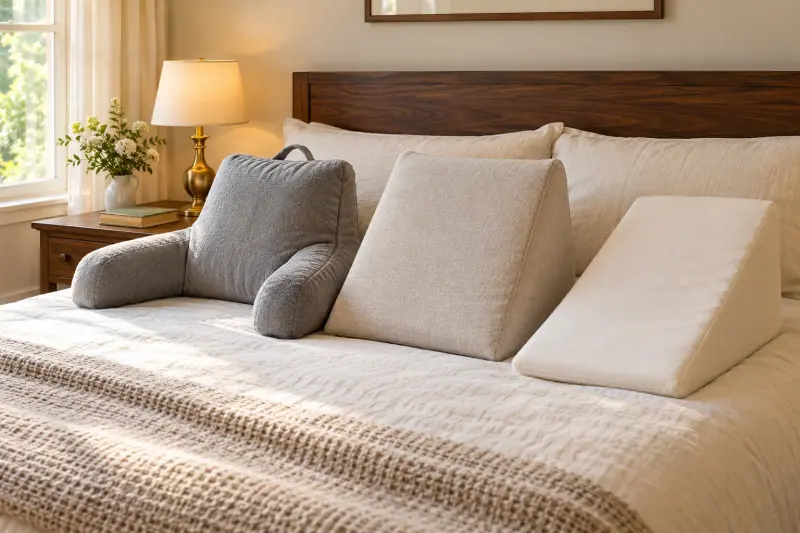
Reading pillow with arms, wedge or triangle: the three types
Reading pillows come in three broad shapes. A backrest with arms looks like the top of an armchair, with a back and two padded arms. A triangle or wedge-shaped backrest is a firm block with one sloping face to lean on. A bed wedge is a long ramp that lifts the whole upper body, and we cover it in its own guide.
A backrest with arms suits someone who reads for a long time and wants support at the sides. Its soft fill shapes to the body, but it is bulky and can flatten over time. A triangle backrest is firmer and simpler to clean, and it gives no arm support.
If the main need is to raise the head and chest for the whole night, a bed wedge or an adjustable bed base does that job. A reading pillow is for sitting up for a while, then lying down again.
- Backrest with arms: side support, soft fill, takes more space
- Triangle backrest: firm slope, no arms, often doubles for the sofa
- Bed wedge: lifts the upper body for sleep, not just for reading
- Adjustable bed: raises the mattress itself at the press of a button
How the two picks compare
We list two products with maker pages we could read. The Husband Pillow Standard+ is a backrest with long padded arms. Its maker says it is filled with shredded memory foam, and a zipper lets you remove some of the foam or add more to change the firmness. It comes with a detachable neck roll, side pockets and a handle on top, and the micro-plush cover unzips to wash cold and tumble dry on low.
The maker's own page gives two different sizes for the Standard+, a listed 18 by 13 by 6 inches and a description of about 18 inches tall and 33 inches wide. Before buying, ask: "What are the height and width of the pillow with the neck roll attached?"
The sleepling Rückenkissen is a triangular backrest for bed and sofa, sold in Germany and France. The maker describes a removable, washable cover, a side pocket and Oeko-Tex fabric. The Amazon listing we checked gives 70 by 40 by 20 cm and a dark gray corduroy cover.
- Husband Pillow Standard+: arms, adjustable foam fill, neck roll, washable cover
- Husband Pillow Standard+: sold on the maker's site; the Amazon listing was not checked
- sleepling Rückenkissen: triangle shape, no arms, washable cover, side pocket
- sleepling Rückenkissen: 70 x 40 x 20 cm on the listing, sold on Amazon.de and Amazon.fr

Setting up to read in bed
An NHS Fife physiotherapy leaflet on looking after the back and neck advises against sitting in bed with the back unsupported. It suggests using cushions on the lap to support the arms and keep a handheld device more upright, so you look at it without bending the neck.
The same leaflet advises changing position or getting up and moving about every 30 minutes. That works well as a reading habit: finish a chapter, shift, stretch, then settle again.
Push the backrest firmly against the headboard or wall before you sit back. If it slides away, a firm pillow behind it or a bed pushed against the wall can stop the gap.
- Sit right back into the pillow, with no gap behind the lower back
- Rest the book or tablet on a cushion or lap desk, not on the chest
- Keep reading glasses, water and the lamp switch within reach
- Change position every half hour or so
Long spells in bed: sliding and skin
Sitting up in bed for many hours brings a different worry. The NHS Borders leaflet on pressure ulcers says they can be caused by sliding down beds or chairs and by rubbing or dragging the skin across a surface.
It names the heels, hips, bottom, base of the spine, elbows and shoulders as the areas most at risk. Skin may look slightly redder, darker or warmer than usual. The leaflet advises changing position regularly, and speaking to the nursing staff if you think you are at risk.
Imagine your father reads in bed most of the afternoon and you notice he has slipped halfway down the pillow each time you look in. Help him back up by lifting, not dragging, and mention it to his nurse or doctor.
- Check heels, bottom and elbows for red, dark or warm patches
- Help someone move up the bed by lifting, not pulling across the sheet
- Keep sheets smooth and dry under a reading pillow
- Ask a nurse about skin checks if someone spends most of the day in bed
When to ask for more than a pillow
If sitting up is hard work every day, or someone cannot move themselves up the bed, an occupational therapist can look at the whole setup. Ask them: "Would a backrest, a bed wedge or an adjustable bed suit this bed and this person?"
An adjustable bed base raises the mattress itself, so there is nothing to slide off. A bed wedge lifts the upper body for sleep. Both are bigger decisions than a pillow, and both are covered in our guides.

- Cannot shift up the bed alone: ask an occupational therapist
- Breathing feels easier only when propped up: tell a doctor
- Red or sore skin that does not fade: speak to a nurse or doctor
- Sitting up for most of the day: ask about an adjustable bed
MAKE THE SPEND MEANINGFUL
Reading pillow guide: low-cost alternatives
- Two firm pillows stood upright and pushed against the headboard
- A sofa cushion behind the lower back, with a pillow on the lap for the arms
- A rolled towel in the small of the back to test where support helps
In brief
Reading pillow guide: questions answered
Is a reading pillow with arms better than a wedge?
They do different jobs. A reading pillow with arms is for sitting up for a while to read, eat or watch TV, with support at the sides for the elbows. A bed wedge is a long ramp that lifts the upper body, often for sleeping. If the need is to stay raised all night, look at a wedge or an adjustable bed instead.
Can you sleep on a reading pillow?
A reading pillow is shaped for sitting upright, not for sleeping. Dozing off against one is common, but a whole night in that position can leave the neck bent and the body slipping down the bed. If someone needs to sleep raised, ask their doctor or an occupational therapist whether a bed wedge or adjustable bed would suit them better.
How do you wash a reading pillow?
Follow the label on your own pillow. For the Husband Pillow Standard+, the maker says to unzip the cover, wash it cold and tumble dry on low. The sleepling backrest has a removable, washable cover. Let any cover dry fully before refitting it, and air the inner cushion in a well-ventilated room now and then.
What size reading pillow do I need?
Measure from the top of the mattress to the top of the headboard or wall. A backrest taller than that may tip forward. Then check the width against the space beside a partner. Size details can be thin or unclear, so ask the seller: "What are the height, width and depth, and is that with or without the neck roll?"
How this guide was prepared
AI-assisted editorial research, checked against the linked primary sources.
Written with AI assistance from the sources listed below and checked against them. We have not tested these products in person.
How we use sources and AI assistance ↗Sources & fact checks
The guide separates sourced facts from editorial questions and examples. How we use sources and AI assistance.
- Husband Pillow: Standard+ backrest with arms ↗
- sleepling: Rückenkissen Keilkissen für Bett und Sofa ↗
- NHS Fife: Looking after my back and neck ↗
- NHS Borders: Preventing pressure ulcers (bedsores) ↗
Found an error or an outdated detail? Contact the editorial team.