
In brief
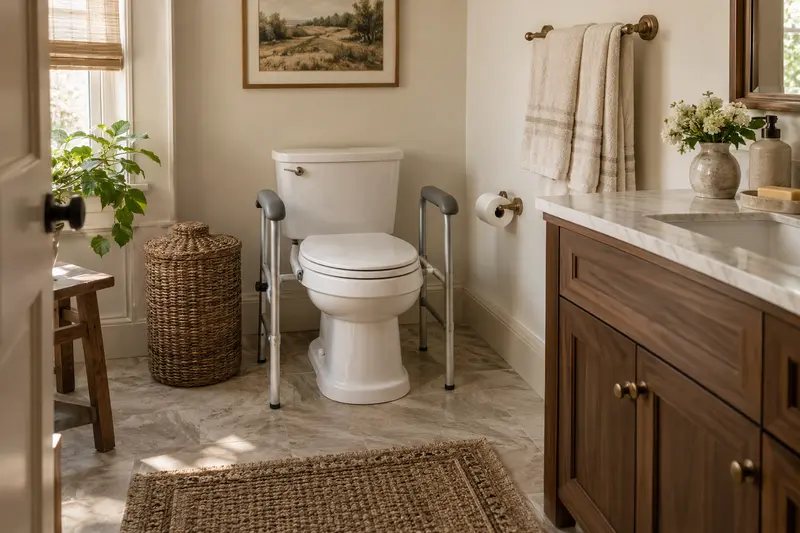
A toilet safety frame is a metal frame with an armrest on each side of the toilet that you push down on when sitting and standing; unlike a raised toilet seat, it does not add height. It suits homes where a wall grab bar is not practical. Measure the space each side of the bowl, check the weight rating and mounting, and test the frame for wobble before first use.
Free tool: Raised toilet seat height calculator ↗
Shortlisted for this decision
Affiliate-
Shortlisted
Vive Compact Toilet Rail
For armrests mounted on the seat bolts
Mounts with the existing seat bolts and adjusts from 18.5 to 21 inches wide, with a 300 lb rating from Vive.
Check price on AmazonCheck first: Check the seat bolts are sound. It adds armrests, not seat height.
-
Shortlisted
Carex Toilet Safety Frame
For adjustable armrests on both sides
Adjustable width and height with cushioned grips and non-slip rubber tips, for armrests on both sides of a standard toilet.
Check price on AmazonCheck first: The maker's page lists no capacity; confirm the listing and measure the space first.
-
Useful companion
Moen Home Care DN7100 shower chair with back and arms
For wide showers, users who want arms
Back and arm rests, a seat 19 in wide by 17.7 in deep, legs adjustable from 15 to 21 in and a stated 400 lb limit, according to Moen.
Check price on AmazonCheck first: The 18 in leg spread plus arms needs a wide, level enclosure floor. Measure the shower before ordering.
Why it is listed: How to choose a shower chair or seat: fit the enclosure and the routine
Affiliate links: we may earn a commission from qualifying purchases at no extra cost to you. Prices are shown only on Amazon. Amazon.com (US listing). See the full comparison ↓
Documented options
Toilet safety frame guide: options compared
Options based on manufacturer documentation. Retailer links are affiliate links: we may earn a commission from qualifying purchases.
Affiliate retailer links
-
Vive Toilet Safety Rail Compact Support Frame
Exact variant: Adjustable grab bar
View product details on Amazon — United States -
Vive Toilet Safety Rail Compact Support Frame
Exact variant: Adjustable grab bar
View product details on Amazon — France
Affiliate retailer links
-
Carex Toilet Safety Frame
Exact variant: Adjustable width, supports 300 lbs per listing
View product details on Amazon — United States
IN THIS GUIDE
What a toilet safety frame is and who it helps
Many people use their arms to lower themselves onto the toilet and to push up again. A toilet safety frame puts a padded armrest on each side, close to the body. That feels steadier than reaching for a towel bar or a sink, which are not made to take weight.
There are two common designs. A freestanding frame stands on four legs around the bowl, while a toilet-mounted rail fixes to the bowl with the seat bolts. Both suit rented homes or walls that cannot take a grab bar, and toilets that sit away from any wall.
A frame is support for the arms, not a lift. British Columbia's safety sheet says a toilet safety frame is designed to give support and stability, not to carry a person's total weight.
- Two armrests to push on, one each side
- Freestanding on legs, or mounted with the seat bolts
- Useful where a wall grab bar cannot be fitted
- Never lean on towel bars, sinks or tank lids
How to measure for toilet safety rails
Measure before you compare frames, because width ranges are fixed by the maker. Use a tape measure and write the numbers down; the steps below take about five minutes.
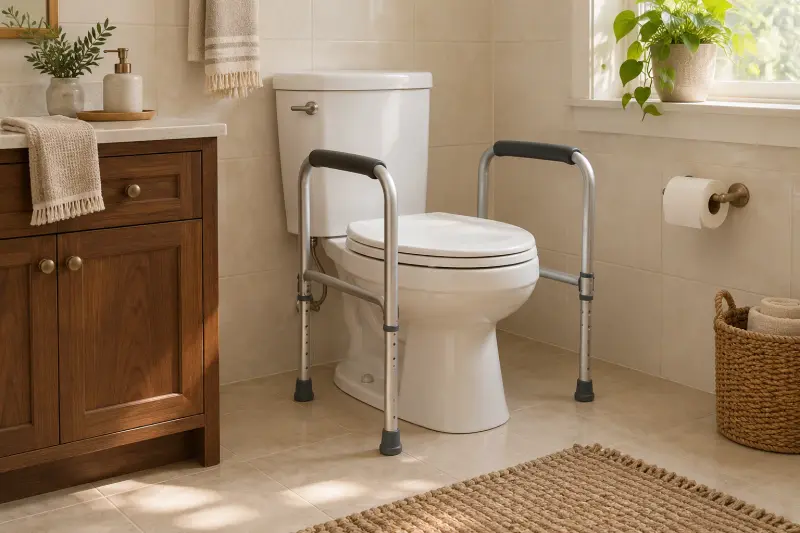
Note the bowl shape and whether the seat bolts are sound. Rails that attach with the seat bolts need firm, uncorroded bolts. Write down the weight the frame must support, with a sensible margin.
Remember the space in front of the toilet too. The user needs room to turn, and a walker or a helper may need to stand close. A frame that fits beside the bowl can still make the room tight if the door swings inward.
- Step 1: clear width from each side of the bowl to the nearest wall, cabinet or tub
- Step 2: comfortable hip width the user needs between the armrests
- Step 3: bowl shape, round or elongated, and the condition of the seat bolts
- Step 4: seat height now, and with any raised seat you plan to add
- Step 5: user weight, with a margin, against the rated capacity
How the Vive and Carex toilet safety frames compare
Both picks give armrests on both sides with adjustable width. They differ in how much the maker publishes. Vive lists a capacity, dimensions and mounting method; Drive Medical's page for the Carex frame gives width and features but no capacity.
The Vive rail mounts with the existing toilet seat bolts. The Carex frame has height adjustment and non-slip rubber tips. Compare each width range with your Step 1 and Step 2 numbers before anything else.
Neither frame raises the seat. If the toilet is low as well as hard to stand from, a raised seat or a seat with arms may be part of the answer. Measure again with any planned seat in place before choosing a frame height, and if the user rests their feet on a footstool, check the toilet stool height against the new seat height too.
- Vive Compact Toilet Rail: width 18.5 to 21 in; 16 in deep, 10 in high; rated 300 lb
- Vive: aluminum frame, latex-free foam grips, mounts with seat bolts; 2-year guarantee
- Carex frame: width 18 to 20 in; height adjustable; Hypalon cushioned grips
- Carex: non-slip rubber tips; capacity not stated on the maker's page
How to fit and use a toilet safety frame, step by step
Follow the maker's instructions first. For a freestanding frame, an NHS fitting leaflet advises removing pedestal mats and loose rugs, placing the frame centrally with the front bar against the bowl, and making sure all four feet touch the floor and are level.
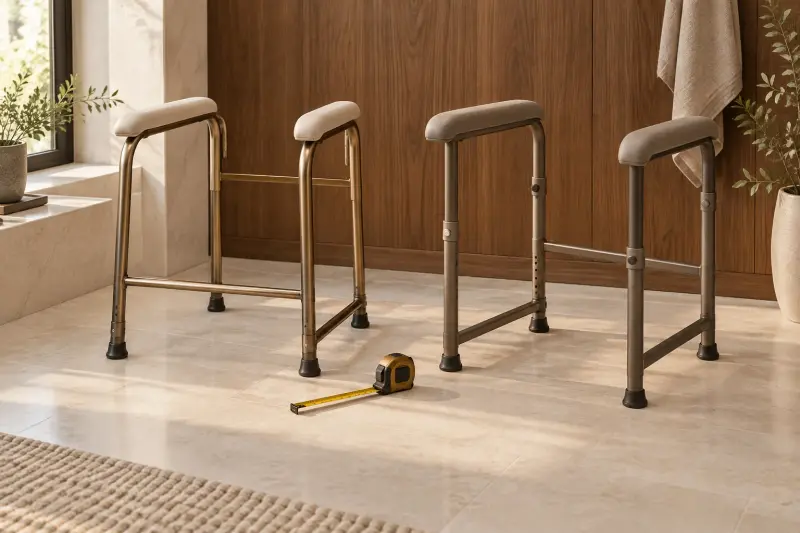
Set both armrests at the same height. British Columbia's sheet says height is set with spring buttons, which must protrude fully through the leg holes, and that the frame should be tested for stability before use.
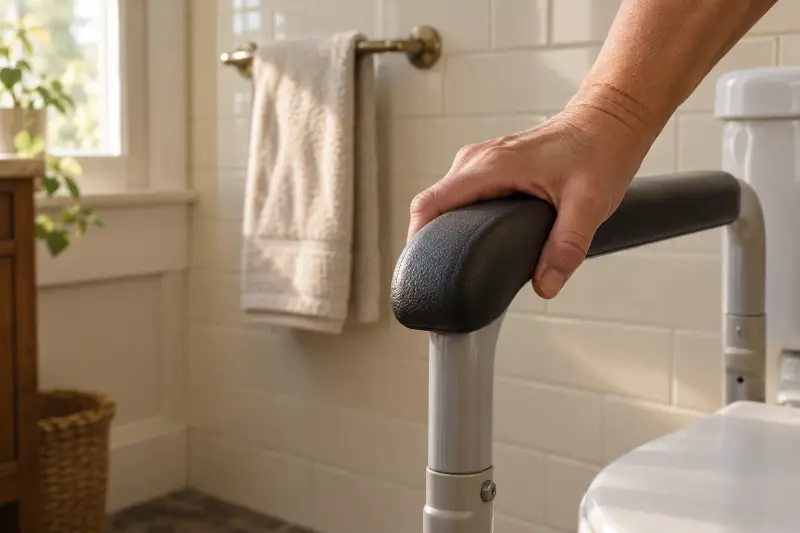
To use it, grip both rails securely and push down on them as you lower yourself and as you rise. Check the fixings each week for the first month, then monthly, and clean the frame with mild household cleaners rather than abrasive powders or scouring pads.
- Remove bath mats and loose rugs from around the toilet
- Center the frame and check all four feet sit level
- Confirm every spring button clicks fully through its hole
- Press down hard on each side before the first use
- Recheck bolts, buttons and padding weekly at first, then monthly
Toilet grab bars for elderly users: frame or wall bar?
A wall grab bar fixed into solid support can be very steady, but it only helps on one side. A frame gives support on both sides and needs no drilling. The CDC's home safety checklist suggests grab bars next to the toilet, and a frame is one way to get support there.
Some people need both. An occupational therapist can suggest the right mix for the person and the room.
Whatever you choose, place support where the hands naturally go when sitting and standing. Watching the user's usual movement, with their permission, shows this better than guessing from a diagram.
- Wall bar: one side, needs solid fixing into studs or blocking
- Frame: two sides, no drilling, takes up floor space
- Suction bars are not a substitute for a fixed bar
- Ask about both if the bathroom is shared
Who should not rely on a frame alone
If standing up from the toilet is getting harder, that change is worth talking about. An occupational therapist or physical therapist can look at seat height, arm support and technique together. After surgery or a fall, follow the care team's advice first.
British Columbia's safety sheet says users with limited physical abilities should be supervised or assisted when using a toilet safety frame. Many areas offer home assessments through health or aging services.
Bring the measurements and photos of the bathroom to that conversation. They make it easier to agree on the right equipment in one visit.
- Cannot take most of their weight through the legs: ask for an assessment
- After surgery: follow the discharge advice on equipment
- Recent fall or dizziness on standing: tell a clinician before changing the setup
- Needs a helper to stand: plan the space for that person too
MAKE THE SPEND MEANINGFUL
Toilet safety frame guide: low-cost alternatives
- Ask about loan equipment or local health and aging services, which sometimes provide frames after an assessment.
- A single well-fixed wall grab bar may be enough when only one side of support is needed.
- A raised toilet seat with built-in arms can combine height and support in one item, if it fits your toilet.
In brief
Toilet safety frame guide: questions answered
Is a toilet safety frame or a grab bar better?
Neither is better for everyone, because they do different jobs. A wall grab bar is very steady when fixed into solid support, but helps on one side only. A toilet safety frame gives armrests on both sides with no drilling, but takes floor space. Some people use both. An occupational therapist can suggest the right mix for the person and the room.
Do toilet safety rails fit every toilet?
No, each frame has a set width range, and some attach with the seat bolts. Measure the space beside the bowl, check whether it is round or elongated, and look at the condition of the bolts. Wall-hung toilets, or toilets set close to a wall or tub, may need a different product.
How much weight can a toilet safety frame hold?
It varies by model, so check the maker's stated capacity. Vive lists 300 lb for its Compact Toilet Rail. Drive Medical's page for the Carex frame does not state a capacity, though the Amazon title says 300 lb. Leave a margin above the user's weight, and remember a frame supports the arms rather than the whole body.
How do you install a toilet safety frame?
Follow the maker's instructions, which differ for bolt-mounted rails and freestanding frames. For a freestanding frame, remove loose mats, center it with the front bar against the bowl, set both armrests to the same height and check all four feet sit level. Make sure every spring button clicks fully into place, then press down hard on each side before first use.
How this guide was prepared
AI-assisted editorial research, checked against the linked primary sources.
Written with AI assistance from the sources listed below and checked against them. We have not tested these products in person.
How we use sources and AI assistance ↗Sources & fact checks
The guide separates sourced facts from editorial questions and examples. How we use sources and AI assistance.
- National Institute on Aging: room-by-room home safety ↗
- Government of British Columbia: toilet safety frame use and safety sheet ↗
- Vive Health Compact Toilet Rail: capacity, dimensions and mounting ↗
- Drive Medical Carex Toilet Safety Frame FGB356C0: width and features ↗
- The Dudley Group NHS Foundation Trust: fitting a freestanding toilet frame ↗
- CDC STEADI: Check for Safety home checklist ↗
Found an error or an outdated detail? Contact the editorial team.