
In brief
Ask about internal seat, legroom, controls and the complete entry sequence, then arrange an appropriate demonstration where available. External bath dimensions do not establish personal fit. Keep anything not tried clearly marked rather than accepting a universal comfort claim.
IN THIS GUIDE
Separate external size from internal space
Kohler publishes distinct external-frame, seat and door dimensions for its bath. Those describe different parts of the product; they do not establish how an individual will sit or reach. Confirm the exact offered model and any configuration change rather than using a generic walk-in bath size.
Request an internal drawing with the seat, foot space, controls and handshower positions labeled. Keep nominal product measurements separate from the surveyed room dimensions. Ask the provider to explain where the dimensions are measured, especially when curves or fitted components affect usable space.
Prepare a demonstration agenda
Write the actions the reader wants to understand: approach, enter, turn, sit, use the handle and controls, wash and leave. Include any assistance normally needed. Ask which of those actions can be demonstrated on the actual or equivalent configuration and which remain unresolved.
If a showroom trial is unavailable, mark videos and drawings as indirect information. They may help explain a feature but cannot replace personal access assessment where required. Do not improvise a seat-height test using an unstable object or assume that a comfortable household chair proves bath suitability.
Worked decision: the control looks close in a photo
Suppose the bath photograph shows controls beside the seat, and the reader expects to reach them comfortably. The provider’s diagram identifies their position, but nobody has demonstrated the reader’s complete seated movement. Record that as a reach question rather than turning the photo into a fit conclusion.
Ask for a clear feature demonstration and appropriate advice about the reader’s routine. Another control arrangement or bathing option might be worth considering. Do not select a larger external bath simply on the assumption that it makes every reach task easier; internal geometry and actual use need separate review.
Keep a personal-fit evidence record
Use the rows below to record dimensions, information seen and any assessed concerns. Give the actual user’s comments their own space. A relative’s preference for a premium finish should not override what the reader can comfortably explain about the daily task.
If the important actions remain uncertain, keep the order pending. Existing room photographs and supplier drawings can support the conversation without another purchase. A simpler bathing arrangement may also deserve discussion. The record should reveal uncertainty early, while changes are still possible, rather than promise that a feature-rich bath suits everyone.
- SpaceSeat, legroom, entrance and internal drawing reference.
- ReachHandle, controls and handshower actions actually explained.
- TrialExact configuration tried, indirect evidence and unanswered tasks.
- AssessmentPersonal access question and appropriate follow-up needed.
Read external and internal dimensions as different evidence
Begin with the exact offered bath and its current drawing. Put the exterior frame, internal seat, foot space, usable entrance and control locations in separate rows. Kohler's US dimensions page publishes distinct exterior, seat and door measurements. That narrow product example shows why a single bath length cannot answer all personal-fit questions. Ask the provider to identify where each dimension is measured and how the supplied configuration relates to it.
Keep room fit separate from personal use. An installer may explain that the bath occupies a proposed space, while the reader still needs to understand entering, turning, sitting and reaching. Neither answer replaces the other. A nominal external measurement should not be described as evidence that an individual will fit comfortably. Likewise, an attractive internal photograph cannot establish that the surveyed bathroom approach and exit are suitable.
Ask about curves and fitted components where a simple line measurement leaves a question. The provider can identify the relevant usable space and position on the drawing. Do not subtract arbitrary amounts from a brochure figure to invent an internal clearance, and do not assume a bigger exterior always improves reach. Seat geometry, controls and movement are related but distinct aspects of the actual task that need explanation and appropriate advice.
Describe the user's questions in their own words. They may want to understand foot position, support, reaching the handshower or turning during the normal entry sequence. Record those questions without converting them into a medical diagnosis or an anthropometric formula. A family helper can organize the information with the user's agreement, but should not declare fit from a general percentage or a height range in marketing material.
Finish the dimensional record with confirmed specification, indirect information and unanswered personal-task question labels. A number can be accurately published yet still not answer the individual's routine. This distinction keeps the evidence honest and gives the provider a clear demonstration or explanation request. It also preserves the option to consider another appropriately reviewed bathing arrangement before ordering a feature-rich bath whose essential seat and reach questions remain unresolved.
Prepare a demonstration agenda around actions
Write an agenda covering approach, entry, door use, turning or settling, sitting, reaching controls, using the handshower, washing and leaving. Include assistance if it belongs to the intended routine. Ask which actions the provider can demonstrate on the actual configuration and which need further assessment. The agenda should make the person's questions visible rather than request an unfamiliar movement simply because the product has an open door.
Confirm what equipment and setting are available for a demonstration. Kohler's US FAQ currently states that its bath is not available in a showroom and describes in-home materials instead. That is a provider-specific availability statement, not a rule for the entire market. Ask another provider what it actually offers. Where only diagrams or videos are available, mark them as indirect information rather than claiming the reader has tried the product.
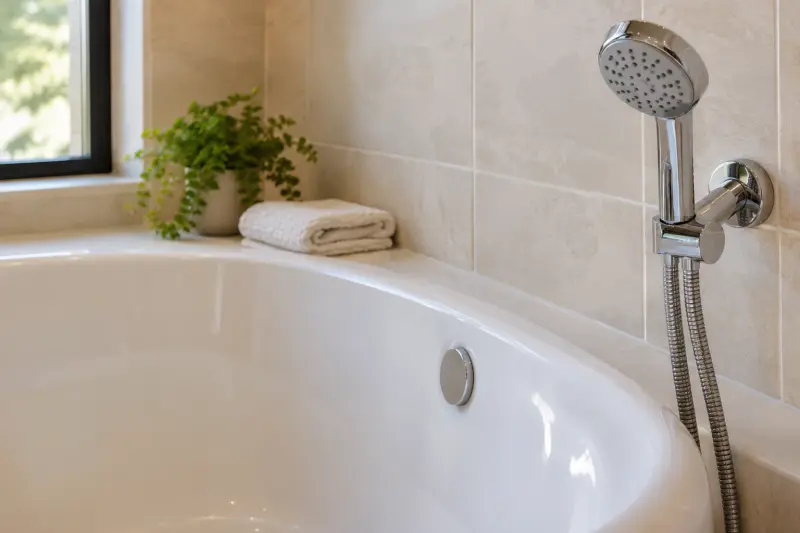
Editorial illustration Ask whether an example configuration differs from the proposed bath. A displayed model may have another orientation, control arrangement or option. Have the provider explain those differences and their relevance. Do not assume a familiar-looking seat makes two variants interchangeable. An equivalent illustration can help explain a concept while leaving the reader's particular action unanswered; retaining that limit is more useful than manufacturing a reassuring trial result.
Give the actual user room to comment after each explanation. A helpful note might say understands control location, still asks about reaching from the intended seated position. Avoid translating hesitation into a fault or translating politeness into a positive review. The provider and appropriate assessor can respond to the precise question. The household record should capture what was understood and what remains, without pretending the website has performed personal testing.
Do not create an improvised bath seat from an unstable object or prescribe a dry transfer exercise in the home. A household chair may be familiar but does not reproduce the bath's internal geometry, entrance or controls. Ask for the appropriate demonstration and advice instead. The no-purchase preparation is a clear agenda and current documents, which can make the next discussion better without an accessory bought solely to simulate an unconfirmed configuration.
Discuss controls, toiletries and assistance as separate reach tasks
List the objects the user expects to reach during the ordinary routine. Include supplied water controls, door handle where relevant, handshower and the items actually used for washing. Ask the provider to show their positions on the selected configuration. A control described as nearby in a photograph still needs to be understood in relation to the intended seated task. This guide gives no universal reach distance or claim that every reader can use the same layout.
Keep supplied controls separate from movable toiletries. A soap location can sometimes be changed within an appropriately reviewed routine, while a fixed control position is part of the bath proposal. Do not recommend an organizer as a way to solve an unanswered control question. Ask the provider which items and surfaces are intended for normal storage and use, then consider existing storage before buying a companion product.
Discuss visual and handling questions in ordinary language. Can the user identify the relevant control and understand the explanation? What part needs a clearer demonstration or readable instruction? These questions do not require the household to invent a capability score. A provider can explain the actual function and an appropriate professional can address personal-task concerns. The current manual remains the source for normal operation rather than a rewritten affiliate summary.
If assistance forms part of the routine, ask which actions are being proposed and where the helper would be. Do not assume a bigger bath or an additional control resolves that arrangement. Space outside the bath, entrance movement and the user's sequence should be discussed together. A helper's willingness matters, but it does not establish that the physical proposal or movement has been appropriately reviewed.

Return to the reader's preference after the reach questions are clearer. A simpler configuration might serve the intended wash, while a different feature may be valued once its task is understood. Avoid equating more controls with better fit. A useful buying decision recognizes the specific job each option performs and its additional care or installation scope, including when an essential unresolved reach question supports another discussion or no order yet.
Worked fit record: the control that looks close in a photograph
Imagine a fictional reader considering a bath whose photograph shows controls beside the seat. The household assumes the position will be comfortable because it looks close. The provider supplies an internal drawing, but nobody has explained the reader's complete seated reach or entry routine. The worked record therefore labels the photograph as indirect information and adds a specific question, rather than converting appearance into a personal-fit conclusion.
The reader asks the provider to identify the exact panel, handshower and seat positions on the proposed variant. The provider explains what each function does and what demonstration is available. Where a hands-on example is unavailable, that limitation remains visible. The household does not describe an illustration as a successful trial. Personal-task concerns are directed to appropriate advice with the current model information available.
Next, the reader explains that the question concerns using one control during the seated routine, not the general size of the room. Buying a larger external bath is not accepted as an automatic answer. The provider is asked whether another offered configuration changes the relevant arrangement and what scope follows. The household compares the actual task rather than assuming a premium package improves every dimension simultaneously.
A separate toiletries question is identified. The reader wants a needed item kept in a more convenient reviewed location. The household considers rearranging existing storage before buying an organizer. This may improve a narrow preparation task, but the control-position question remains separate. A low-cost companion product is not used to make the unresolved fixed feature appear suitable.
The final decision waits for the important answers. It could favor the original bath, a different proposal, an appropriately assessed alternative or further information. The record contains the user's comments, documents seen and open questions, with no fictional test result or medical promise. Its value is specificity: close in a photo becomes a defined seated-use question that the relevant provider and advice can address before a substantial purchase is made.
Use a personal-fit evidence record without a universal score
Make a record with one row for each action on the demonstration agenda. Add the applicable configuration, information seen, user's comment, relevant professional answer and next action. This separates a supplier explanation from a personal assessment and a household preference. Avoid a traffic-light suitability verdict generated from these entries. Essential unanswered tasks should remain visible rather than being balanced against several positive comfort features.

Record dimensions in a separate specification column. State their source and reference point, keeping nominal product values distinct from the surveyed room. A published measurement can be useful without proving a personal action. Ask the provider about any configuration change and update the record accordingly. Do not retain a favorable dimension from one variant while using another variant's photograph or control explanation to complete the comparison.
Keep personal information private and proportionate to the relevant discussion. The provider or assessor may need to understand the task, but an affiliate website does not need the reader's diagnosis, body measurements or home address to explain this paper-note format. Use neutral action labels in household notes and retain household notes privately. A helper can maintain the record with the user's agreement without presenting themselves as a fabricated expert reviewer.
Link the record to the accepted proposal if the household proceeds. Ask the installer to explain the supplied configuration at handover and revisit the specific questions, including controls and the normal bathing sequence. Do not substitute a generic video for the relevant explanation. If the delivered option differs, request the responsible provider's response and updated document rather than assume the previous fit discussion remains applicable.
Review new questions through the appropriate route after a meaningful change. A different bathing aid, household support arrangement or product option can change the task. The old record explains what was considered; it does not guarantee lifelong suitability. An existing notebook or plain folder can preserve this information. The useful purchase, if any, follows a confirmed practical need rather than treating more accessories as proof that the seat and internal space are understood.
- ActionEntry, sitting, control use, washing, or exit in the intended routine.
- ConfigurationExact variant and relevant source drawing.
- EvidenceSpecification, indirect material, demonstration, or professional response.
- User commentPreserve the actual question without an invented capability score.
- Next actionClarification, appropriate advice, revised proposal, or handover explanation.
Questions readers ask about walk-in bath seat dimensions
Does a larger bath mean a better seat fit?
External size, internal geometry, entrance and controls are different questions. Ask for the exact variant's internal drawing and an explanation of the complete routine. A larger exterior does not automatically improve every reach or movement. Keep personal-fit questions for appropriate advice and record which actions remain untried or unexplained.
Can I use a normal chair to check seat height?
A familiar chair does not reproduce the bath's entrance, internal space or control arrangement. Do not improvise an unstable test or prescribe a transfer from this article. Ask what appropriate demonstration and task advice are available for the actual proposal. Existing information can frame that discussion without pretending a household seat proves bath suitability.
What if there is no showroom trial?
Identify the materials available and mark them as indirect information. A drawing or video can explain a feature without establishing a successful personal trial. Ask the provider how important questions can be addressed and obtain appropriate advice where needed. Kohler's current US FAQ is one example of a product with no showroom availability; other providers need their own verification.
How do I assess whether controls are reachable?
State the actual intended task and ask for the exact control positions and a relevant explanation, with personal-task assessment where appropriate. Do not derive a universal answer from a photograph or label saying easy reach. Keep fixed control questions separate from movable toiletries. An organizer cannot establish suitability of an unanswered supplied control arrangement.
Should a relative choose the seat for me?
A helper can organize information and take notes with your agreement, while your own comments remain central. Decorative preferences should be separate from the tasks you want to understand. The relevant provider and appropriate advice address physical and personal questions. No invented reviewer credential or family reassurance should replace evidence for the actual routine.
What should be recorded before ordering?
Keep the exact configuration, sourced dimensions, materials seen, actions demonstrated where available, user's comments and remaining questions. Leave uncertainty visible and request the relevant next answer. A decision to seek another proposal or wait is valid when an essential task remains unresolved. The record should support an informed choice rather than promise that a feature-rich bath fits everyone.
MAKE THE SPEND MEANINGFUL
Before adding to the basket.
- Use supplier drawings and existing notes for the first discussion.
- Discuss a simpler appropriately assessed bathing arrangement if key tasks remain unresolved.
How this guide was prepared
AI-assisted editorial research, checked against the linked primary sources. Product testing and a credentialed individual review are not claimed.
source-checked editorial; no hands-on testing or expert suitability assessment claimed
How we use sources and AI assistance ↗Sources & fact checks
The guide separates sourced facts from editorial questions and examples. We have not claimed hands-on product testing. How we use sources and AI assistance.
Found an error or an outdated detail? Contact the editorial team.