
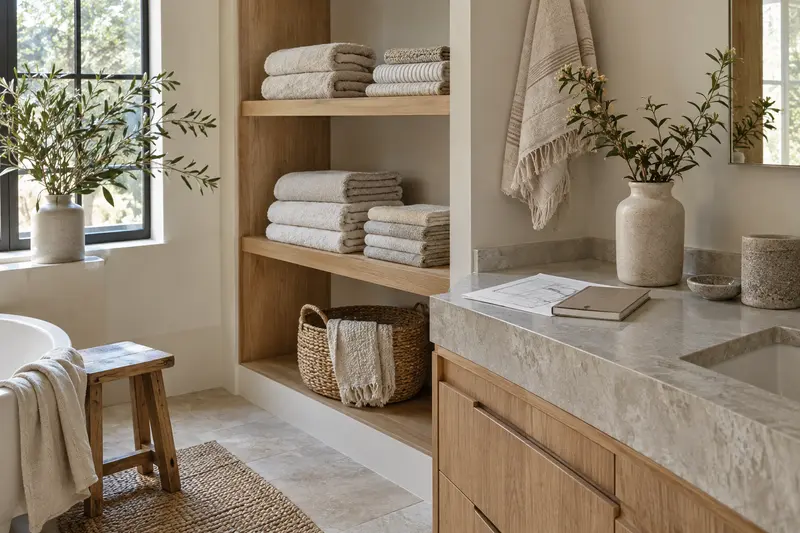
In brief
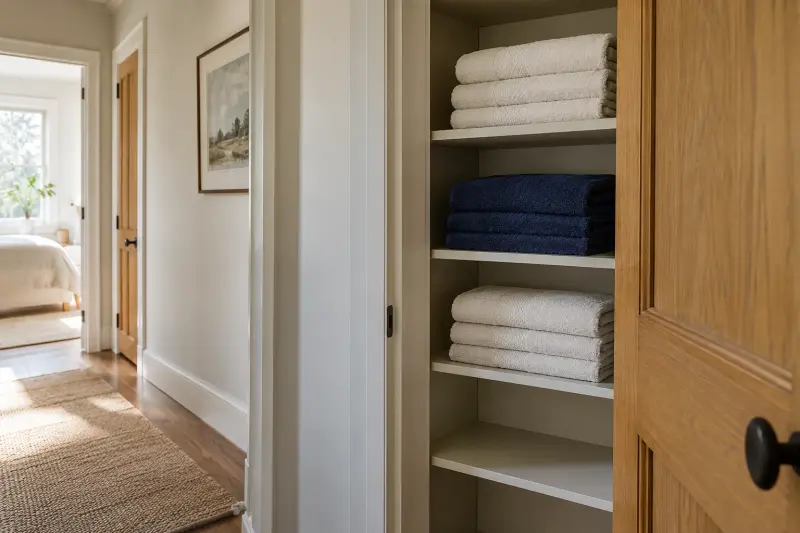
Place towels where the reader’s routine needs them, while keeping doors, movement and drying space clear. Storage is not a support fixture. Start by rearranging existing items; buy a hook, rail or organizer only after its placement and purpose are clear.
IN THIS GUIDE
Locate the moment the towel is needed
The CDC home checklist addresses lower kitchen shelves and clear floors. Use those household organizing prompts to ask about your towel routine; they do not establish a universal bathroom reach measurement or prescribe a particular towel rail.
Describe when the reader wants the towel: before entering, during part of the routine or after leaving. Mark their actual position at that moment and include any assistance normally used. Do not place storage solely to match an attractive bathroom photograph. A convenient-looking shelf can answer the wrong stage of the sequence.
Keep storage and support distinct
Ask whether the proposed item is only for hanging or whether someone might grab it while moving. An ordinary towel hook, rail or freestanding rack should not be treated as a load-bearing support. Discuss any required support fixture with an appropriate professional rather than substituting a storage product.
Check the bath door, room door, aid position and walking route around the placement. Include the space a wet towel occupies, not just the empty rack. Ask how the towel dries and how nearby surfaces are cleaned. Avoid adding a stand that narrows a useful passage simply because it is cheap or easy to assemble.
Worked decision: the rack beside the exit
Suppose a freestanding rack seems handy beside the bath, but the room sketch shows it within the exit route. Move the proposed rack position on paper first. Ask whether an existing suitable location serves the towel task without creating another obstacle or encouraging use as a support.
A wall-mounted storage solution may be discussed after the wall, fixing and placement are reviewed, or the household may reuse a hook elsewhere. Do not drill into the bath or conceal a service panel to make storage fit. The useful companion purchase is the one that serves a confirmed task and preserves the agreed route.
Use a storage placement checklist
Make a short inventory of existing hooks, rails, shelves and spare towels. Test the organizing plan through a calm discussion of the routine, without asking the reader to perform an unsafe reach or transfer. Keep uncertain access questions for appropriate assessment. The matrix below gives the storage task a clear boundary.
If an inexpensive item is needed, compare its stated purpose, material care and suitable professional fixing or placement. Do not buy a set just because the finish matches. A smaller arrangement using what is already at home may provide the same convenience with fewer objects to maintain and clean.
- MomentWhere the reader is when the towel is needed.
- RouteDoor movement, device position and exit space.
- PurposeStorage only; separate any assessed support requirement.
- CareWet-towel space, drying, cleaning and service access.
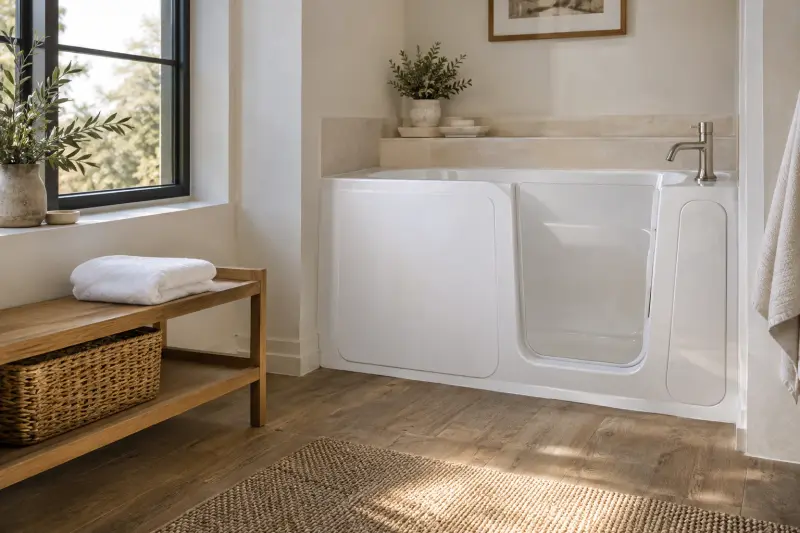
Follow the towel through the bathing routine
Start with the moment the towel is needed. A clean towel prepared before entry, an item used during an explained routine and a towel reached after leaving can involve different positions. Write the actual sequence in ordinary words and ask the user which stage matters. Storage placed to look attractive in a bathroom photograph may answer the wrong moment. The task is a useful location within the understood routine, not simply another place to hang linens.
Mark the relevant position on the room sketch. Include the bath door, room door, ordinary furniture and any aid or assistance already part of the reviewed task. Do not ask the reader to perform an unfamiliar reach or transfer to prove that a shelf is convenient. If a personal access question remains, obtain appropriate advice. A household discussion can explain preferences without pretending a paper sketch establishes suitability.
The CDC's home checklist recommends lower shelves for frequently used kitchen items and addresses floor clutter across the home. Applying that organizing question to a towel routine is our household planning inference, not a bathroom reach dimension or an instruction from CDC to install a particular rail. Keep the user's actual task and room proposal central. Discuss a storage location against the complete route rather than selecting it because a product has a matching finish.
Describe what happens after use. Where does a wet towel go, what space does it occupy and how is the location cleaned? An empty hook or rack can look small while the hanging towel projects into another task. Include this ordinary state on the sketch. The plan should account for both preparation and drying without inventing a health or hygiene benefit for a particular material or storage format.
Finish with one clear storage need. It might be an existing location that serves preparation, a revised place for drying or a question about the reviewed exit area. Inventory what is already available before shopping. The no-purchase option can be a better routine using suitable existing hooks or shelves. An inexpensive companion item becomes useful when it answers the confirmed need without adding another obstacle or being mistaken for support.
Keep ordinary storage separate from required support
Identify whether the user expects to hang a towel or also reach for the object while moving. These are different functions. An ordinary storage rail, hook or freestanding rack should not be assumed to provide body support. If support is part of the task, discuss the appropriate fixture, placement and installation with the relevant professional. Do not choose a storage product because it resembles a grab bar or looks sturdy in a photograph.
Ask the provider to explain the actual product's stated purpose and fitting requirements. A dual-purpose product, if considered, needs its own documented function and appropriately reviewed installation. Do not infer support from a metal finish, large screws or a towel-bar name. The household's question should remain what task is this specified item intended to perform and what professional evidence supports its use in this location.
Editorial illustration
Kohler Assist's guidance for its specified shower units explains that grab-bar support depends on the relevant backing arrangement. This narrow manufacturer example is a reason to review the actual wall and product, not a universal DIY fixing method. The page does not establish a storage solution for another bath or room. Leave support design and fixing to the appropriate professional rather than copy a generic anchor recommendation.
Keep fixed support decisions outside the towel-shopping comparison. A low-cost hook may answer a hanging task while a required support fixture has a separate assessed role. Combining the questions can create misleading value claims, such as suggesting a cheap rack saves the cost of a professional support arrangement. The ethical companion recommendation describes storage honestly and does not imply that it prevents falls or replaces appropriate access work.
If the planned location encourages someone to grab ordinary storage while moving, record that concern and seek the relevant advice before installing it. A household member can explain the routine without testing the object's strength or demonstrating an uncertain movement. The useful outcome may be another storage position or a separately reviewed support solution. Buying the same attractive rail in a heavier finish is not an evidence-based answer to an unconfirmed function.
Compare hooks, rails, shelves and stands by actual placement
List the formats the household is considering and the task each would serve. A hook may hold an item in a compact location, a rail may suit a preferred hanging arrangement, a shelf may hold folded linens and a stand may use floor space. These are format descriptions, not universal recommendations. Compare the actual product dimensions, stated purpose and proposed location rather than assume one is best for all older adults or every bath layout.
For wall storage, ask about the surface and appropriate fitting before choosing hardware. Keep the bath, wall finish and service access requirements visible. Do not drill into the bath or cover an access area to make a product fit. A finish-matching item may be attractive while unsuitable for the proposed location. The relevant professional can explain the actual wall and equipment interface, with no need for this article to prescribe anchors or drilling positions.
For floor storage, show its footprint and the hanging towel on the room sketch. Include ordinary door movement, exit route, mobility aid position and access to other fixtures. A freestanding item is not automatically convenient because it requires no wall work. Ask whether an existing location serves the task with fewer objects in the room. The comparison should keep household use visible rather than reward easy assembly as proof of suitable placement.
For shelves and folded storage, identify which stage of the routine they answer and who retrieves the towel. A location useful for preparing items may not be the location the user needs after bathing. Keep these tasks separate. Do not improvise a high or awkward reach to test a shelf. Appropriate personal-task advice can address a concern while the household considers a no-purchase routine using existing storage.
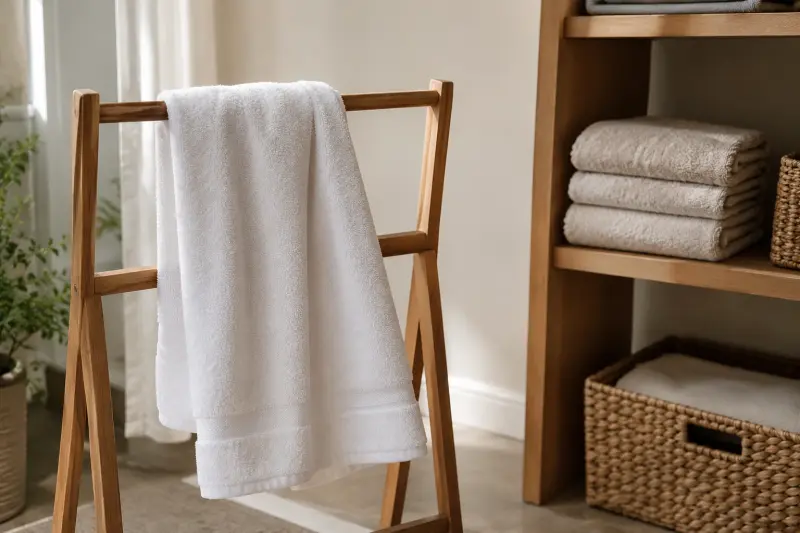
Check care and ordinary upkeep in the product's actual information. Will the item be cleaned alongside nearby surfaces, and does the household understand its material care? Avoid claims that a particular rack is hygienic, therapeutic or guaranteed to last without evidence. A modest product can be useful when its purpose and placement are clear. The preferred format should follow the confirmed task and reviewed room, with appearance as a separate legitimate preference.
- Format and purposeHook, rail, shelf, or stand and the routine stage it serves.
- PlacementActual dimensions, hanging towel, doors, route, and service access.
- FittingAppropriate wall or product review; no improvised equipment modification.
- CareStated material instructions and household responsibility.
- Existing optionIdentify suitable storage already available before buying.
Worked layout: the convenient rack beside the exit
Imagine a fictional bathroom with a proposed freestanding towel rack beside the bath exit. Its finish matches the room and the household expects the towel to be close at hand. The sketch places it in a route also used by the bath door and an ordinary aid arrangement. The worked decision does not declare a real installation unsafe; it identifies an unanswered placement question before the product is bought.
The household marks the rack and the hanging towel on the room plan. It describes the moment the user wants the towel and asks about the reviewed exit routine. A nearby existing hook is considered for preparation, while another location may suit drying. The household does not assume a single product must answer every stage. It asks appropriate advice if a personal reach or movement concern remains.
Next, the user explains that they might instinctively grab the rack while leaving. That introduces a support question separate from towel storage. The household does not test the rack's strength or select a larger ordinary stand as an automatic solution. It discusses the required support through the relevant professional and keeps any storage product's stated purpose distinct. The same attractive finish cannot turn an unanswered function into an approved one.
One revision removes the proposed rack from the exit route and reuses suitable existing storage elsewhere. Another considers wall-mounted storage after the surface and location are appropriately reviewed. The household keeps both options tied to preparation, reach and drying tasks. No fictional purchase price or universal mounting height is used to force a winner. The comparison is about which actual arrangement answers the confirmed need.
The final outcome could be no purchase, one modest hook or another documented storage choice. Any unresolved personal or fixed-fixture question remains visible. The worked value is a more precise small purchase: the towel's useful location, ordinary room use and support boundaries are understood before appearance decides the product. An ethical affiliate link can follow that task without suggesting every bath installation needs a complete new accessory set.
Use a small-purchase worksheet and keep the no-purchase choice
Create a worksheet with towel stage, proposed location, existing item, new item if needed, ordinary room use, fitting question and next action. Start with the user's actual routine and current room proposal. Keep personal-task advice and fixed-fixture review identified where relevant. The worksheet should define a narrow purchase need, not collect private diagnoses, home addresses or body measurements for a public affiliate tool.
Inventory existing hooks, rails, shelves and spare towels privately. Record which are already useful and which are not part of the intended routine. A suitable existing item may answer the task with no purchase. Do not replace everything just to match a premium finish. Appearance can be a preference, but the comparison should distinguish it from an unresolved practical need and the obligations of fitting or maintaining new storage.
If a new item is justified, compare its actual stated purpose, dimensions, material care and supplied fitting information. Check current availability and merchant terms at purchase rather than rely on an invented price or endorsement. The product should answer the confirmed location and task. Do not describe it as tested by our team, rated for support or medically beneficial unless the appropriate evidence truly exists and applies.
Include wet-towel and ordinary-use states before accepting placement. A tidy product photograph often shows storage empty, while the household uses it with linens and other room activities present. Keep door movement, service access and other users on the sketch. Ask the relevant provider about a change affecting the reviewed equipment arrangement. A small accessory is not exempt from a real room question merely because its price is low.
Revisit the plan after the room is complete or a meaningful routine change occurs. Keep the current note in the household folder if useful, with any professional response privately attached. No complicated app is required. The value is a reader-controlled decision and a clear reason for a companion purchase, including choosing nothing when the existing arrangement works. Small, useful storage should support the routine rather than become another object the user has to navigate.
- Routine stageWhen the towel is prepared, needed, and placed to dry.
- Existing arrangementSuitable item already available and its actual task.
- Proposed purchaseStated purpose, dimensions, care, and confirmed location.
- Room interactionDoors, aid route, other fixtures, wet towel, and service access.
- Next actionNo purchase, appropriate review, or one defined storage choice.
Questions readers ask about bath-side towel storage
Where should a towel go beside a walk-in bath? Start with the stage at which the user needs it and the actual reviewed routine. Include doors, route, assistance and drying afterward. This guide supplies no universal mounting height or reach distance. A placement that looks close in a photograph can still answer the wrong moment, so define the task before choosing the item.
Can a towel rail be used for support?
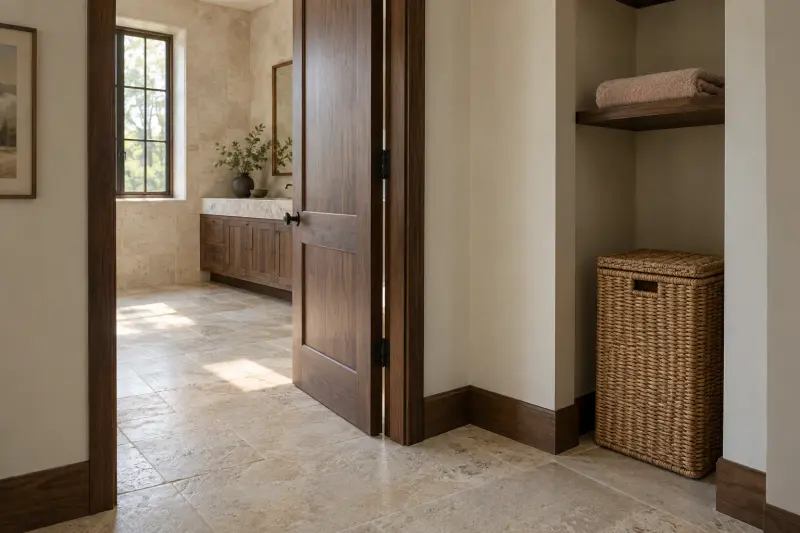
Do not assume an ordinary storage product has that function. Discuss any required support fixture and installation with the relevant professional, using the actual product documentation. A matching finish or sturdy appearance is not evidence of its intended role. Keep hanging and body-support questions separate rather than present a low-cost rack as a substitute for appropriate access work.
Is a freestanding rack the easiest option?
It may avoid wall fitting while occupying floor space and interacting with a door, route or other fixture. Show its actual footprint and hanging towel on the plan. Compare an existing location before buying. Easy assembly does not establish appropriate placement, and a floor product should not be selected solely because it appears convenient in an empty-room image.
Should I install hooks on the bath or over service access?
Do not modify the bath or conceal a required access area to fit storage. Ask the provider about the accepted arrangement and appropriate surface review. A different existing location may answer the task. The relevant professional should explain any fixed-fixture change rather than a shopping guide prescribe drilling or anchors.
What is the cheapest useful improvement?
Begin with suitable existing storage and a clearer preparation-and-drying routine. If a confirmed gap remains, compare one modest item by its purpose, placement and care rather than buy a matching set. No universal price or savings claim is supplied here. The ethical small purchase is the one that answers the actual task with no unnecessary objects.
What if reaching the towel is uncertain?
Describe the question without asking the user to perform an unfamiliar reach or transfer to test it. Obtain appropriate personal-task advice and keep the room proposal visible. A storage accessory cannot establish suitability of an unresolved movement. The next useful step may be another discussion, a revised routine or no purchase until the location and task are understood.
MAKE THE SPEND MEANINGFUL
Before adding to the basket.
- Rearrange existing suitable storage first.
- Use fewer stored items instead of buying a larger organizer set.
How this guide was prepared
AI-assisted editorial research, checked against the linked primary sources. Product testing and a credentialed individual review are not claimed.
source-checked editorial; no hands-on testing or expert suitability assessment claimed
How we use sources and AI assistance ↗Sources & fact checks
The guide separates sourced facts from editorial questions and examples. We have not claimed hands-on product testing. How we use sources and AI assistance.
- CDC: Check for Safety home checklist ↗
- Kohler Assist: support requirements for grab bars in specified shower units ↗
Found an error or an outdated detail? Contact the editorial team.