

In brief
An automatic pill dispenser is a locked tray that turns to the right compartment at each dose time, then flashes and sounds an alarm until the pills are tipped out. It suits someone who forgets doses or doubles up, with a helper who fills it. Ask the pharmacist first which medicines can leave their original pack.
Shortlisted for this decision
Affiliate-
Shortlisted
e-pill MedTime Station Pro
For a locked, alarmed monthly routine
Two 28-compartment trays under one locked lid, with up to 24 daily alarms and a window that opens only at dose times.
Check price on AmazonCheck first: Check the lid color and item number against the maker page, and ask the pharmacist which medicines can go in.
Affiliate links: we may earn a commission from qualifying purchases at no extra cost to you. Prices are shown only on Amazon. Amazon.com (US listing). See the full comparison ↓
Documented options
Automatic pill dispenser guide: options compared
Options based on manufacturer documentation. Retailer links are affiliate links: we may earn a commission from qualifying purchases.
Affiliate retailer links
-
e-Pill MedTime Station Pro Automatic Locked Pill Dispenser
Exact variant: Lid color not stated in the listing title
View product details on Amazon — United States
IN THIS GUIDE
Who an automatic pill dispenser helps
Say your mother takes four medicines at three different times, and lately you find Tuesday's pills still in the box on Thursday. A plain weekly box shows what she missed, but it cannot remind her or stop her taking the next dose early. That gap is what an automatic dispenser is built for.
MedlinePlus describes automatic dispensers as holding 7 to 28 days of pills, with a blinking light and an audio alarm as reminders. Most have a locked lid, so only the person with the key can reach the stored doses. Only the compartment that is due opens.
- Someone who forgets doses, or is not sure whether a dose was taken
- Someone who might take extra pills from the next compartment
- A family helper who lives nearby and can fill the tray every week or two
- A home where a key-locked store keeps pills away from visitors or grandchildren
Start with the pharmacist: which medicines can go in
Some tablets keep well in their blister pack but not loose in a tray. The NHS Specialist Pharmacy Service says the preferred option is to keep medicines in their original packaging, and that deciding whether a medicine goes into a compartment aid is a matter of professional judgement. It also advises keeping such trays out of bathrooms and kitchens, and away from direct light.
So bring the full medicine list and the bottles to the pharmacy, as MedlinePlus suggests, and ask plainly: "Which of these can sit loose in a dispenser for up to four weeks, and which must stay in the pack?" Some pharmacies also offer to fill trays, so it is worth asking.

- Ask: "Can this tablet be stored out of its blister for 28 days?"
- Ask: "Do any of these need to be taken with food or at an exact time?"
- Ask: "Is there anything here I should never take together?"
- Keep liquids, inhalers and fridge medicines outside the dispenser
What to check in a pill dispenser with alarm
Count the doses first. Multiply the doses per day by the days you want between refills, and check that the tray has enough compartments. A 28-compartment tray lasts 28 days at one dose a day, but only seven days at four doses a day.
Then picture the person using it. Can they hear the alarm from the next room, see the light, and tip the tray with a weak or shaky hand? A good question for the seller is: "What happens to the alarm and the lock if the batteries run flat?"
- Doses per day times days between refills, against the compartment count
- How many tablets fit in one compartment, including large ones
- Alarm volume and length, and whether a light flashes as well
- A key-locked lid, and a spare key kept by a second helper
- Battery type and a low-battery warning
Locked dispenser, alarm pillbox or weekly organizer
There are three common routes. A weekly organizer is a row of lidded boxes with no reminder. An alarm pillbox adds a beep but leaves every day open. A locked automatic dispenser reminds, opens only the dose that is due, and keeps the rest behind a key.
Our product pick is a locked dispenser, and the facts below come from the maker's page for the white-lid model. Locked units like this sit at the high end of the price range, so a simpler route may be enough for many homes.
Put simply, a weekly organizer suits someone who only needs a tidy layout. An alarm pillbox suits someone who forgets the time but takes the right pills. A locked dispenser suits someone who might take a dose twice, or take tomorrow's pills today.
- e-pill MedTime Station Pro: two 28-compartment trays that share one locking lid, item 993040
- Capacity: up to 18 large aspirin-sized tablets per compartment, and up to 24 daily alarms
- Access: a self-locking window opens only at scheduled times; two keys included
- Power and size: 4 AA batteries, 6 to 12 months stated, low-battery warning; 10 x 9 x 8 in, 2.8 lb
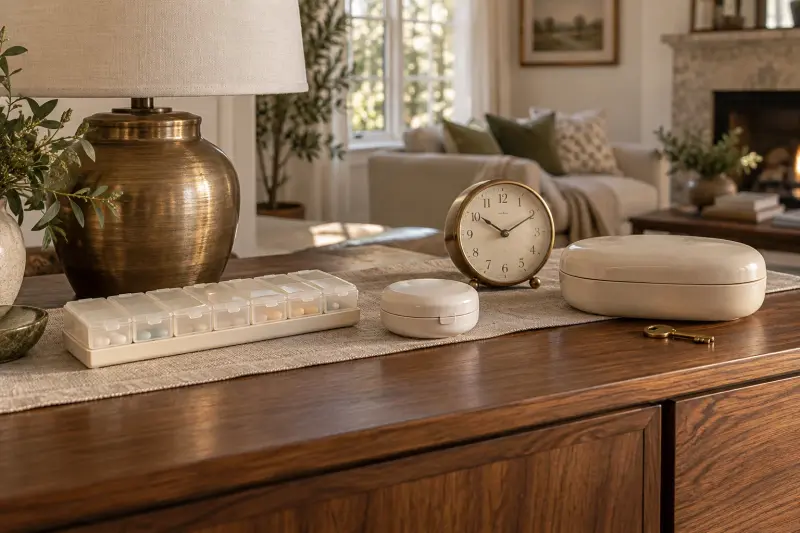
Filling, alarms and everyday care
Choose one person to fill the tray, on the same day each week or fortnight. Fill it at a clear table with the pharmacy list in front of you, one medicine at a time, and lock the lid before you leave.
Set the alarms with the person who will hear them, so the times fit real mornings and evenings. Say your father sleeps until nine: a seven o'clock alarm will ring to an empty room. Agree what happens if he is out when it sounds.
- Write the fill date and the next fill date on a card beside the unit
- Keep the medicine list next to the dispenser for visiting helpers
- Store it in a dry room away from a sunny window
- Change batteries at each low-battery warning, not later
Common mistakes and when to ask for help
The real limit is this: a locked dispenser keeps the pills at home. MedlinePlus points out that you cannot take medicine out of it, which can be a problem when you go out. Plan a small travel box, filled by the same helper, for days away.
If doses are still missed with an alarm, or the person feels confused about the tray, speak to the doctor or pharmacist. MedlinePlus notes a provider may be able to reduce or simplify medicines. An occupational therapist can also look at the routine at home.
Watch the first two weeks closely. Call or visit at a dose time, and check the tray on fill day: an untouched compartment tells you more than a question on the phone. Ask the person, "Is the alarm too loud, too quiet or at the wrong time?"
- Filling it without asking the pharmacist which medicines may come out of the pack
- Picking a tray too small for the number of daily doses
- Keeping the only key with the person who uses the dispenser
- Forgetting to refill the dispenser after a medicine change
MAKE THE SPEND MEANINGFUL
Automatic pill dispenser guide: low-cost alternatives
- A plain weekly pill organizer with four compartments a day, filled by a helper, plus a phone or clock alarm
- Ask the pharmacy whether it can supply medicines in dated packs or prepare trays
- A large-display day and date clock beside the pills, so it is clear which day it is

In brief
Automatic pill dispenser guide: questions answered
How does an automatic pill dispenser work?
A helper fills a round tray with each dose in its own compartment and locks the lid. At each set time the tray turns so the next compartment sits under an opening, and the unit flashes and sounds an alarm. The person tips out that dose. MedlinePlus notes these units run on batteries that need regular replacement.
Can all medicines go into a pill dispenser?
Not always. The NHS Specialist Pharmacy Service says medicines are best kept in their original packaging, and that including one in a compartment aid is a professional judgement. Take the bottles to the pharmacy and ask: "Which of these can sit loose for four weeks?" Liquids, inhalers and fridge medicines stay outside the tray.
Is a pill dispenser with alarm the same as a pill reminder?
Not quite. A pill reminder can be any alarm, from a phone to a clock, and it leaves every dose within reach. A locked automatic dispenser reminds and also opens only the compartment that is due, which matters when someone may take the next dose early. Both need a helper who checks the routine.
What happens if a dose is missed?
MedlinePlus says you usually take the next dose when it is due and should not take a double dose, but it also says to check with your provider or pharmacist. Ask them once, for each medicine on the list, and write the answer down so every helper gives the same advice.
How this guide was prepared
AI-assisted editorial research, checked against the linked primary sources.
Written with AI assistance from the sources listed below and checked against them. We have not tested these products in person.
How we use sources and AI assistance ↗Sources & fact checks
The guide separates sourced facts from editorial questions and examples. How we use sources and AI assistance.
- MedlinePlus: Review your medicine list with your pharmacist ↗
- NHS Specialist Pharmacy Service: Using the medicines compliance aid stability tool ↗
- e-pill: MedTime Station Pro, white lid (item 993040) specifications ↗
Found an error or an outdated detail? Contact the editorial team.