
In brief
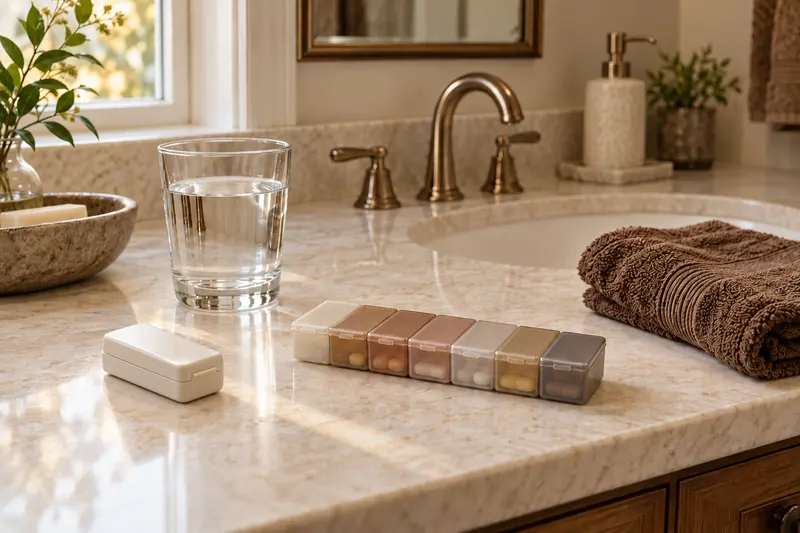
A pill cutter, also called a pill splitter, is a small hinged case with a blade that halves a tablet more evenly and safely than a knife. Use it only on tablets your pharmacist says can be split. Choose one with a centering guide for small or round pills and a lid you can press closed easily.
Shortlisted for this decision
Affiliate-
Shortlisted
Equadose V2 Pill Cutter
For even halves with a centering device
A centering device and twin stainless steel blades aim for even halves when a split dose is prescribed.
Check price on AmazonCheck first: Only split tablets a pharmacist says can be split; never cut extended-release tablets or capsules.
-
Shortlisted
Ezy Dose Pocket Pill Cutter
For occasional splitting at home or away
A compact cutter with a stainless steel blade and built-in storage for occasional splitting at home or away.
Check price on AmazonCheck first: No centering guide; confirm item 67755A on the listing and check with a pharmacist first.
Affiliate links: we may earn a commission from qualifying purchases at no extra cost to you. Prices are shown only on Amazon. Amazon.com (US listing). See the full comparison ↓
Documented options
Pill cutter guide: options compared
Options based on manufacturer documentation. Retailer links are affiliate links: we may earn a commission from qualifying purchases.
Affiliate retailer links
-
EQUADOSE Pill Cutter
Exact variant: Double stainless steel blade and centering device, Blue
View product details on Amazon — United States -
EQUADOSE Pill Cutter
Exact variant: Double stainless steel blade and centering device, Blue
View product details on Amazon — Germany -
EQUADOSE Pill Cutter
Exact variant: Double stainless steel blade and centering device, Blue
View product details on Amazon — France
Affiliate retailer links
-
Ezy Dose Pill Cutter and Splitter
Exact variant: Built-in pill dispenser, color may vary
View product details on Amazon — United States
IN THIS GUIDE
Check before you split: which tablets can be cut
The most important step happens before you buy. The FDA advises talking to your healthcare professional before splitting any tablet, and notes that most sustained, controlled or timed-release medicines are not meant for splitting.
If a tablet is FDA-approved for splitting, the label insert says so and the tablet carries a score mark. Without that, the FDA has not checked that the two halves match in weight or drug content. Some tablets suit a splitter poorly because of their shape and size, even when they look scored.
The pharmacist group ASHP lists further medicines that are usually not split, such as blood thinners, anti-seizure medicines, contraceptives and combination tablets. Keep a short written list of which tablets may be split, so anyone who helps can check it.
- Ask the pharmacist: can this exact tablet be split?
- Do not cut capsules, or coated, delayed-release or extended-release tablets, without clear advice
- Recheck when the pharmacy switches brands or manufacturers
- Ask whether a half-strength tablet is available instead
Who a pill cutter helps
A pill cutter helps when a prescriber asks for a half tablet, or when the pharmacist agrees a large tablet can be split to make it easier to swallow. It gives cleaner halves than a kitchen knife or scissors, which ASHP advises against, and keeps fingers away from the blade.
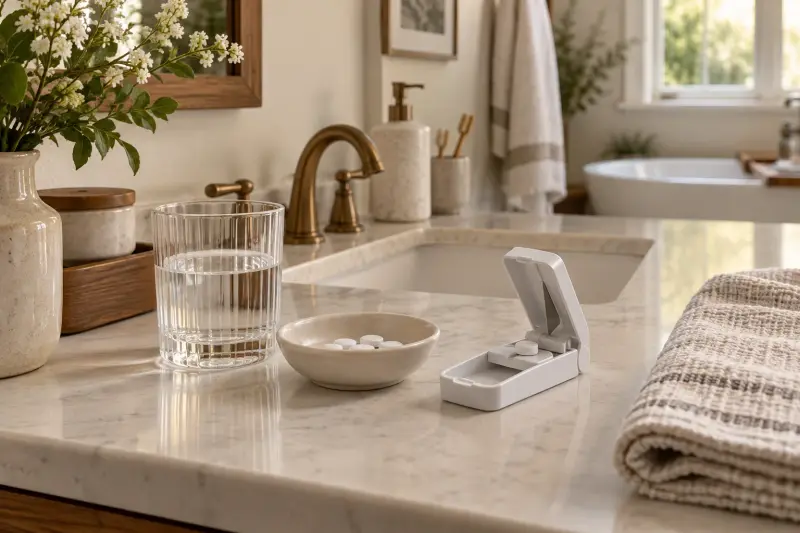
It also helps family members who prepare doses for someone else. Because the FDA advises splitting one tablet at a time, ask the pharmacist how to fit split doses into a weekly routine.
- People prescribed a half-tablet dose
- Anyone with weak grip who finds a knife unsafe
- Caregivers who prepare doses for a parent or partner
- Travelers who need to split a dose away from home
What to look for in a pill cutter for small or large pills
Pill cutter and pill splitter are two names for the same tool. Even halves depend on holding the tablet still in the center while the blade comes down, so a centering guide or V-shaped holder matters most for small, round tablets without a score line.
Then look at the blade, the size range and how easy the lid is to press. People with weak hands need a cutter that closes with little force, and people with low vision benefit from a brightly colored body that stands out on the counter.
Size matters for travel too. A pocket cutter fits a bag or toiletry case, while a larger cutter with a guide is easier to use at home on a steady surface.
- A centering device or V-shaped holder for small and round tablets
- A stainless steel blade that is covered when the lid is closed
- A size range that covers both your smallest and largest tablets
- A lid that closes with light pressure
- Built-in storage for the second half, if you split on the go
How the two models compare
Both picks come from Apothecary Products brands and use stainless steel blades. The Equadose V2 is built around even halves, while the Ezy Dose cutter is a compact pocket design with a dispenser.
The facts below come from the Apothecary Products page for each item. Prices on those pages are store case packs, so they do not reflect a single unit.
Put simply, the Equadose V2 suits regular prescribed splitting where even halves matter, and the Ezy Dose suits occasional splitting and carrying a cutter in a bag.
- Equadose V2 Pill Cutter: twin angled stainless steel blades and an integrated centering device; part EQ-BM-PS-002
- Equadose V2: made to split large hard pills and small soft pills
- Ezy Dose Pocket Pill Cutter with Dispenser: stainless steel blade and built-in dispenser; item 67755A
- Ezy Dose: compact for storage and travel, made to cut with little pressure; no centering guide listed
How to split pills evenly, step by step
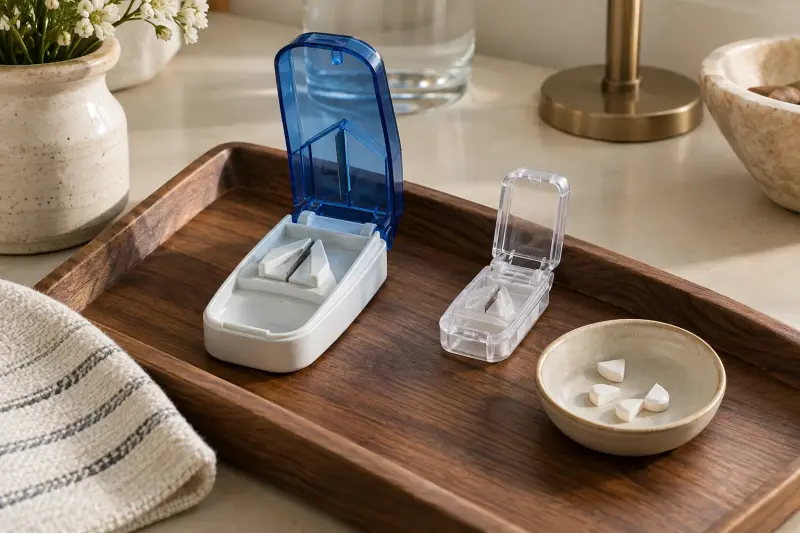
Health information service HealthLink BC describes the basic method: place the pill in the slot, close the lid so the blade cuts it in half, then sweep the halves into the open box and store them in your normal container.
Split one tablet at a time. The FDA advises taking both halves before splitting the next tablet, and ASHP notes that some medicines lose effectiveness once exposed to air. Keep the cutter away from children, as the blade is sharp when the lid is open.
- Start with clean, dry hands and a light-colored surface
- Line the score line up with the blade, or seat a round tablet in the guide
- Close the lid with one steady press, not a slow squeeze
- Take the second half at the next dose, as directed
- Wipe the blade area with a dry tissue before a different medicine
Uneven or crumbling halves: common mistakes and fixes
The biggest mistake is splitting a tablet that should not be split. Others are smaller but add up, such as uneven halves, lost crumbs or mixing halves from different medicines.
Most uneven halves come from a tablet sitting off center or a dull blade. If halves still come out uneven or crumble with a clean, sharp cutter, stop and tell the pharmacist; the tablet may not suit splitting, or another strength may exist.
Write down any change in how a tablet looks, such as a new color, shape or score line. A different look can mean a different manufacturer, which is a good moment to ask again whether splitting is fine.
- Tablet rolls or slips: use a cutter with a centering guide
- Halves uneven: realign the score line with the blade and press once
- Tablet crumbles: replace a dull cutter, then ask the pharmacist
- Never use a kitchen knife or scissors, or split a month in advance
MAKE THE SPEND MEANINGFUL
Pill cutter guide: low-cost alternatives
- Ask the pharmacist whether a lower-strength tablet is available, which may remove the need to split at all.
- Ask whether your pharmacy can split tablets or prepare doses for you; services vary.
- For occasional splitting, a basic pocket cutter does the job without extra features.
In brief
Pill cutter guide: questions answered
Can you split any pill with a pill cutter?
No. Only split tablets that your pharmacist or prescriber says can be split. The FDA notes that most sustained, controlled or timed-release medicines are not meant for splitting, and capsules should not be cut. ASHP also lists blood thinners, anti-seizure medicines, contraceptives and combination tablets as usually not split. Recheck whenever the brand or manufacturer changes.
Is half a pill half the dose?
Only reliably when the tablet is approved for splitting. The FDA says that when splitting is approved, the label insert says so and the tablet carries a score mark. Without that, the FDA has not checked that both halves match in weight or drug content. Ask your pharmacist before treating any half tablet as a half dose.
How do you split a small round pill evenly?
Use a cutter with a centering device or V-shaped holder, which keeps a round tablet from rolling before the blade comes down. Place it in the middle, close the lid with one steady press, and check the halves. If halves stay uneven, ask your pharmacist about a different strength.
Can you cut pills with a knife instead of a pill cutter?
It is not advised. ASHP recommends a pill splitter from the pharmacy and advises against a kitchen knife or scissors, which can slip, crush the tablet or cut fingers. If you cannot use a cutter safely, ask the pharmacist whether they can split the tablets for you or supply a different strength.
How this guide was prepared
AI-assisted editorial research, checked against the linked primary sources.
Written with AI assistance from the sources listed below and checked against them. We have not tested these products in person.
How we use sources and AI assistance ↗Sources & fact checks
The guide separates sourced facts from editorial questions and examples. How we use sources and AI assistance.
- FDA: Tablet splitting, split one tablet at a time ↗
- ASHP SafeMedication: Is it OK to split my pills in half? (medicines not to split) ↗
- Equadose V2 Pill Cutter: twin stainless steel blades and centering device ↗
- Ezy Dose Pocket Pill Cutter with Dispenser (item 67755A): blade and dispenser ↗
- HealthLink BC: Pill splitter, how to use one ↗
Found an error or an outdated detail? Contact the editorial team.