

In brief
Use the charger supplied or explicitly authorized by the trike or drive-system manufacturer. A matching connector or nominal voltage does not establish compatibility. Confirm the battery model, charging instructions and storage conditions, then choose a place that follows those instructions and does not obstruct an escape route.
IN THIS GUIDE
Identify the complete electrical combination
Copy the trike model, battery part number and charger identification from the labels into a private equipment record. Photograph labels for your own support queries, keeping account and serial details out of public posts. If buying a spare, ask the manufacturer to confirm the precise replacement in writing.
The US CPSC warns against universal chargers for micromobility products because incompatibility can create a fire hazard. Treat marketplace claims such as universal, compatible or upgraded as questions to verify. Do not try a charger because its connector fits, or assume a faster charger is approved for every battery in a model family.
Treat the vehicle, battery and charger as a complete documented combination. Begin with the identifiers actually supplied, then ask the maker which replacements are approved for that version and region. A family name is not enough when different batteries or electrical versions exist. Keep original labels and written confirmations with the receipt. If a label is inaccessible, ask the provider how to identify the part without opening components or reaching into an inappropriate area. The record should make a support enquiry easier, not encourage technical inspection by an unqualified owner.
A marketplace description can contain several reassuring words without answering compatibility. Compatible, universal and upgraded may describe the seller's claim rather than the manufacturer's authorization. Ask for the exact approved part and source, not simply a matching connector or nominal specification. The US CPSC's universal-charger warning is directly relevant to this distinction. This guide supplies no generic electrical-selection formula, adapter recommendation or charger substitution. An attractive replacement offer remains an unresolved purchase until the maker confirms the complete combination.
For a hypothetical order, a retailer offers a faster charger alongside a trike but names only the brand family. The buyer asks which exact battery it serves and whether the manufacturer authorizes that charger for the quoted configuration. If the answer is unavailable, the buyer leaves the accessory off the order and confirms the supplied original system. Speed is not a reason to assume approval. Another buyer replacing a lost charger should follow the same exact-part process rather than select a cheaper object because its plug appears identical.
Keep photographs of labels private. They can include serial or other identifying details that are useful for support but unnecessary in a public comment. Save a plain inventory showing the current approved battery, charger and exact manual. Record the source of any later part and obtain the required maker confirmation. A documented purchase route is more useful than a collection of screenshots from sellers whose descriptions change. If an item's origin is uncertain, seek advice before use rather than treating normal appearance as evidence of suitability.
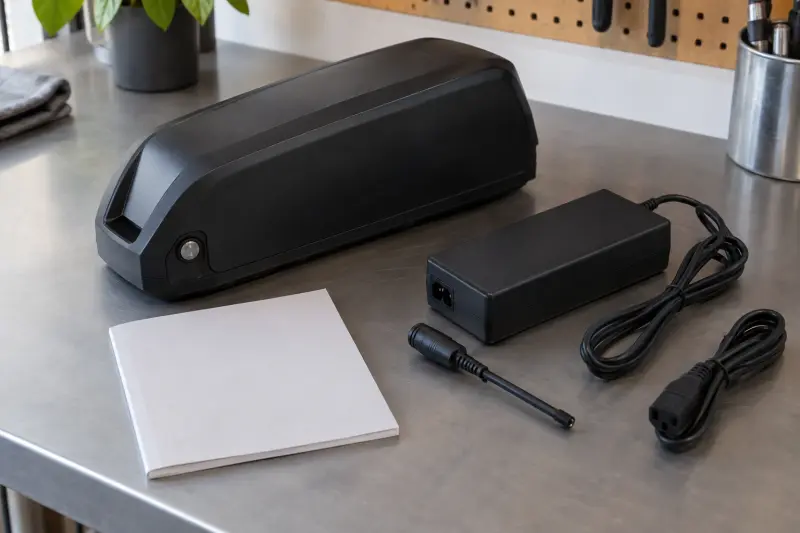
Plan charging before delivery
UK government e-cycle guidance advises using authorized chargers and avoiding storage or charging that could block escape. These are UK source recommendations, not a certification of a particular home layout. Apply the exact manufacturer’s instructions and obtain appropriate local advice where the building has shared routes or landlord restrictions.
For an illustrative apartment, the only available socket is beside the communal exit. That is an unresolved storage problem, even if the battery can be removed easily. Ask the building manager and supplier about a permissible arrangement before purchasing. Buying an extra-long cable or leaving a trike in a hallway does not resolve the original concern.
Describe the proposed charging place to the supplier before delivery. Include whether it is inside the home, in a detached space or in a building shared with other residents. Ask how the exact instructions apply and which building permissions or local advice are relevant. Do not interpret the presence of a socket as a complete charging plan. The British government guidance explicitly addresses escape routes and communal areas; its advice applies to England, Scotland and Wales as stated on the source page.
Draw the location privately with the vehicle or battery position, the ordinary route people use and the other items usually stored there. Explain the actual conditions instead of photographing an empty room that will later be full of household goods. Where an electrical installation, shared building rule or fire-safety arrangement is uncertain, obtain appropriate local advice. The guide cannot certify a home layout or specify an improvised extension-lead solution. The maker's instructions and the responsible building or local professionals need to answer those questions.
A hypothetical apartment has a convenient socket in a communal hallway. The battery is removable, so the buyer initially considers that an easy answer. The shared escape-route issue remains unresolved regardless of the removal feature. They ask the building manager and supplier about a permissible arrangement before committing. Another household has a separate shed but has not confirmed the environmental conditions for its equipment. The shed's separation from the home does not automatically settle the manufacturer's storage and charging requirements. Each proposed place needs its own check.
Keep storage and charging as distinct entries even if they happen near each other. A vehicle may fit a space while the electrical task remains unsuitable there. A cover or organizer can change how equipment is stored without establishing approved charging conditions. Do not buy accessories to disguise an unresolved location problem. If the home cannot support a permitted arrangement under the exact instructions, investigate another vehicle or transport option instead of assuming that ownership will become practical after delivery.
Have a clear response to an uncertain battery
Keep the maker’s guidance for condition checks, charging, temperature and end-of-life handling with the equipment. CPSC’s micromobility guidance says to follow supplied charging instructions and not charge while sleeping. A timetable or reminder can organize the task, but it cannot make a damaged or incompatible electrical system appropriate for use.

If a battery or charger is damaged, recalled, behaves unexpectedly or has uncertain provenance, stop using it and seek manufacturer guidance. Do not open a battery case or attempt electrical repair from a blog. In an immediate emergency, follow local emergency instructions. Arrange disposal through an appropriate local route rather than ordinary rubbish.
Keep the current official safety guidance and the maker's instructions available to the household. They should explain the conditions for ordinary charging, storage, owner checks and support. The CPSC directs users to remain present during charging and not charge while asleep or away. UK guidance similarly addresses charging while awake and alert. A calendar reminder can organize the routine, but it does not make an incompatible or damaged system appropriate. Do not use a timer or smart accessory as a substitute for the stated precautions.
Ask the provider how to respond when a battery or charger appears damaged, recalled or behaves unexpectedly. Preserve the exact model and support route so that the question can be handled without guessing. Do not open the battery, reuse cells, bridge a connection or attempt an electrical repair from a blog. A battery that looks tidy can still have an uncertain history, which is particularly relevant to used purchases. The purpose of a condition record is to direct questions to the appropriate source, not diagnose electrical safety remotely.
For a hypothetical incident, a household notices unfamiliar behaviour during the ordinary routine and decides the battery must simply be old. That interpretation is not a safe basis for buying an unsupported replacement. The household should stop using the uncertain equipment and seek the relevant guidance rather than repeatedly charge it to test the assumption. If smoke or fire is present, follow emergency instructions, leave the area and contact the local emergency service. The UK source specifically says to get out, stay out and call 999 for smoke or fire; use the correct emergency route in other jurisdictions.
Plan end-of-life handling with an appropriate local route. Lithium e-cycle batteries do not belong in household rubbish or general recycling according to the cited UK and US guidance. Ask the manufacturer, retailer or local authority which arrangement applies, and follow any recall-specific instructions. Do not transport a damaged battery to an ordinary shop without seeking the appropriate advice. Keep this information separate from the shopping list. Disposal is an ownership responsibility, not a reason to accept an unverified battery trade-in or a generic replacement bundle.
Create a battery-and-charger card
The card should show approved battery, approved charger, manufacturer instruction link, charging location and support contact. Add an expiry reminder for reviewing the source when the equipment changes, not a replacement schedule invented by us. Leave a spare battery off the shopping list until the actual journey and approved system are clear.

At handover, ask to see the provided charger and battery labels against the order. Store invoices and instructions so a future replacement can be identified correctly. A documented original system is a more useful starting point than a cheap-looking replacement offer with uncertain origin; no affiliate saving should take priority over compatibility.
The battery-and-charger card should be specific enough to support a future replacement enquiry. Include the vehicle model, approved battery and charger identifiers, the exact manual, the permitted charging arrangement and the regional support contact. Add the receipt and confirmation privately rather than publishing them. Record the date of the source check so that a later part change can prompt a review. Do not invent a replacement schedule from the age of the equipment or an unsupported number of charge cycles.
At handover, ask the supplier to identify the actual parts against the written offer. A component change needs a documented explanation from the appropriate source. The same family name or similar casing does not erase a different part number. Ask where the ordinary instructions are kept and who can explain a confusing section. If the household prefers paper or offline access, discuss a suitable document format rather than relying entirely on a retailer's QR link that may change.
A hypothetical buyer wants a spare battery because it appears in an accessory promotion. Their journey ledger shows that the ordinary route is still being assessed and that storage for an extra component is unconfirmed. The next step is to resolve those questions, not add capacity automatically. Another buyer has a documented requirement for an approved spare but still needs to understand its handling and charging arrangement. The same card can organize both discussions without recommending a universal part or pretending an extra battery always improves value.
Review the record after any change to the vehicle, battery, charger or proposed location. Ask the maker to confirm the affected combination rather than reusing an old approval for a new part. Keep the support and disposal routes accessible to those involved. This guide gives practical buying questions and safety-source references; it does not certify an electrical system or authorize modifications. A considered purchase prioritizes exact approval and a workable household arrangement, with optional accessories bought only when their purpose and compatibility are clear.
Compare a replacement purchase without a compatibility guess
If a charger is lost or a battery needs replacement, begin with the exact maker's support route. Give the vehicle and existing part identifiers privately and ask which current authorized part applies. A product may have several generations or regional versions, so an old order link can be a useful starting record without being the final answer. Ask whether the replacement includes new instructions, which regional electrical version is supplied and whether the seller is part of the approved route.

Separate the part price from the evidence. A cheaper offer with uncertain origin cannot be compared as though it were the same approved product. Ask about the supplier, exact identifier, manufacturer authorization and applicable support. A longer warranty headline does not create electrical compatibility. A faster charging claim also needs the exact maker's approval and instructions. This guide deliberately provides no universal charger shortlist because selecting the correct combination requires evidence beyond a plug, a nominal rating or a persuasive marketplace description.
For a hypothetical comparison, offer A is an unidentified third-party battery described as fitting many trikes. Offer B is a maker-confirmed replacement for the exact unit, with a documented regional support route. The unresolved origin and approval on A are not small disadvantages that can be averaged against a lower payment. Resolve them before considering the offer. If no authorized replacement can be confirmed, ask the maker about appropriate next steps instead of using a modified battery to keep the vehicle in service.
Keep the purchase proportionate to the actual need. A supplied approved charger may already answer the ordinary routine. A spare battery introduces another component to handle, store and eventually dispose of, so it should serve a documented journey requirement. Confirm its complete arrangement before buying. A decision to retain the original approved system or postpone an optional accessory is a useful outcome when it avoids spending on a feature whose practical purpose has not yet been established.
Make the ownership record usable by the household
Choose a private place for the instructions and support information that the relevant household members can find. Keep the exact owner manual, approved-part record, source links and local contacts together. If access to power or the internet is unavailable, an offline copy can still identify the correct guidance. Avoid making a public checklist collect serial numbers, addresses or health information. Those details may be relevant to a private supplier enquiry but are not needed for a website to explain the buying process.
Agree who normally follows the charging routine and who contacts support when an issue is noticed. This is household organization, not a guarantee of safety. The exact instructions and appropriate precautions still govern the task. A person helping occasionally should be shown where the relevant documentation is kept rather than expected to improvise from a remembered conversation. If the ordinary routine cannot be completed as instructed, ask for advice or choose another ownership arrangement rather than relying on a reminder application to resolve it.
A hypothetical household initially keeps every document in the purchaser's email. Another person regularly uses the vehicle but cannot identify the correct charger or find the support route. The household creates a simple private equipment folder and asks the supplier to clarify the actual parts. That is a useful organizational improvement; it does not approve an uncertain component. The same folder can hold future written confirmations and recall information, with old part records marked clearly when equipment changes.

The final buying question is whether the complete system and ordinary routine are understood, not whether the battery looks modern or the accessory offer feels inexpensive. Exact manufacturer approval, appropriate storage and charging, current guidance and a clear support route belong together. This publisher has not assessed the equipment or the home. Follow the cited authorities and exact maker instructions, and seek the appropriate local help when questions remain. No affiliate saving or premium feature should take priority over an unresolved electrical combination.
MAKE THE SPEND MEANINGFUL
Before adding to the basket.
- Use the supplied approved charger before buying extras.
- Avoid an unnecessary spare battery when ordinary journeys do not need it.
How this guide was prepared
AI-assisted editorial research, checked against the linked primary sources. Product testing and a credentialed individual review are not claimed.
source-checked editorial; no hands-on testing or expert suitability assessment claimed
How we use sources and AI assistance ↗Sources & fact checks
The guide separates sourced facts from editorial questions and examples. We have not claimed hands-on product testing. How we use sources and AI assistance.
- CPSC: warning against universal micromobility chargers ↗
- UK government: battery warning signs, emergency response and disposal guidance ↗
- CPSC: micromobility riding and charging guidance ↗
Found an error or an outdated detail? Contact the editorial team.