

In brief
Use the battery and charger specified or approved for the exact scooter. A matching plug, voltage figure or marketplace phrase such as universal is not enough to establish compatibility. Keep the model, battery and charger part information together and ask the maker about any replacement.
IN THIS GUIDE
Identify the scooter before searching for a battery or charger
Start with the exact scooter, supplied battery arrangement and applicable documentation. A model name alone may not settle a replacement question if variants, revisions or regional configurations differ. Record the manufacturer, full identifier, relevant serial or service reference privately, and the current component information the responsible provider confirms.
A marketplace search for mobility scooter charger can return many unrelated devices. Similar appearance, a matching plug or one familiar voltage figure does not establish approval. The battery, charger and scooter form a documented arrangement. A replacement should be confirmed through the maker or appropriate provider before price comparisons begin.
Describe why you are asking: a missing charger, a damaged component, a service recommendation or another observed issue. Do not diagnose battery failure from a range change or a light alone. The appropriate service can review the concern and say which information or inspection is needed. Buying a battery first can leave the real problem unresolved.
This guide creates a compatibility enquiry and purchase record. It does not provide battery wiring, charger selection algorithms, voltage adjustment or repair instructions. Keep the actual charging and replacement procedures with the exact documentation and responsible service. The useful result is an approved component and clear responsibility, or a decision to wait for further advice.
Find the applicable documents and ask about missing information
Pride's Super Portable and Elite Traveller 2 pages provide model-specific routes to owner information and specification sheets. Golden maintains an owner-document library with different product and regional routes. These are useful starting points for locating the appropriate documentation, not proof that a manual for one scooter covers another.
Ask the provider to identify which document applies to the supplied configuration. A series manual may need model-specific supplements, and a quick-start card may not contain the complete battery information. Keep all applicable documents together. We do not claim that a generic manual-library link resolves the exact component question on its own.
If a file is unavailable or unclear, ask the maker or provider for the relevant current information. Do not fill the gap using an old forum post, a similar model's charging instructions or a retailer's universal description. A missing document is a concrete question that the responsible source should answer.
If a series manual and model-specific supplement appear to describe different components, ask which applies to the actual scooter and region. A newer-looking filename does not establish that answer. Ask whether a proposed replacement supersedes an original component and which documented approval confirms it. Retain the explanation with the applicable instructions rather than selecting whichever description matches a cheaper listing.
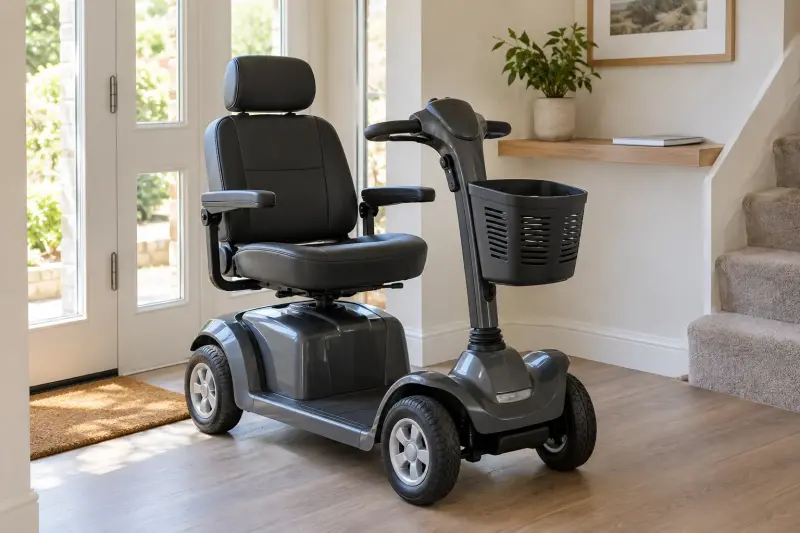
Do not treat battery chemistry as an interchangeable upgrade
Pride's US SC15M Super Portable page names a lithium-ion battery arrangement, while its US SC442E Elite Traveller 2 page names sealed lead-acid batteries. The contrast demonstrates why a shared brand or travel-scooter label does not make the battery systems interchangeable. It is not a recommendation to convert either product.
Record the chemistry and exact approved configuration from the applicable source. Do not select a replacement because it is described as lighter, longer-range or more modern. A chemistry change can be a different technical arrangement requiring manufacturer approval, not a routine shopping substitution that an online calculator can authorize.
If a supplier proposes an upgrade, ask the maker or responsible provider to confirm the exact parts, charger, installation, permitted use and warranty implications in writing. Keep that answer tied to the actual scooter. A broad claim that lithium fits mobility scooters is not model-specific evidence.
The smallest useful purchase may be the approved original replacement or no component purchase until a service concern is resolved. We do not rank chemistries as universally best for every reader. The user's task, actual product and approved support route determine the relevant options. A tempting capacity or weight figure cannot replace that confirmation.
Build a battery-and-charger identity card
Use one card with separate entries for scooter model, battery or pack identifier, documented chemistry, charger identifier, applicable region and provider approval. Add the source document and the exact unanswered question. Keep service references and serial details privately rather than publishing them in a product review or public shopping tool.
Treat each number as a labelled specification rather than a compatibility verdict. Voltage, amp-hours and charger output can appear on labels, but a set of matching numbers does not establish the completed approved arrangement. Ask the responsible source to identify what is relevant for the actual replacement.
Do not dismantle a pack or open a charger to obtain information. If labels are inaccessible or handling is awkward, ask the provider what record it holds and how to obtain the necessary details appropriately. A shopping enquiry should not create a technical task the household is not instructed or equipped to perform.
Finish with a clear status: replacement approved with exact identifier, inspection required or documentation clarification pending. The card must not fill every blank through guesswork. Its value is giving the service enough accurate identity and context to answer the question, while showing why a generic marketplace item has not yet been confirmed.
Ask about the complete charger, not only its connector
A connector that appears to fit is not a complete charger comparison. Obtain confirmation of the exact charger or approved replacement for the supplied battery and scooter arrangement. Ask what is included, which current documentation applies and whether any setup or service is required. Do not adapt a plug or cable to make an unrelated item connect.
Keep charging location and electrical questions separate from component identity. The appropriate manual and local professional advice should address the permitted environment and supply arrangement. We do not recommend extension leads, travel adapters or generic power accessories as a way to overcome an unresolved installation or location question.
For a replacement order, ask the supplier to state the exact item and approval rather than saying it works with most scooters. A broad compatibility list can still omit the supplied variant. Keep the manufacturer's or responsible provider's answer with the invoice, so a future household member can understand why that component was selected.
If a charger behaves differently, appears damaged or presents an unexplained concern, seek the appropriate service guidance rather than testing improvised alternatives. A buying guide cannot diagnose a light pattern or electrical fault. The useful next step is an accurate issue report with the exact product identity, not repeated purchases of similar-looking chargers.
Make charging an understandable household routine
Ask the provider to explain the actual charging process under the applicable instructions and identify who manages it. The household should understand the relevant components, permitted location and contact route. Do not substitute a universal overnight schedule from an unrelated model or invent a frequency because a planner has daily boxes.
Include practical handling concerns before purchasing a new configuration. A removable battery may create an additional carrying task, while another arrangement may involve a different access question. Tell the provider what the household wants to manage and what is difficult. Capacity should not be selected without considering that routine.
Keep instructions accessible in a format the household can use. A brief reminder card can point to the applicable procedure and responsible contact, but it should not omit essential limitations or become an unofficial replacement manual. If the user wants simple controls, include that preference in the wider equipment enquiry.
If the agreed location conflicts with ordinary household access, ask about a suitable arrangement rather than improvising cables across the route. The electrical and equipment requirements must be resolved through the appropriate sources. A new organizer, cover or extension accessory should not be purchased to disguise an unresolved charging problem.
Describe a concern without assuming which component has failed
A shorter outing, changed indicator or difficulty using the charging arrangement can have several possible questions behind it. Record what was observed, when it occurred and the exact equipment configuration. Do not declare the battery worn out from one event or assume that a larger capacity will solve the concern.
Ask the responsible provider what information it needs and whether inspection is required. Keep the response with the equipment record. We do not give electrical tests, diagnostic thresholds or directions to open components. A screenshot or label photograph can help only where the service requests it and it can be obtained appropriately.
For a used scooter, the new-model specification is not measured evidence of its present battery condition. Ask about actual history, inspection and documented support. A seller's statement that the battery holds a charge does not replace the professional assessment relevant to a purchase or replacement decision.
If the concern affects use, follow the appropriate provider and manufacturer guidance rather than continuing while shopping for a replacement. The worksheet should state the issue and next action clearly. That can prevent paying for an irrelevant component and keeps equipment condition connected to the actual support route.
Worked example: a matching plug does not complete the order
Imagine a fictional household replacing a missing charger. A marketplace item shows a familiar connector and includes the scooter brand in a broad title. The household initially assumes it is the relevant replacement. But the actual battery configuration and charger identifier have not been confirmed.
The family asks the provider to distinguish two possible offers: supplying a documented replacement charger, or inspecting the scooter before a part can be specified. It requests the item or service scope, any additional necessary work and who confirms compatibility. Until that answer arrives, a part-only price and an inspection-inclusive proposal are not equivalent offers.
The provider's response is recorded before the order proceeds. If the proposed marketplace item is not documented as approved, it is removed from the shortlist rather than modified to fit. If an exact replacement is identified, the invoice and component card retain that identity and the agreed support responsibility.
This example does not confirm a particular charger, diagnose an electrical issue or promise a lower price. It demonstrates why a short compatibility enquiry can be more useful than comparing dozens of similar plugs. The successful outcome is a documented replacement route or a justified wait for additional evidence.
Treat extra capacity and spare batteries as separate enquiries
A proposed larger battery or spare should answer a documented task under manufacturer approval. Ask what the actual configuration changes and which instructions, charger and service requirements apply. Do not assume that a higher amp-hour figure can be added to any scooter or that a physically similar pack is suitable.
Keep the range claim attached to its exact battery arrangement. A combined total involving a spare is different from a single installed-battery figure. Ask the provider how the permitted routine relates to the intended journey; this article does not teach swapping procedures or recommend carrying additional batteries for everyone.
Transport requirements can change with the battery. Airline acceptance, vehicle handling and storage are separate questions needing the appropriate documentation and actual operator or provider confirmation. A product marketed as travel friendly is not universal permission. Our flight and car-fit guides develop those connected tasks when relevant.
Do not buy extra capacity to bypass another problem, such as an unsuitable route, uncertain personal operation or unavailable service. A battery purchase cannot resolve those requirements. The useful comparison asks why the upgrade is needed, whether it is approved for the actual product and what complete scope it introduces.

Compare the approved replacement scope and written support
Ask for a current written quote identifying the exact component, any necessary fitting or service, delivery and support. Keep optional items separate. We do not publish assumed battery prices, expected lifespan or universal replacement intervals. Actual condition, configuration, region and provider evidence determine the relevant purchasing scope.
Read current warranty and return terms for the actual seller and market. A component bought from one retailer does not automatically carry another seller's policy. Ask how approval, installation and a reported fault are handled. Save the written answer with the identity card rather than relying on a broad customer-service promise.
If replacement involves service attendance, ask who performs it and how the equipment reaches the provider. A lower part-only amount may omit a necessary task included in another quote. Compare the same complete arrangement, and do not choose an unapproved item because its headline price is smaller.
A no-purchase outcome can be appropriate when inspection identifies another issue or an existing approved component remains suitable. A replacement can also be the right confirmed action. The guide's purpose is not to maximize battery sales; it is to keep the order tied to an actual documented requirement.
Ask the provider about storage, service and end-of-use handling
The battery record should include applicable storage and service information, not only the day it was bought. Ask the provider which instructions govern periods without ordinary use and who answers a later concern. Do not invent a generic maintenance-charging timetable or apply another chemistry's routine to the supplied arrangement.
If the equipment or household changes, bring relevant charging and handling questions back to the appropriate source. A new storage location, travel plan or helper can create a practical issue without changing the product name. The old purchase card should support that conversation rather than automatically approve the new routine.
For a component reaching end of use, ask the responsible provider or local disposal route about the actual battery type and applicable process. Do not assume ordinary household waste is appropriate or give a universal disposal recipe. Keep the final action within the relevant local requirements and documented service advice.
Retain the component identity and replacement history privately so a future enquiry has accurate context. A short record of what changed and who confirmed it is enough. It should not claim that the household performed a professional condition test or that a warranty end date determines the battery's actual condition.
Your exact-compatibility battery and charger decision card
Finish with the scooter identifier, confirmed battery arrangement, approved charger, applicable documents and responsible support contact. Add the reason for the enquiry and the actual response. Keep private serial or service details out of public content. The card should make the purchase understandable without exposing unnecessary information.
Use a clear outcome: exact replacement confirmed, inspection pending or approval clarification needed. Do not calculate a compatibility score from matching label numbers. The essential answer comes from the maker or appropriate provider for the supplied product, and a missing approval must remain visible.

If an order proceeds, verify that its item identifier and included scope match the documented response. Keep current written terms and any required service responsibility with the receipt. Delivery of a component is not evidence that an altered battery arrangement is approved or that an unresolved concern has been diagnosed.
Our range and ownership-budget guides can organize connected journey and cost questions. They should reference the same confirmed configuration rather than generate another battery choice. The best outcome is an approved, understood arrangement and a useful support record, including no new purchase when the evidence does not justify one.
MAKE THE SPEND MEANINGFUL
Before adding to the basket.
- Ask the responsible service to review the concern before assuming a new battery is required.
- Retain an approved suitable existing component where the provider confirms that outcome.
- Use a private paper identity card rather than buying a maintenance application.
- Buy only the exact approved component and necessary service scope.
How this guide was prepared
AI-assisted editorial research, checked against the linked primary sources. Product testing and a credentialed individual review are not claimed.
AI-assisted, source-checked editorial; no hands-on test, human expert review or personal suitability assessment claimed
How we use sources and AI assistance ↗Sources & fact checks
The guide separates sourced facts from editorial questions and examples. We have not claimed hands-on product testing. How we use sources and AI assistance.
- Pride Go Go Super Portable US: route to the applicable owner manual and specification documents ↗
- Pride Go Go Elite Traveller 2 US/Canada: model-specific documentation route ↗
- Golden Technologies: manufacturer owner-document library and regional document routes ↗
- Pride Super Portable US SC15M: named lithium-ion battery configuration ↗
- Pride Elite Traveller 2 US SC442E: named sealed lead-acid battery configuration ↗
Found an error or an outdated detail? Contact the editorial team.