
In brief
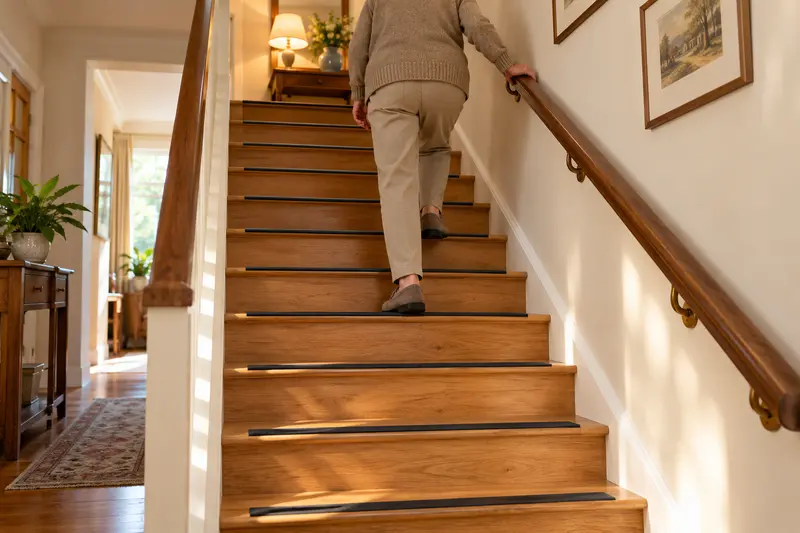
Stair treads add grip where a foot lands, and they help most near the front edge of each step. Slim grit tape suits bare wood, painted or outdoor steps, a reflective tread helps on a dim stair, and carpet treads suit people who want a softer step. Whatever you choose, it must lie flat and stay fixed, and it should sit alongside a sturdy handrail and good light.
Shortlisted for this decision
Affiliate-
Shortlisted
3M Reflective Tread 7768NA
For a dim step indoors or out
A single grip tread with a reflective strip, for a dim step indoors or out.
Check price on AmazonCheck first: One tread per pack; wood or stone needs a separate contact adhesive.
-
Shortlisted
3M Safety-Walk Tape 4 in x 15 ft
For cutting strips to each step
A long roll you cut with scissors to fit each step's width.
Check price on AmazonCheck first: Measure how many steps one 15 ft roll covers before you buy.
Affiliate links: we may earn a commission from qualifying purchases at no extra cost to you. Prices are shown only on Amazon. Amazon.com (US listing). See the full comparison ↓
Documented options
Stair treads for older adults: options compared
Options based on manufacturer documentation. Retailer links are affiliate links: we may earn a commission from qualifying purchases.
Affiliate retailer links
-
3M Safety-Walk Reflective Tread 7768NA
Exact variant: Black, 6 in x 2 ft
View product details on Amazon — United States
Affiliate retailer links
-
3M Safety-Walk Slip Resistant Tape
Exact variant: Black, 4 in x 15 ft roll
View product details on Amazon — United States
Affiliate retailer links
-
3M Safety Walk Antirutschbelag Universal
Exact variant: Schwarz, 50 mm x 18,3 m
View product details on Amazon — Germany -
3M Safety-Walk 610B
Exact variant: 2 in x 15 ft
View product details on Amazon — France -
3M Safety-Walk 610B
Exact variant: 2 in x 15 ft
View product details on Amazon — Spain
IN THIS GUIDE
Who stair treads help most
Say your mother walks down polished wooden stairs in socks each morning. Her heel catches the front edge of a step, and on a smooth surface there is little to stop a slide. A tread puts grip exactly there.
Treads also help on painted porch steps that turn slick in rain, on dim stairs to a basement, and for anyone whose eyesight makes step edges hard to judge. They are a small change that can make a familiar stair feel calmer.
They do not fix a loose step, a wobbly rail or a stair that has become too hard to climb. Those need a different kind of help, covered further down.
- Bare wood, laminate or painted stairs that feel slippery underfoot
- Outdoor steps that get wet, frosty or leafy
- Dim stairs where the edge of each step is hard to see
- Family members who want a quick, low-cost safety step
Grit tape, rubber or carpet stair treads
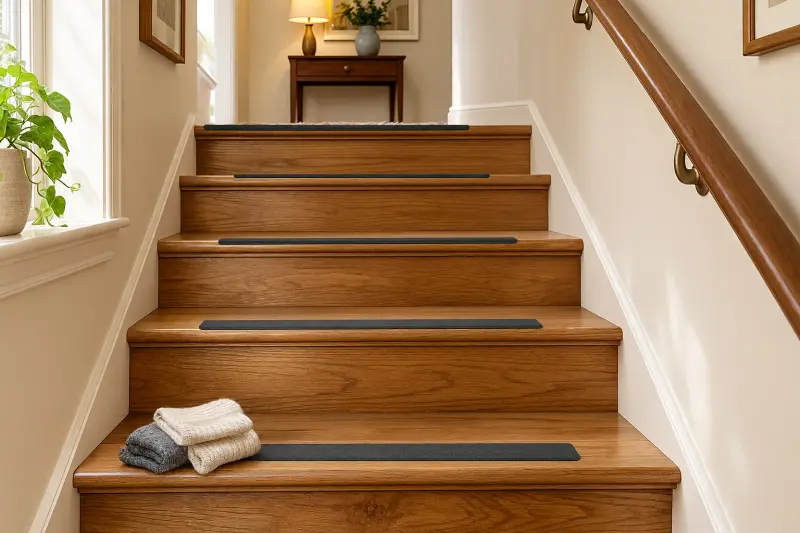
Grit tape is a thin strip with a mineral surface, a little like fine sandpaper. It is low and firm, so it barely changes the height of the step. Rubber treads are thicker strips with a ribbed or textured top.
Carpet stair treads are soft rectangles laid on each step, usually with a backing meant to grip the wood. They feel kind on bare feet and look more like a rug. The CDC's home safety brochure says carpet must be firmly attached to every step, or removed and replaced with non-slip rubber treads.
That one line is the real test for any tread. If it can slide, curl or lift at a corner, it can become the very thing someone trips on.
- Grit tape: slim, firm grip; can feel rough on bare feet
- Rubber treads: thicker and textured; check the edges stay flat
- Carpet treads: softer and quieter; must not shift when stepped on
- Reflective or contrasting strips: help the step edge stand out
What to check on your stairs first
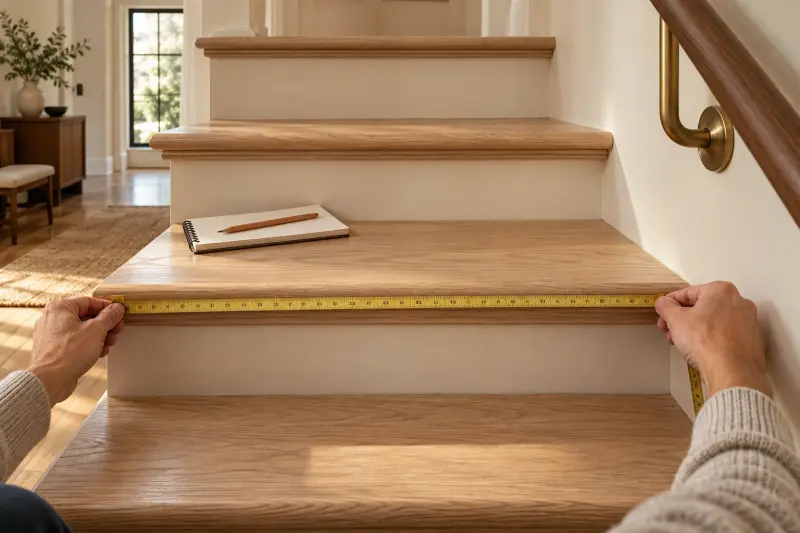
Before buying, walk the stairs slowly with the person who uses them most. Notice where their foot lands and whether they look down at the edges. Measure the width of one step, since most treads are cut or sold to a set length.
The UK Health and Safety Executive, writing about care settings, says stairs should have good slip resistance, particularly at the leading edge, clearly marked edges, good lighting and handrails that contrast with their surroundings. The same ideas carry over well to a family home.
Then check the surface itself. 3M's tread pages say the self-adhesive backing is meant for clean metal, while clean, dry wood, concrete or stone need a contact adhesive as well.
- Step width, and how far back from the edge the foot lands
- Surface: bare wood, painted wood, stone, concrete, metal or carpet
- Indoor or outdoor, and whether the steps get wet
- Light at the top and bottom, and whether edges are easy to see
- A firm handrail, ideally on both sides
How the three 3M non slip stair treads compare
All three picks come from 3M's Safety-Walk range, and all are firm grip strips rather than soft carpet treads. They suit bare wood, stone, painted and outdoor steps, where a slim strip near the edge does the most work.
The facts below come from 3M's own pages and the verified Amazon titles. Sizes differ by market, so match the listing you buy to the step you measured.
- Reflective Tread 7768NA: 6 x 24 in (15 x 61 cm) tread with a reflective strip; indoor or outdoor; 3M aims it at low-light areas
- Home and Recreation Tread: 1, 2 or 4 in wide; gray or black; pre-cut or roll; trim with scissors; 3M lists stair treads and home steps
- General Purpose 610: mineral-coated, low-profile tape in black; 3M lists steps and stairways and NFSI High Traction Certification for the 600 series
- Fixing for all three: self-adhesive on clean metal; 3M advises contact adhesive on wood, concrete or stone for the two tread pages
Fitting non slip stair treads so they stay put
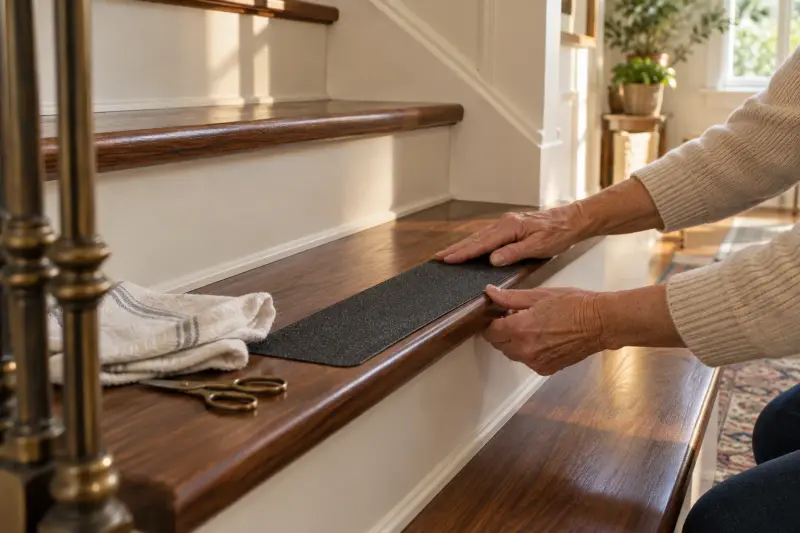
Clean each step well and let it dry fully, since 3M says the surface must be clean, and wood, concrete or stone dry. Place each strip a short, even distance back from the front edge, where the ball of the foot lands, and press it down firmly from the middle out.
On wood or stone, follow 3M's advice and use a contact adhesive. Before you do, ask yourself one question: "Am I happy for this to stay, or will I want it off the wood one day?" 3M's pages do not say how the strips come off, so a renter should ask the landlord first.
Check the treads every few weeks. Run a hand along each edge, and replace any strip that has started to lift.
- Clean and dry each step before fitting
- Keep every strip the same distance from the edge
- Trim each strip to the step width with scissors, cutting cleanly
- Walk the stairs once in the shoes or socks used every day
- Keep the stairs clear of shoes, bags and laundry
When to ask for a home safety visit
Treads add grip, but they cannot steady a person whose balance or strength has changed. If someone has slipped on the stairs, holds the wall to get down, or has started to avoid going upstairs, speak to their doctor.
An occupational therapist can look at the whole stair: rails, light, step edges and how the person moves. Ask them plainly: "Would a second handrail, better light or a different tread help most here?" In an emergency after a fall, call 911.
- A recent slip, trip or near miss on the stairs
- Holding the wall or furniture to climb
- New dizziness, weakness or changes in eyesight
- Loose steps or rails, which need a repair first
MAKE THE SPEND MEANINGFUL
Stair treads for older adults: low-cost alternatives
- Fix loose stair carpet or remove a slippery runner, as the CDC suggests
- Add a brighter bulb or a light switch at both the top and bottom of the stairs
- Wear well-fitting shoes with grippy soles on the stairs instead of socks
In brief
Stair treads for older adults: questions answered
Are carpet stair treads safe for older adults?
They can be, as long as each one stays firmly in place. The CDC says carpet must be firmly attached to every step. Press a foot on the front edge of each tread and try to slide it. If it moves, curls or lifts at a corner, fix it down properly or choose a tread that is stuck or glued instead.
Where should non slip stair treads go on the step?
Near the front edge, where the ball of the foot lands when going down. The UK Health and Safety Executive stresses good slip resistance at the leading edge of a step. Keep every strip the same distance back from the edge, so the stair looks and feels even, and nobody has to look for the grip with each step.
Do stick-on stair treads need extra glue?
It depends on the surface. 3M's tread pages say the self-adhesive backing is for clean metal, and that clean, dry wood, concrete or stone need a contact adhesive such as 3M 90 Spray Adhesive. Before you buy, ask: "What is my stair made of, and am I happy for this to stay on for good?"
Will treads alone stop falls on the stairs?
No single product can do that. Treads add grip, but the CDC also points to handrails on both sides that run the full length of the stairs, light at the top and bottom, and keeping objects off the steps. If balance or strength has changed, an occupational therapist can look at the whole stair with you.
How this guide was prepared
AI-assisted editorial research, checked against the linked primary sources.
Written with AI assistance from the sources listed below and checked against them. We have not tested these products in person.
How we use sources and AI assistance ↗Sources & fact checks
The guide separates sourced facts from editorial questions and examples. How we use sources and AI assistance.
- CDC STEADI Check for Safety: carpet firmly attached to every step, or non-slip rubber treads ↗
- HSE: reducing the risk of falls on stairs, including leading edges, lighting and handrails ↗
- 3M Safety-Walk Reflective Tread 7768NA ↗
- 3M Safety-Walk Home and Recreation Tread ↗
- 3M Safety-Walk General Purpose 610, black, 2 in x 60 ft roll ↗
Found an error or an outdated detail? Contact the editorial team.