

In brief
TV headphones suit a household where one person needs the TV louder than everyone else. A wireless set has a transmitter that plugs into the TV and headphones the listener wears. First check which audio output your TV has, such as optical or a 3.5 mm headphone jack. Then choose between long-battery over-ear headphones and lighter under-chin sets with balance controls.
Shortlisted for this decision
Affiliate-
Shortlisted
Avantree Ensemble TV Headphones
For one person setting their own TV volume
Over-ear headphones that charge on a dock and plug into the TV's optical or headphone output, so one person sets their own volume.
Check price on AmazonCheck first: Not for HDMI-only TVs or soundbar passthrough; check the TV's outputs first.
-
Shortlisted
SIMOLIO SM-823D Pro TV Headset
For ears that differ, balance and tone
Left-right balance, tone and mono controls help when ears differ, with optical, RCA and 3.5 mm inputs.
Check price on AmazonCheck first: Battery lasts 5 to 7 hours, so it needs daily charging; uses ear tips, not over-ear cups.
Affiliate links: we may earn a commission from qualifying purchases at no extra cost to you. Prices are shown only on Amazon. Amazon.com (US listing). See the full comparison ↓
Documented options
TV headphones for seniors: options compared
Options based on manufacturer documentation. Retailer links are affiliate links: we may earn a commission from qualifying purchases.
Affiliate retailer links
-
Avantree Ensemble Wireless Headphones for TV Watching
Exact variant: Headphones with transmitter and dock
View product details on Amazon — United States -
Avantree Ensemble Wireless Headphones for TV Watching
Exact variant: Headphones with transmitter and dock
View product details on Amazon — Germany -
Avantree Ensemble Wireless Headphones for TV Watching
Exact variant: Headphones with transmitter and dock
View product details on Amazon — France
Affiliate retailer links
-
SIMOLIO TV Headphones Wireless SM-823D Pro
Exact variant: SM-823D Pro
View product details on Amazon — United States -
SIMOLIO TV Headphones Wireless SM-823D Pro
Exact variant: SM-823D Pro
View product details on Amazon — France -
SIMOLIO TV Headphones Wireless SM-823D Pro
Exact variant: SM-823D Pro
View product details on Amazon — Spain
IN THIS GUIDE
Who wireless TV headphones for seniors help
TV headphones solve a common household argument: one person turns the volume up, and everyone else turns it down. With a wireless set, the listener hears the TV at their own level while the room stays at normal volume.
They also help late at night, when a partner is asleep, or in shared rooms. They are a listening aid, not a hearing test. If speech has become hard to follow in many places, a hearing check comes first.
Think about who else watches. If a partner also wants headphones, check whether a second headset can pair with the same transmitter. If everyone else prefers the speakers, make sure the TV can keep them on while the headphones play.
- One viewer needs the TV much louder than others
- Dialogue sounds muddy under music and effects
- Late-night watching without waking anyone
- Hearing differs between the left and right ear
Check your TV connections first
This is where most returns start. Look at the back of the TV for an optical output, often labeled optical or digital audio out, and a 3.5 mm headphone jack. Some newer TVs only send sound through HDMI.
Check what else is already plugged in. If a soundbar uses the optical port, you may need a splitter or the TV's headphone jack instead. Take a photo of the TV's ports before you shop and compare it with the brand page.
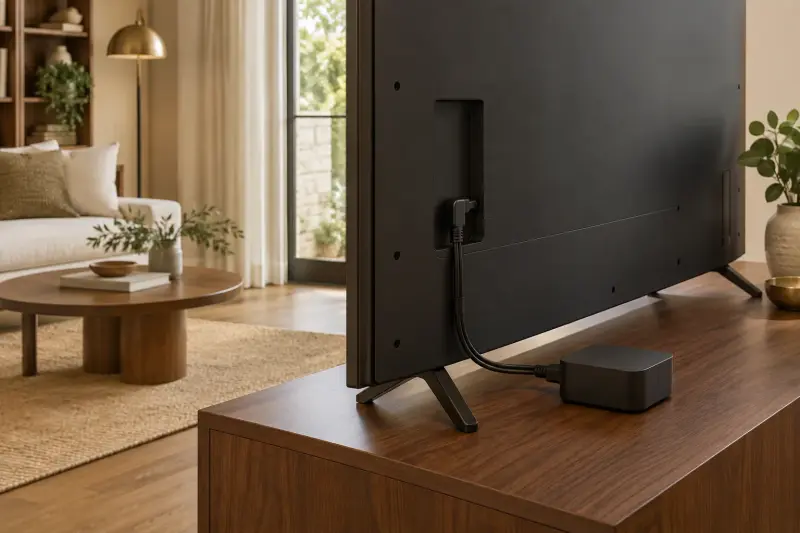
If the ports are hard to reach, ask a family member to take the photo and note any labels. You only need to set the transmitter up once. After that, the listener just picks up the headphones and switches them on.
- Optical output: supported by both picks below
- 3.5 mm headphone or AUX output: supported by both picks
- RCA red and white outputs: supported by the SIMOLIO set
- HDMI-only TVs need an audio extractor for the Avantree set
- A soundbar on the optical port may need a splitter
How the TV headphones picks compare
Both picks have their own manufacturer pages. The facts below come from those pages and the Amazon titles, not from our own testing.
The Avantree Ensemble is an over-ear set with long battery life and a charging dock. The SIMOLIO SM-823D Pro is a light under-chin style headset with ear tips, tone and left-right balance controls, and a shorter battery.
The Avantree brand page appears to describe a newer Ensemble version than some older Amazon listings. Confirm the version on the listing before ordering. Other TV headphones are sold online, but we only list sets whose brand publishes its own page for the exact model.
- Style: Avantree is over-ear headphones at 234 g (about 8 oz); SIMOLIO is an under-chin headset with memory foam ear tips
- Battery: Avantree up to 35 hours with dock charging; SIMOLIO 5 to 7 hours, 2 to 3 hours to charge
- Range: Avantree headphones up to 30 ft; SIMOLIO up to 164 ft on 2.4 GHz
- Inputs: Avantree optical and 3.5 mm; SIMOLIO optical, RCA and 3.5 mm
- Controls: SIMOLIO adds treble or bass tone, left-right balance, stereo or mono and an ambient sound mode
Comfort, controls and charging
Comfort decides whether headphones get used. Over-ear cups spread the weight but can feel warm and press on glasses. Under-chin sets are lighter but put tips in or near the ear, which some people dislike.
Charging is the other daily habit. A dock that the headphones simply sit on is easy to remember. A short battery means charging every day, so plan a spot beside the chair where the charger always lives.
Balance and mono controls can help when one ear hears better than the other. Large, easy-to-find volume buttons matter more than extra features.
Think about getting up mid-show, too. A wireless set lets the listener walk to the kitchen without unplugging anything, but sound may drop beyond the stated range or behind several walls. Treat range figures as best-case numbers.
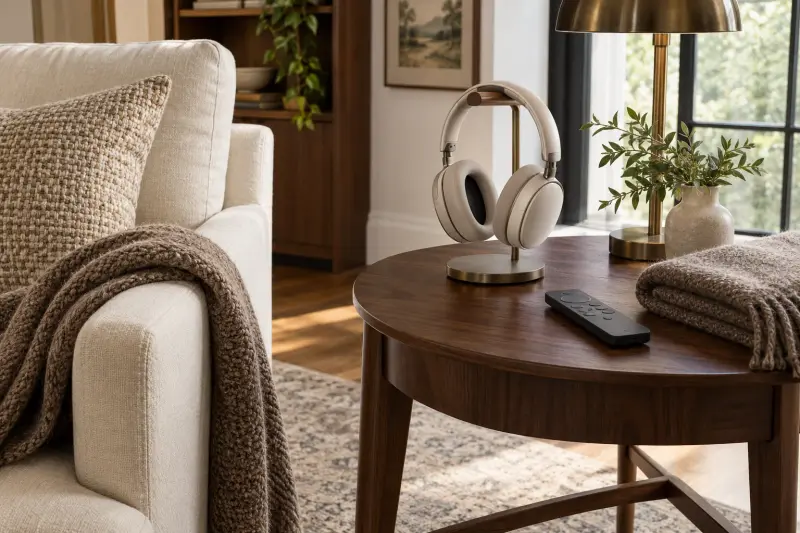
- Try the weight and fit with glasses on if possible
- Find the volume control by touch without looking
- Choose a charging spot within reach of the chair
- Check whether a second headset can join for a partner
When to get hearing advice
The National Institute on Deafness and Other Communication Disorders notes that personal amplifiers are useful when watching TV. That makes TV headphones a reasonable everyday step, but they do not diagnose or treat hearing loss.
If the person also struggles with conversation, phone calls or noisy rooms, book a hearing test with an audiologist or doctor. Very high headphone volumes can also be uncomfortable, so keep levels moderate.
- Trouble following conversation: book a hearing test
- Ringing in the ears or sudden change: see a doctor promptly
- Hearing aid users: ask the audiologist about TV streaming options
- Keep headphone volume at a comfortable level
Common mistakes to avoid
The most common mistake is buying before checking the TV outputs. The second is choosing a set with a short battery for someone who will forget to charge it.
Some buyers also expect the TV speakers to keep playing for everyone else. On some TVs, plugging into the headphone jack mutes the speakers. Check the TV settings, or use the optical output where the TV allows both.
A final mistake is setting the headphones up once and never showing the listener how to recover from a problem. Write down the two or three steps to reconnect or recharge and keep the note by the charging spot.
- Not photographing the TV ports before buying
- Ignoring a soundbar already using the optical port
- Choosing a short battery for an irregular charger
- Assuming the Amazon listing matches the latest brand version
MAKE THE SPEND MEANINGFUL
TV headphones for seniors: low-cost alternatives
- Turn on TV captions and any dialogue or clear voice setting before buying anything.
- Use wired headphones on a long extension cable from the TV's headphone jack, if the cable can run safely away from walkways.
- Ask an audiologist whether existing hearing aids can stream TV sound with an accessory.
In brief
TV headphones for seniors: questions answered
Do wireless TV headphones work with any TV?
Not always. Most sets connect through an optical output or a 3.5 mm headphone jack, and some also accept RCA. TVs that only output sound through HDMI may need an audio extractor. Photograph your TV's ports and compare them with the inputs listed on the manufacturer page before buying.
Can others hear the TV speakers while I use headphones?
It depends on the TV. Some TVs mute their speakers when the headphone jack is used, while the optical output often lets both play. Look in the TV's sound settings for an option to keep speakers on, or ask the TV maker how its outputs behave.
Are TV headphones a substitute for hearing aids?
No. The NIDCD describes personal amplifiers as useful for watching TV, but TV headphones do not test, diagnose or treat hearing loss. If conversation and phone calls are also difficult, book a hearing test with an audiologist or doctor. They can still be a useful everyday step for TV time.
Which is more comfortable, over-ear or under-chin headphones?
It is personal. Over-ear cups spread weight across the head but can feel warm and press on glasses. Under-chin sets are lighter but place tips in or near the ear. If possible, let the listener try both styles before choosing.
How this guide was prepared
AI-assisted editorial research, checked against the linked primary sources.
Written with AI assistance from the sources listed below and checked against them. We have not tested these products in person.
How we use sources and AI assistance ↗Sources & fact checks
The guide separates sourced facts from editorial questions and examples. How we use sources and AI assistance.
- Avantree: Ensemble wireless headphones for TV ↗
- SIMOLIO: SM-823D Pro wireless TV headset ↗
- NIDCD: Assistive devices for people with hearing, voice, speech or language disorders ↗
Found an error or an outdated detail? Contact the editorial team.