

In brief
A gait belt is a sturdy waist belt that a caregiver holds to steady someone who can bear weight while they stand, walk or transfer. Buy one that buckles over everyday clothes with spare strap to grip, plain or with handles. Fit it snug with room for your fingers underneath, and never use it to lift.
Shortlisted for this decision
Affiliate-
Shortlisted
Vive Gait Belt, 60 in
For guiding, plain belt with locking buckle
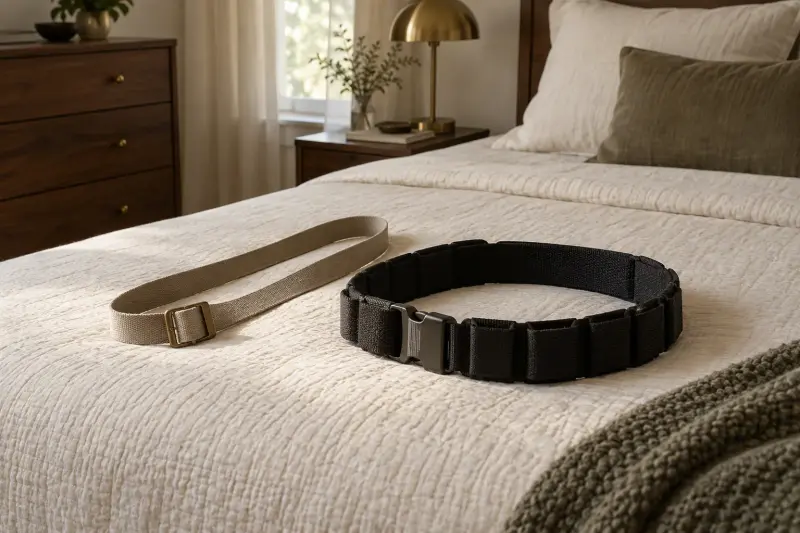
Plain 2 in cotton belt with a metal locking buckle; this listing is the 60 in length.
Check price on AmazonCheck first: A guiding aid, not a lifting device; check the 60 in length fits the waist over clothing.
-
Shortlisted
Vive Transfer Belt with Handles
For carers wanting fixed handle grips
Padded handles give the carer several fixed grip positions instead of holding the belt fabric.
Check price on AmazonCheck first: Fits waists up to 54 in; confirm seven handles on the listing before buying.
Affiliate links: we may earn a commission from qualifying purchases at no extra cost to you. Prices are shown only on Amazon. Amazon.com (US listing). See the full comparison ↓
Documented options
Gait belts and transfer belts: options compared
Options based on manufacturer documentation. Retailer links are affiliate links: we may earn a commission from qualifying purchases.
Affiliate retailer links
-
Vive Gait Belt - Transfer Assist Device for Caregiver, Nurse
Exact variant: 60 Inch
View product details on Amazon — United States
Affiliate retailer links
-
Vive Gait Belt Transfer Belt with Handles
Exact variant: 350 lb listing, handles version
View product details on Amazon — United States
IN THIS GUIDE
What a gait belt does at home
A gait belt, also called a transfer belt, buckles snugly around the waist. The caregiver holds the belt instead of an arm or clothing, which gives a steadier grip close to the person's center. Families often buy one after a hospital stay, when a parent comes home a little less steady on their feet.
MedlinePlus describes using a gait belt to get a grip during a bed-to-wheelchair transfer. The same guidance assumes the person can stand on at least one leg. If they cannot, it says a lift is needed instead.
- Used for standing up, sitting down, short walks and bed-to-chair or toilet transfers.
- Gives a firm handhold that does not pull on skin, arms or shoulders.
- Works only when the person can bear some of their own weight.
- Does not replace a mechanical lift, a second caregiver or professional training.
Choosing length, buckle and grip
Length is the first check. Measure around the waist over the clothes the person usually wears, then choose a belt that fastens with spare length to grip and tuck away. Plain belts are usually sold by belt length, while handled belts tend to list a waist range.
Next, decide how you want to hold it. A plain belt is gripped from underneath, hand palm-up. A belt with sewn handles gives fixed places to hold, which some caregivers find easier on the hands. Handles also let two caregivers hold the same belt from different sides, if a therapist has advised that.

- Waist measurement over everyday clothing, not bare skin.
- Buckle type: metal with locking teeth, or a quick-release clip.
- Material: soft cotton webbing or heavier nylon with padding.
- Handle count and spacing, if you prefer fixed grips.
- Washing instructions, since the belt is used daily.
How the two transfer belt picks compare
Both picks come from the same maker but suit different preferences. The figures below are from the Vive Health product pages.
Neither belt changes who can be helped safely. The choice is about fit, grip and washing. If the person's waist is above 54 in, only the plain belt in its longer lengths is listed to fit.
- Vive Gait Belt: cotton, 2 in wide, latex-free, metal quick-release buckle with locking teeth.
- Vive Gait Belt sizes: 54, 60 or 72 in; machine washable, air dry.
- Vive Transfer Belt with Handles: heavy-duty nylon, 3.94 in wide, seven padded handles.
- Transfer Belt with Handles fit: waists 30-54 in, plastic quick-release buckle, 0.64 lb.
- The handles version's maker page does not state a weight capacity.
How to use a gait belt, step by step
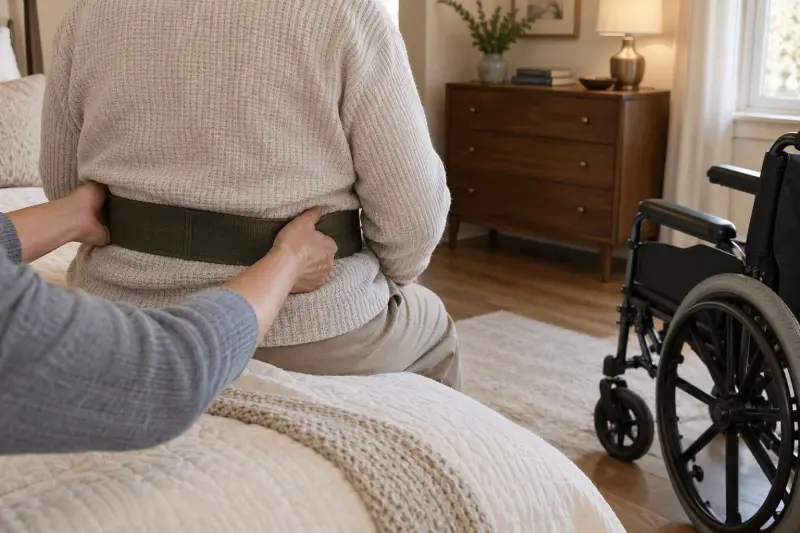
Put the belt around the waist over clothing, with the buckle at the front. Thread it through the buckle teeth and the locking loops, then tighten until it is snug with just enough room to slide your fingers underneath. Tuck the loose end away and ask whether it feels comfortable.
For a bed-to-chair move, MedlinePlus describes bringing the person to the edge of the bed with feet on the floor, locking the wheelchair brakes, counting to three aloud and standing slowly. The caregiver bends at the knees, keeps the back straight and turns by moving the feet rather than twisting.
During a walk, stand slightly behind and to the weaker side, with one hand on the belt. Walk at the person's pace and plan rest stops. If they start to fall, the aim is to ease them down safely, not to hold them up at any cost.
- Step 1: explain the move, lock the brakes and clear the route.
- Step 2: fit the belt over clothing, buckle at the front, room for your fingers.
- Step 3: grip from underneath, palms up, at both sides of the waist.
- Step 4: count to three together while the person pushes up with legs and hands.
- Step 5: remove the belt when the walk or transfer is finished.
Who should not use a transfer belt, and when to get advice
A belt is easy to buy, but the technique matters more than the product. A physical therapist, occupational therapist or home health nurse can show a caregiver how to stand, where to hold and when to stop, and many will watch a real transfer at home.
Some situations call for a different method altogether. Never use a gait belt as a restraint or to keep someone in a chair, and never fasten it over a wound, tube or sore area. Ask again whenever things change.
- The person cannot stand on at least one leg; MedlinePlus says a lift is needed instead.
- They have had recent abdominal, chest or back surgery, or have a feeding tube.
- They are too drowsy or confused on the day to follow a simple count.
- Transfers are becoming heavier or less predictable.
- The caregiver has back pain or feels unsure during moves.
Common transfer belt mistakes
Most problems come from fit and habit rather than the belt itself. A belt that is too loose rides up under the arms during a stand, which moves the caregiver's grip away from the person's center.
Another common slip is treating the belt as a handle for pulling. The caregiver should guide and steady, while the person pushes up with their own legs and hands. If that is no longer possible, the plan needs to change, not the grip.
Belts also wear. Check the stitching, webbing and buckle before each use, and replace a belt that is frayed, stretched or slow to lock.
- Fastening the belt loosely so it slides toward the chest.
- Pulling on the belt instead of letting the person stand.
- Leaving the belt on after the move is finished.
- Skipping the check of stitching and buckle teeth.
- Starting a transfer before brakes are on and the route is clear.
MAKE THE SPEND MEANINGFUL
Gait belts and transfer belts: low-cost alternatives
- Ask the hospital, therapist or home health service whether a belt is supplied at discharge.
- Some local loan closets and senior centers lend gait belts and other aids.
- A free training session with a therapist often does more for safety than a costlier belt.
In brief
Gait belts and transfer belts: questions answered
What is a gait belt used for?
A gait belt gives a caregiver a secure grip while helping someone stand up, sit down, walk or move between a bed, chair, toilet or car. Transfer belt usually means the same thing, and some versions add sewn handles. It steadies and guides a person who can bear weight; it is not designed to lift someone who cannot.
What size gait belt do I need?
Measure around the waist over the clothes the person usually wears. Choose a belt that buckles at that size with enough spare length to hold the end and tuck it away. Plain belts often come in several lengths, such as 54, 60 or 72 in, while handled belts list a waist range, such as 30-54 in.
How tight should a transfer belt be?
Snug, with just enough room to slide your fingers between the belt and the person. Fit it over clothing around the waist, buckle at the front, so it cannot ride up toward the chest during a stand. Avoid wounds, tubes and recent surgical sites, and recheck the fit before each walk or transfer.
Can a transfer belt be used to lift someone?
No. A gait belt gives the caregiver a secure grip while the person does much of the work. MedlinePlus guidance for bed-to-wheelchair transfers assumes the person can stand on at least one leg. If they cannot, it says a lift is needed. Ask a therapist about the right equipment and technique.
How this guide was prepared
AI-assisted editorial research, checked against the linked primary sources.
Written with AI assistance from the sources listed below and checked against them. We have not tested these products in person.
How we use sources and AI assistance ↗Sources & fact checks
The guide separates sourced facts from editorial questions and examples. How we use sources and AI assistance.
- MedlinePlus: moving a patient from bed to a wheelchair (gait belt use and one-leg standing) ↗
- Vive Health Transfer Belt (gait belt): lengths, width, buckle and care ↗
- Vive Health Transfer Belt with Handles: handles, waist range and material ↗
- Drugs.com care notes: how to use a gait belt (buckle at front, snug with room for fingers) ↗
Found an error or an outdated detail? Contact the editorial team.