
In brief
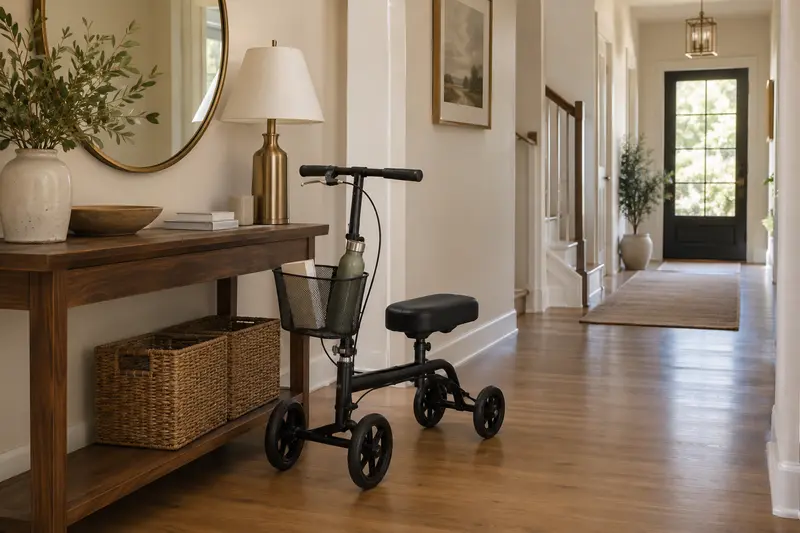
A knee scooter is a wheeled frame with a padded knee rest that lets you keep weight off one foot or ankle after injury or surgery, and unlike crutches it cannot be used on stairs. Choose a steerable model whose height range and weight limit fit you, with a locking hand brake. First confirm your surgeon allows it and your daily route has no steps.
Shortlisted for this decision
Affiliate-
Shortlisted
KneeRover Deluxe KneeCycle, Blue
For a steerable knee walker with brakes
Steerable knee walker with rear drum brakes, 7.5 in wheels and a basket; the maker lists a 300 lb capacity.
Check price on AmazonCheck first: Weighs 24.7 lb to lift into a car; check user height is 4 ft 9 in to 6 ft 4 in.
Affiliate links: we may earn a commission from qualifying purchases at no extra cost to you. Prices are shown only on Amazon. Amazon.com (US listing). See the full comparison ↓
Documented options
Knee scooter guide: options compared
Options based on manufacturer documentation. Retailer links are affiliate links: we may earn a commission from qualifying purchases.
Affiliate retailer links
-
KneeRover Deluxe KneeCycle Steerable Knee Walker
Exact variant: Blue
View product details on Amazon — United States
IN THIS GUIDE
Who a knee scooter suits
A knee scooter, also sold as a knee walker, has a padded platform for the bent knee of the injured leg and wheels on a steerable frame. The user pushes along with the other foot and steers with the handlebar. Many people find it less tiring than crutches on flat floors, though it brings its own limits.
The American Orthopaedic Foot and Ankle Society describes being non-weightbearing as putting no weight at all on the foot, not even for a second. Crutches, knee scooters and walkers are all options, and the surgeon decides which ones fit the recovery plan.
- Suits: a foot or ankle injury or surgery with orders to avoid weight on that foot.
- Suits: steady balance and a strong opposite leg.
- Not for: an injury at or above the knee on that side, since you kneel on it.
- Check first: knee pain on the injured side, which can make kneeling hard.
- Check first: steps between rooms or at the entrance.
How to size and set up a knee scooter for your home
Fit starts with the user's height. Compare it with the maker's stated range before anything else, then check the weight limit. KneeRover lists its Deluxe KneeCycle for users 4 ft 9 in to 6 ft 4 in, up to 300 lb.
Set the knee pad so the injured leg rests bent at about 90 degrees with the good foot flat on the floor. Set the handlebar near waist height so the arms are relaxed. KneeRover's safety guidance gives both settings.
Choose steerable over fixed if the home has tight turns. A steerable front end turns with the handlebar, while a non-steerable frame must be lifted or pivoted at every corner.

- User height and weight, against the maker's stated ranges.
- Knee bent at about 90 degrees on the pad.
- Handlebar near waist height, elbows slightly bent.
- Steerable front end for hallways and bathroom turns.
- Narrowest doorway on the daily route, and the turn into the bathroom.
Knee scooter, crutches or walker: how they compare
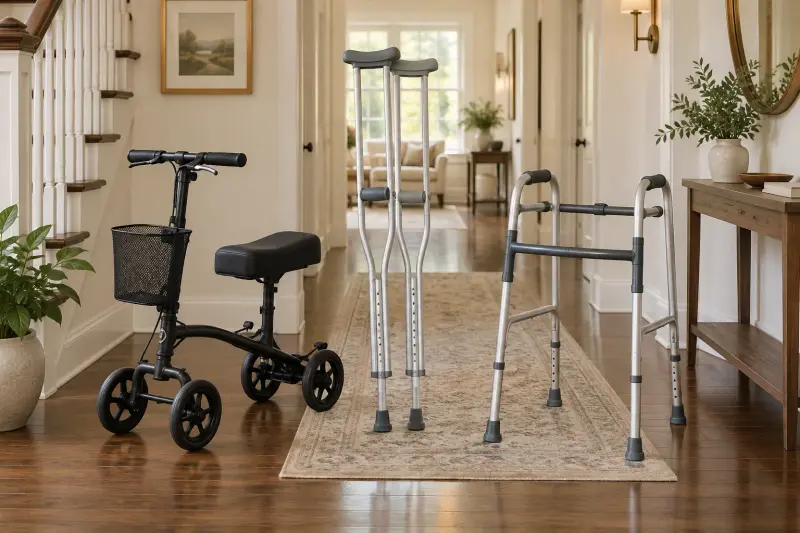
Each option keeps weight off the foot in a different way. The comparison below uses the same plain attributes for each, plus the maker's figures for the one model in this guide.
The right choice depends on the user's balance, strength and home, and on what the surgeon allows. Many people end up using two aids: a knee scooter on the main floor and crutches for stairs.
- Knee scooter: hands free to steer, needs kneeling on the injured side, cannot climb stairs.
- Crutches: compact and work on stairs once taught, need arm strength and balance.
- Walker: stable frame, hopping on one leg can be tiring, cannot climb stairs.
- KneeRover Deluxe KneeCycle: rated to 300 lb, weighs 24.7 lb, 7.5 in wheels, handlebar 34.5-41.5 in.
- KneeRover Deluxe KneeCycle: rear drum brakes, tie-rod steering, basket, folds to 17 in high, user height 4 ft 9 in to 6 ft 4 in.
How to use a knee scooter safely at home
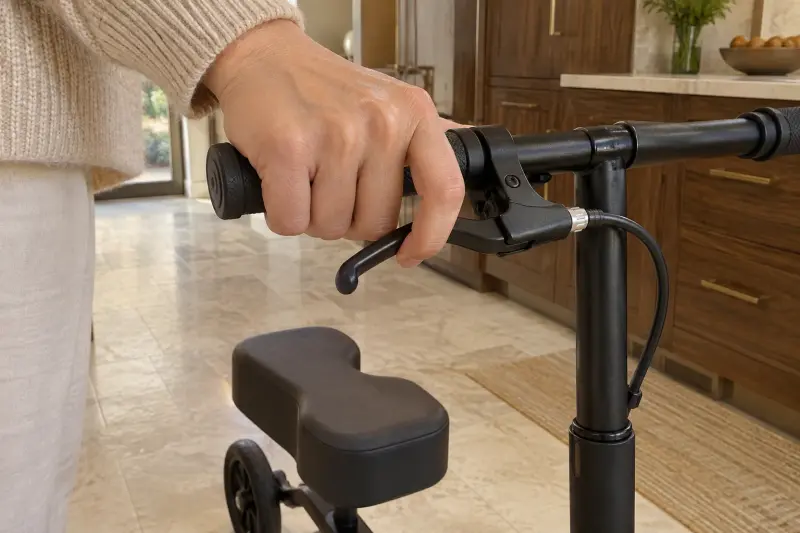
KneeRover advises engaging the hand brake before getting on, so the scooter cannot roll away. Rest the shin on the pad, hold the handlebar, release the brake and push off gently with the good foot. Practice in a clear room before tackling the bathroom.
Turn slowly. KneeRover warns that a fast turn can tip the scooter. Keep the knee on the pad, the head up and the body over the center of the frame, and avoid reaching to the side. Park against a wall with the brake on before stepping off onto the good leg.
- Lock the brake before getting on or off.
- Turn slowly; wide, gentle turns are steadier than sharp ones.
- Never use a knee scooter on stairs.
- Take extra care on wet floors, thick rugs and raised thresholds.
- Check nuts and bolts regularly, since they can loosen with use.
Set up the home for a few weeks on wheels
Most people use a knee scooter for weeks rather than years. Before the first day, measure the narrowest doorway on the daily route and the turn into the bathroom. A scooter that cannot turn into the bathroom will be parked in the hall most of the day.
Bring daily items to counter height and clear a loop through the main rooms. Thick carpet makes pushing harder, and the scooter must stay on one level, so plan the bathroom and any stairs early.
- Check the car trunk opening if the scooter must travel folded.
- Roll up loose rugs and tape down cable runs.
- Move daily items to waist height in the kitchen and bathroom.
- Set up a bed or sitting area on the main floor if stairs are a problem.
- Add night lights and keep a chair where the scooter is parked.
When to get personal advice
The surgeon's orders come first. FootCareMD warns that putting weight on the foot too early can damage the repair and lead to a longer recovery, so ask exactly what is allowed and for how long.
A physical therapist can check the scooter's setup, teach safe getting on and off, and plan the stairs. Ask again if anything changes, such as new pain in the kneeling knee or a near fall.
Older adults, and anyone with balance or vision problems, may need a different aid altogether. That is a decision for the care team, not a product page.
- Pain, numbness or swelling in the kneeling knee.
- Dizziness, weakness or a near fall while using the scooter.
- Stairs that must be climbed every day.
- Doubt about how much weight the foot may take.
- A change in the recovery timeline after a checkup.
MAKE THE SPEND MEANINGFUL
Knee scooter guide: low-cost alternatives
- Many medical equipment suppliers and some insurers offer knee scooter rental for short recoveries.
- Hospital loan programs, churches and senior centers sometimes lend knee walkers.
- Crutches or a walker may already be supplied at discharge; ask whether either is enough.
In brief
Knee scooter guide: questions answered
Knee scooter or crutches: which is better after foot surgery?
It depends on the person and the home. A knee scooter needs less arm strength and frees the hands to steer, but it cannot be used on stairs. Crutches work on stairs once taught but demand balance and upper-body strength. Ask the surgeon or physical therapist which suits your recovery.
Can you use a knee scooter for a knee injury?
Usually not. A knee scooter works by kneeling on the injured side, so it suits injuries below the knee, such as a broken ankle or foot surgery. An injury at or above the knee on that side generally needs a different aid. Ask the surgeon or physical therapist which option fits your injury.
Can you use a knee scooter on stairs?
No. A knee scooter is for level floors. If the home has stairs, plan another method with a physical therapist, such as crutches taught for stair use or setting up living space on one floor. Carry the scooter up separately with help, never while the user is on it.
How long can you use a knee scooter?
As long as your surgeon wants weight kept off the foot, which is often a period of weeks. The care team sets that timeline and may change it at checkups. Because use is usually short, many people compare renting with buying. Recheck the fit and the bolts if you use it for a long time.
How this guide was prepared
AI-assisted editorial research, checked against the linked primary sources.
Written with AI assistance from the sources listed below and checked against them. We have not tested these products in person.
How we use sources and AI assistance ↗Sources & fact checks
The guide separates sourced facts from editorial questions and examples. How we use sources and AI assistance.
- FootCareMD (American Orthopaedic Foot and Ankle Society): crutches, knee scooters, walkers and seated scooters ↗
- KneeRover: how to safely operate a knee walker (handlebar at waist height, knee at 90 degrees) ↗
- KneeRover Deluxe KneeCycle product page: brakes, steering and specifications ↗
Found an error or an outdated detail? Contact the editorial team.