

In brief
Find the exact seat’s current care instructions and keep an inspection and parts record. Do not copy another model’s cleaning recipe or replace a foot with a similar-looking component. If damage or instability is suspected, stop using the questionable setup and ask the manufacturer or responsible provider for guidance.
IN THIS GUIDE
Identify the shower seat before choosing a cleaning method
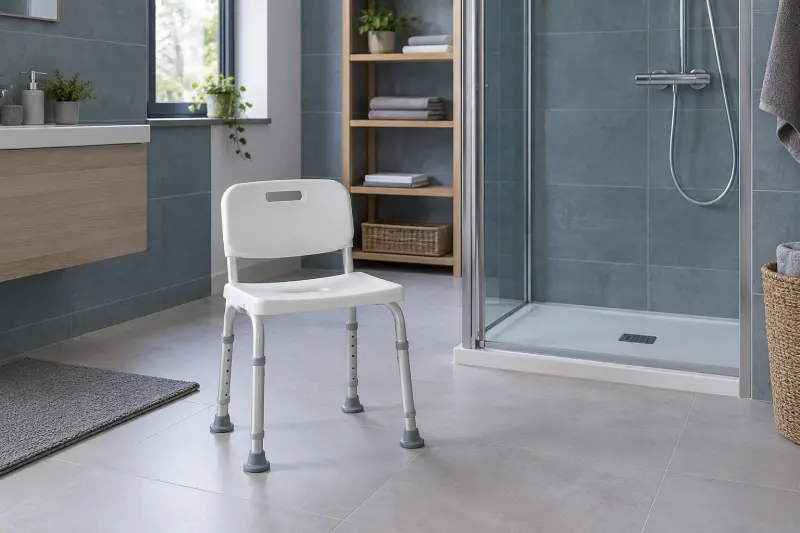
Begin with the exact seat, not a generic search for how to clean shower chairs. Record its manufacturer, model, configuration and any approved accessories. A stool, a chair with arm supports and a wall-mounted seat can have different care requirements. Even products sharing a name may have variants that need the appropriate documentation.
Look for the supplied instructions and product identification without moving equipment in an awkward way. If the seat was provided by a care service, ask that service for its record and the applicable user information. A household member should not dismantle the seat just to discover a model number. Mark missing information and ask for help finding it.
Keep the information privately in a simple equipment folder. Include the purchase or service reference, supplier contact and the date of the manual you obtained. You do not need to enter the user's diagnosis into a public maintenance tool. Product identity and care responsibility are enough to organize the practical record.
The purpose is to avoid a common mismatch: applying a cleaning recipe from a similar-looking chair to a different material, pad or fixing. A generic blog cannot approve a chemical or method for every product. Once the exact instructions are found, your worksheet can translate the required tasks into a routine the household can actually manage.
Separate user care, professional service and product information
A product page, user manual and service document can answer different questions. The product page helps identify configurations and document routes. The applicable manual describes the covered use and care. A service document may concern work that is not intended for a household user. Do not treat every downloadable sheet as permission to perform its procedures yourself.
Etac's Swift international page provides a route to product documents and spare-part information. Use that route to obtain the document appropriate to the supplied configuration and region. We are not treating the page's marketing descriptions as proof of personal suitability, or transferring Swift's care information to another maker's seat.
If a provided seat has additional instructions from its service, keep them with the manufacturer information. Ask the responsible provider about any apparent conflict before changing the routine. A note copied by a previous user may be incomplete or out of date. It should not outrank the applicable current instructions or the provider's explanation.
Make three labels in the folder: household care, contact before action and professional service. Place tasks under those labels only after their scope is confirmed. This prevents a replacement-part drawing from becoming an improvised repair guide, and makes it easier for a helper to understand what they are expected to do without guessing.
Turn the documented requirements into manageable tasks
Read the applicable instructions and list the required cleaning, drying, checking and storage tasks in plain language. Keep the manufacturer's limitations attached to each task. Do not invent a daily or weekly schedule simply because a downloadable planner has those headings. Enter intervals only when the actual instructions or responsible provider establish them.
Assign each task to a person who can carry it out comfortably. Ask about handling the equipment, reaching relevant surfaces and locating permitted supplies. If the care plan depends on lifting a chair that the household cannot manage, that is a question for the provider. Removing an inconvenient support or foot is not a solution.
Keep necessary materials together in an appropriate place under their own storage instructions. The aim is a routine that does not require searching through several cupboards while equipment is out of use. You may already own suitable supplies, but confirm compatibility rather than buying a specialist-looking cleaner simply because its label mentions bathrooms.
A practical task entry reads: “Required action from the applicable instructions; responsible person; where instructions are kept; what to do if the task cannot be completed.” The wording should allow another helper to follow the same documented routine. It should not turn an uncertain cleaning method into an established fact through repetition.
Check every approved component, not only the visible seat
A shower chair can include several materials and optional components. The visible sitting surface is only part of the equipment. Ask whether a pad, back support, feet or other supplied accessory has separate care information. A method appropriate for the main frame may not be appropriate for an attached component.
Use an inventory with one line for each fitted component. Record its identity, applicable care document and who confirms an uncertain instruction. If an accessory was added later, do not assume it is covered by the first manual you find. Ask the maker or provider to identify the correct information and whether the accessory remains appropriate.
Avoid adding substances to make a surface feel softer, smell fresher or appear shinier without permission in the documentation. Equally, do not remove a component just because it is harder to clean. The equipment's assessed configuration and the household's care ability should be considered together through the responsible provider.
For a wall-mounted seat, include the responsible installation or service contact in the record. Household cleaning is different from assessing the mounting or repairing the mechanism. A photograph of an apparently tidy hinge cannot certify its condition. Record concerns and contact the appropriate service rather than attempting a repair based on an online image.
Choose care supplies from instructions rather than advertising
The phrase bathroom cleaner does not establish compatibility with an equipment component. Compare the exact product instructions with the intended cleaning product and ask the manufacturer about unclear terminology. Do not combine chemicals, copy a recipe for a different chair or assume that a stronger concentration provides a better result.
We do not reproduce a universal disinfecting recipe here. Concentrations, contact conditions and materials can be model-specific, while a household may also have service requirements. The useful buying question is whether an existing permitted supply meets the documented task. Buying a larger selection of cleaners can increase complexity without improving the routine.
Keep the packaging information for any supply used under the applicable instructions. If a provider specifies something particular, ask for a clear name and explanation of the relevant use. A vague message such as “use the usual spray” is difficult to follow consistently and may mean different products to different household members.
If the care instructions describe professional equipment or a service process the household does not possess, do not improvise an equivalent using domestic appliances. Ask how routine household care should be carried out for the supplied seat. The practical gap should be resolved by the provider rather than hidden by a purchase recommendation.
Record an observed issue without diagnosing it yourself
Use plain descriptions for a change you notice: a component appears damaged, a part is missing, or the arrangement behaves differently. Record when it was observed and the exact product identity. Avoid declaring the technical cause from a photograph or continuing to use a questionable setup while waiting to see if the problem gets worse.
Moen's DN7100 technical sheet is a useful example of model-specific limits: it directs users to contact the stated support route about missing or damaged components and cautions against modification or substitution. That document is not a current stock recommendation and must not be applied as another manufacturer's repair instructions.
For your own equipment, use the manufacturer's or responsible provider's contact and current guidance. Explain the observation and ask what to do next, including whether the equipment should be withdrawn from use. Do not test an uncertain support by standing, jumping, leaning or applying body weight. An informal household test cannot establish its condition.
Take a clear empty-equipment photograph only if the provider requests it and it can be obtained comfortably. Keep personal details out of the image. A useful message contains the model, observation, date, supplied configuration and the question requiring an answer. That is more helpful than an unstructured request to buy whichever replacement looks similar.
Order a replacement by exact identity and approval
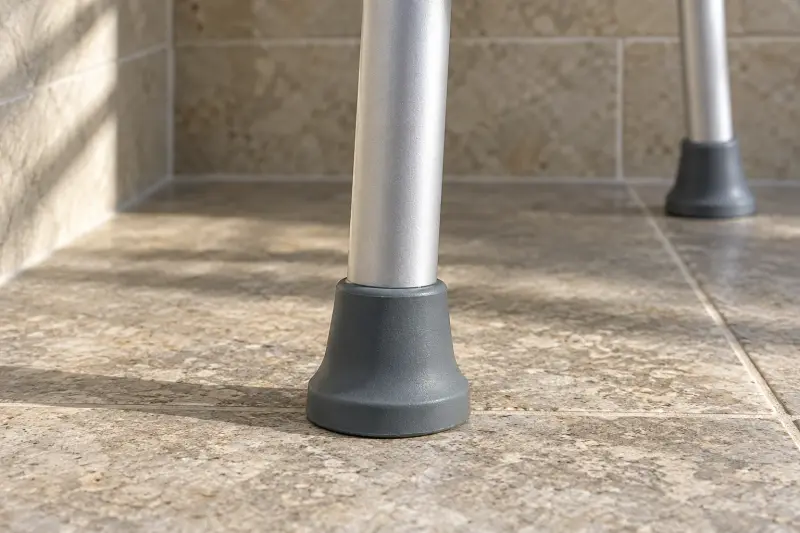
A replacement foot, pad or fastener should be matched through the correct product information, not appearance alone. Similar colour, diameter or shape is not evidence that a part is approved. Record the manufacturer's component identifier and ask the supplier to confirm compatibility with the actual model and configuration before ordering.
If the seat was supplied through a service, check who authorizes or provides replacements. Buying a part privately may bypass the responsible maintenance route or leave the provider unaware of a change. Clarify ownership and responsibility instead of assuming that equipment in the home can be altered by any household member.

Ask whether replacement requires professional attendance or a documented household procedure. A spare-part listing proves that a component is identified; it does not prove that every user should fit it. Keep the approved action with the order. This guide does not prescribe assembly sequences, tightening methods or substitutes for unavailable components.
A small approved part may avoid unnecessary replacement of the whole seat, but that decision still depends on equipment condition and continued suitability. Do not treat repair as inherently cheaper or better in every case. Ask the provider to explain the options and any unresolved issue before comparing the cost of a part with a complete new product.
Worked example: turn a vague replacement search into a useful enquiry
Imagine a fictional household noticing a worn-looking component on an existing shower chair. The first idea is to buy a pack of “universal” replacements online. The household does not know the chair's model and cannot confirm whether the component is the only issue. A broad shopping search would leave both questions unanswered.
Instead, it retrieves the original equipment record and contacts the responsible supplier. The message identifies the model and configuration, describes the observation and asks for guidance on use and the correct next step. The household does not continue using the questionable setup while conducting its own strength test or fit experiment.
The provider confirms which information or inspection is needed and whether an approved replacement is appropriate. The household records that answer before placing an order. If replacement is confirmed, the order names the exact component and the agreed fitting responsibility. If the provider advises a different route, the household follows that route rather than treating its original shopping idea as a commitment.
The example shows why careful identification can reduce wasted purchases. It does not conclude that every worn part can be repaired or that a pictured part is suitable. The successful outcome is a documented response to an actual observation, with equipment condition, approved components and responsibility kept together.
Build a care log that supports continuity
The log needs a few useful fields: date, documented task, person responsible, observation, advice received and action taken. Add a reference to the applicable manual or provider instruction. Avoid filling the record with a medical history or unrelated details. Its purpose is continuity of equipment care, especially when more than one person helps.
Keep “task completed” distinct from “equipment approved.” A household member may complete the instructed cleaning while a technical concern still requires a provider response. The log should not convert a ticked box into a condition assessment. Similarly, the absence of an observed issue is not a guarantee of personal suitability or future performance.
Use a visible pending-action entry when advice has not arrived. Include the contact date and the exact unanswered question, then follow the provider's guidance about the equipment's use. A missing response should not disappear because the next cleaning task is recorded. Clear ownership of follow-up makes the record more useful than a long calendar of ticks.

Editorial illustration
For an ordinary household, paper or a private local document is sufficient. You do not need a paid maintenance app or a public upload of equipment and health details. Choose a format the household can access, understand and keep with the relevant instructions. A brief record used consistently is more valuable than a complicated system nobody maintains.
Review handling and storage as part of the care arrangement
If the seat is moved or stored, ask the provider to explain the permitted arrangement and what setup confirmation is needed before reuse. Removable equipment is not automatically convenient for every household. The person managing it may face a different task from the person using it, and that task should be considered before buying or changing the arrangement.
Record the proposed storage space, the complete equipment footprint and any handling difficulty. Keep required bathroom routes available. A chair that fits in a cupboard mathematically may still be awkward to retrieve or reset. Do not detach supports simply to make it fit unless the appropriate instructions and provider establish the arrangement.
For shared use, describe who moves the equipment and who verifies the required configuration afterward. A cleaning helper should not assume that another household member has completed setup. Use the same equipment record so each person knows which responsibilities are confirmed and which belong to a provider. The process should not depend on remembering an informal conversation.
If the documented storage or care tasks cannot be managed, bring that problem back to the assessor or supplier. Buying a carrying strap, a generic hook or a different pad does not establish a suitable solution. The useful next step may be an alternative assessed configuration or service support rather than a collection of accessories.
Keep service, warranty and recall information separate
Keep the purchase record and warranty terms with the equipment identity, but do not use a warranty period as a maintenance schedule. A warranty describes specified responsibilities under its terms. It does not tell you that a seat is personally suitable, damage-free or ready for use for the whole stated period.
Ask which contact handles ordinary care questions, replacement parts and a possible defect. These routes may differ. A retailer can explain its return process while the manufacturer identifies components and the responsible care service manages provided equipment. Knowing the correct route helps avoid repeating the same incomplete enquiry to several unrelated sellers.
If checking an official product notice, use the exact model, identifier and relevant market. A notice for another model does not establish a problem with yours; absence from a search is not proof of approval. Follow the responsible authority or maker's applicable instructions rather than relying on a social post summarizing a recall.
Before paying for a complete replacement, ask what problem the new seat is intended to solve and whether a new assessment is needed. Changing equipment can change footprint, supports and care tasks. A new purchase should not be chosen solely because it resembles the old seat in a photograph or because the old warranty has ended.
Your final shower-seat care and parts card
Finish a one-page card with the exact seat identity, approved configuration, applicable instructions, household care responsibilities and provider contacts. Include any required intervals exactly as confirmed and a place for unresolved observations. Keep the card with the private equipment folder so another helper can find it without searching through online shopping receipts.
Add a replacement-parts section that stays blank until compatibility and responsibility are confirmed. Record the part identifier, who approved it, who supplies it and who fits it. This makes the distinction between shopping information and an authorized equipment change visible. A blank field is preferable to an invented “universal” part specification.
Review the card when the equipment, household support or routine changes. That review does not require a new product. It may simply mean updating who carries out a documented task or asking a provider about a new difficulty. Where a personal suitability question arises, use the appropriate assessment route rather than trying to solve it through maintenance alone.
The best purchase outcome can be no purchase, an approved component or a different assessed arrangement. Our shower-chair comparison guide helps with a new buying brief, while this card keeps existing equipment care organized. Neither replaces the manufacturer's instructions or a professional condition assessment. Together they help keep useful questions attached to the actual seat.
MAKE THE SPEND MEANINGFUL
Before adding to the basket.
- Use suitable existing care supplies when the exact instructions permit them.
- Keep the care log on paper or in a private local document instead of buying an app.
- Ask about an approved replacement component before assuming a whole new seat is needed.
- Contact the responsible equipment service about provision and repairs before purchasing privately.
How this guide was prepared
AI-assisted editorial research, checked against the linked primary sources. Product testing and a credentialed individual review are not claimed.
AI-assisted, source-checked editorial; no hands-on test, human expert review or personal suitability assessment claimed
How we use sources and AI assistance ↗Sources & fact checks
The guide separates sourced facts from editorial questions and examples. We have not claimed hands-on product testing. How we use sources and AI assistance.
- Etac Swift: configurations and model-specific documents; international page ↗
- Moen DN7100 technical specification: model-specific component and use cautions; not proof of current stock ↗
Found an error or an outdated detail? Contact the editorial team.