
In brief
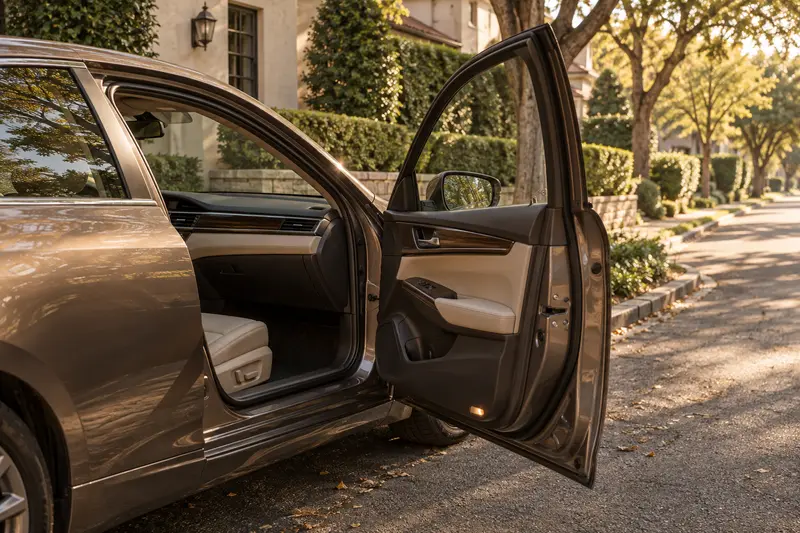
A car handle assist, or car cane, helps an elderly person stand up from the car: it is a small portable grip that slots into the U-shaped striker latch on the door frame, giving a fixed hand-hold. It suits people who can stand with a firm push. Check that your car has a U-shaped latch with room around it, and that the user's weight is within the rating.
Shortlisted for this decision
Affiliate-
Shortlisted
Vive car handle assist
For a hand-hold getting into the car
Slots into a U-shaped door latch on either side for a firm hand-hold, rated to 300 lb, and stores in a door pocket.
Check price on AmazonCheck first: Needs a U-shaped striker latch; use only with the car parked and door fully open.
-
Shortlisted
Stander HandyBar 3001
For users up to 350 lb
A steel latch handle with a rubber grip, rated to 350 lb, according to Stander.
Check price on AmazonCheck first: Needs a U-shaped latch striker held by two bolts; it does not fit a striker bolt.
Affiliate links: we may earn a commission from qualifying purchases at no extra cost to you. Prices are shown only on Amazon. Amazon.com (US listing). See the full comparison ↓
Documented options
Car handle assist (car cane) for elderly: options compared
Options based on manufacturer documentation. Retailer links are affiliate links: we may earn a commission from qualifying purchases.
Affiliate retailer links
-
Vive Car Handle Assist
Exact variant: Single handle with scratch-proof latch
View product details on Amazon — United States -
Vive Car Handle Assist
Exact variant: Single handle with scratch-proof latch
View product details on Amazon — Germany -
Vive Car Handle Assist
Exact variant: Single handle with scratch-proof latch
View product details on Amazon — France
Affiliate retailer links
-
Stander HandyBar
Exact variant: Item 3001, single handle, red
View product details on Amazon — United States
IN THIS GUIDE
Who needs a car handle assist?
Standing up from a low car seat means pushing up with little to hold. Many people grab the open door, which can swing, or a walking frame, which can roll.
A car handle assist gives a fixed point to push on. It locks into the door frame, which does not move, so the user can push up and steady themselves before stepping away. The Royal College of Occupational Therapists mentions this kind of portable door handle, sometimes called a bunny handle, as an option.
It helps people who can stand with some effort. It is not a lifting aid, and some people pair it with a swivel cushion, which helps turn the legs out first.
- Can stand from a seat with a firm push
- Currently grabs the door or a walking frame for support
- Rides as a passenger or drives, in different cars
- Wants an aid small enough for a door pocket or glove box
- Not for someone who needs another person to lift them
Will a car handle assist fit your car? A two-minute latch check
Most portable handles slot into the U-shaped striker, the metal loop on the door frame that the door latches onto. Vive says its handle is made for compact and midsize cars, trucks and SUVs with this kind of latch, on the driver or passenger side.
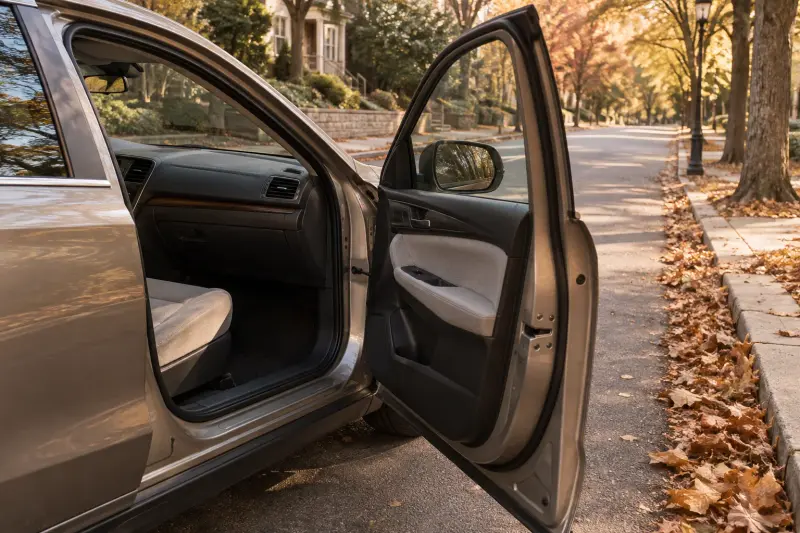
Vive's own page also notes that some owners reported a loose fit on certain newer vehicles, including a recent pickup and some Subaru models, where the latch opening is sized differently. So treat fit as something to confirm on your own car, not something to assume.
Position matters too. A tall SUV puts the latch near hip height, while a low sedan puts it below the seat, and that changes how much the handle helps.
- Open the door fully and find the metal loop where the door latches.
- Check it is a U-shaped loop with clear space behind it, not a flat pin or a covered latch.
- Sit in the seat and reach for the latch area; it should be within easy reach of your stronger hand.
- Check both front and rear doors if the user travels in different seats.
- Try the handle once, parked, with a helper nearby, before the first real trip.
Car handle assists compared: Vive LVA2098 and Stander HandyBar
We list two car handle assists that are sold on Amazon.com and have manufacturer pages: Vive Health's Car Assist Handle (SKU LVA2098) and the Stander HandyBar 3001. The figures below come from the makers' pages.
Use these numbers to check fit and capacity. Extras such as the HandyBar's window breaker and seat belt cutter do not change how well the handle supports you, so judge fit and rating first. Keep the receipt and packaging until the handle has been tried in each car it will be used in; Vive offers a 60-day guarantee on its own store.
| Handle | Weight rating | Size and weight | Build | Fit notes | Extras |
|---|---|---|---|---|---|
| Vive Car Assist Handle LVA2098 | 300 lb (136 kg) | 6 x 1.5 x 1.5 in (15 x 4 x 4 cm); 0.5 lb (0.23 kg) | Composite body, cushioned non-slip TPR grip, latex-free | U-shaped striker latch on cars, trucks and SUVs; Vive notes loose-fit reports on some newer vehicles | Vinyl coating against scratches; wipe clean |
| Stander HandyBar 3001 | 350 lb (159 kg) | 1 lb (0.45 kg) | Steel with a rubber grip | U-shaped latch striker; will not work with a striker bolt | Seat belt cutter and window breaker |
How to use a car cane to stand up, step by step
Only use the handle with the car parked, the engine off and the door fully open. RCOT suggests using the car's fixed frame for support rather than balancing on a walking frame.
The Ability Toolbox guidebook notes that the handle can be set facing forward or sideways to suit different arm positions. Try both once to see which lets the user push straight down.
A helper should stand to the side, not in front, so the user has room to rise.
- Turn to face out of the car and place both feet flat on the ground.
- Insert the handle fully into the latch and test it with a light push.
- Hold the handle with one hand and the seat edge or frame with the other, then push down and up.
- Stand fully and find your balance before letting go or reaching for a walking aid.
- Remove the handle before closing the door.

Common mistakes with a car cane
The most common mistake is using the handle while the door could move or the car is not fully stopped. Another is leaving it in the latch and trying to shut the door, which can damage the latch or the car.
Some people buy a handle without checking their car, or keep it in the trunk where the user cannot reach it from the seat. Store it in the door pocket or console so it is always at hand.
- Using it before the car is parked and the engine is off
- Closing the door with the handle still in the latch
- Pulling sideways instead of pushing down
- Ignoring the weight rating
When to get personal advice
RCOT notes that its tips do not replace one-to-one advice from an occupational therapist or another health professional. Ask for advice if standing from the car has become much harder, or after surgery or a fall.
A therapist can watch the whole transfer and suggest the right mix of aids, such as a handle, a swivel cushion or a different seat. Bring the car if possible, or photos of the door frame and latch.
- After hip, knee or shoulder surgery
- After a fall getting out of a car
- If the user cannot push up with their arms
- If the user's weight is close to the rating
MAKE THE SPEND MEANINGFUL
Car handle assist (car cane) for elderly: low-cost alternatives
- Use the car's fixed frame or the grab handle above the door, with the door fully open, as RCOT suggests
- Choose the seat with the highest cushion and widest door opening in the household's car
- Ask an occupational therapist whether a loan closet has a handle to try
In brief
Car handle assist (car cane) for elderly: questions answered
Does a car handle assist (car cane) fit every car?
No, car handle assists fit cars, trucks and SUVs with a U-shaped metal striker latch on the door frame, which is common but not universal. Vive notes that some owners of certain newer vehicles reported a loose fit. Open the door, check the latch shape and space, then try the handle with the car parked before relying on it.
What device helps an elderly person get out of a car?
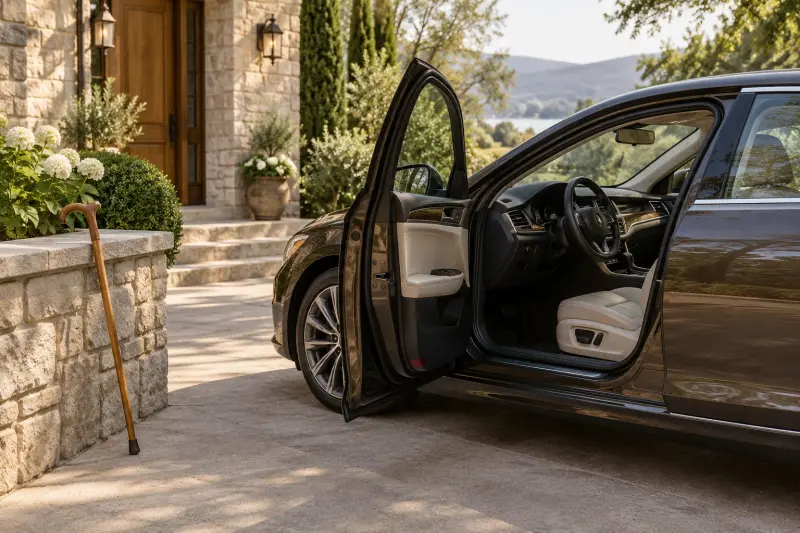
A portable car handle assist is the simplest device: it slots into the door latch and gives a firm hand-hold for standing. A swivel seat cushion helps with turning the legs out first, and the two are often used together. An occupational therapist can suggest the right mix if getting out has become hard.
How much weight can a car handle assist hold?
It depends on the model: Vive rates its Car Assist Handle at 300 lb (136 kg), and Stander rates its HandyBar 3001 at 350 lb (159 kg). Treat the rating as a maximum for the person's weight, and remember that pushing up quickly adds force. If the user is close to the limit, ask an occupational therapist about other options.
Can a car cane damage my car door?
It can mark the striker latch if used carelessly, because it rests in the latch. Vive says its handle is vinyl-coated to help avoid scratches. Wipe grit off the handle before inserting it, push straight down rather than twisting, and never close the door with the handle still in place.
How this guide was prepared
AI-assisted editorial research, checked against the linked primary sources.
Written with AI assistance from the sources listed below and checked against them. We have not tested these products in person.
How we use sources and AI assistance ↗Sources & fact checks
The guide separates sourced facts from editorial questions and examples. How we use sources and AI assistance.
- Royal College of Occupational Therapists: Lift Up, mobility advice ↗
- Vive Health: Car Assist Handle (LVA2098) ↗
- Stander: HandyBar 3001 ↗
- Ability Toolbox guidebook (IFOPA): car door assist handle ↗
Found an error or an outdated detail? Contact the editorial team.