
In brief
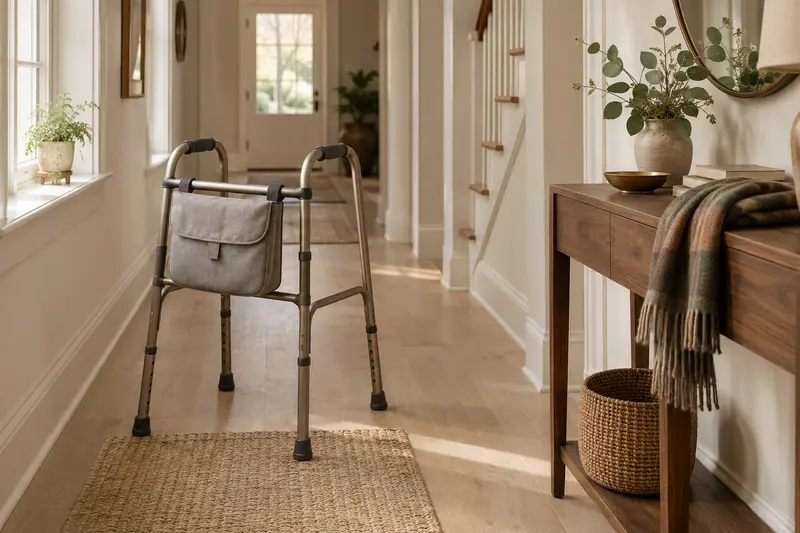
A walker bag, or rollator bag, lets someone carry a phone, keys, water and small purchases while keeping both hands on the frame. Choose by two checks: how the bag attaches to your exact walker, rollator or wheelchair, and whether it hangs clear of the legs while walking. Keep the load light: the Vive bag we checked is rated for 10 lb (4.5 kg).
Shortlisted for this decision
Affiliate-
Shortlisted
Vive walker and wheelchair bag
For walkers or wheelchairs, up to 10 lb
Buckle straps fit handles or push bars, with exterior pockets, a large main compartment and a shoulder strap for carrying off the frame.
Check price on AmazonCheck first: Holds 10 lb; check it clears the user's legs and brakes, and confirm color and size on the listing.
Affiliate links: we may earn a commission from qualifying purchases at no extra cost to you. Prices are shown only on Amazon. Amazon.com (US listing). See the full comparison ↓
Documented options
Walker bag: options compared
Options based on manufacturer documentation. Retailer links are affiliate links: we may earn a commission from qualifying purchases.
Affiliate retailer links
-
Vive Wheelchair Bag
Exact variant: Machine-washable accessory bag for rollators, wheelchairs and walkers; color as selected on the listing
View product details on Amazon — United States -
Vive Wheelchair Bag
Exact variant: Machine-washable accessory bag for rollators, wheelchairs and walkers; color as selected on the listing
View product details on Amazon — Germany -
Vive Wheelchair Bag
Exact variant: Machine-washable accessory bag for rollators, wheelchairs and walkers; color as selected on the listing
View product details on Amazon — France -
Vive Wheelchair Bag
Exact variant: Machine-washable accessory bag for rollators, wheelchairs and walkers; color as selected on the listing
View product details on Amazon — Spain
IN THIS GUIDE
Why use a walker bag?
Carrying things is one of the hardest parts of using a walking frame. A cup in one hand or a purse on the wrist means only one hand on the handle, just when steady support matters most.
MedlinePlus suggests attaching a small bag or basket to the walker so both hands stay on the frame. A bag also keeps essentials in one known place, which helps when memory or eyesight is less sharp.
A good bag is part of the walking aid, not a fashion extra. It should suit the frame and the user's routine, including trips out and moving between rooms at home.
- Keeps both hands on the handles
- Holds the phone, keys, glasses and water in one place
- Moves with the frame from room to room
- Can come off the frame to be carried as a shoulder bag
- Saves trips back to the kitchen or bedroom for forgotten items
Where does a walker bag attach? Check the frame and the walking space
Bags attach in different ways. Some hang from the front cross bar of a standard walker, some strap to the handles or push bar of a rollator or wheelchair, and some sit in the space under a rollator seat.
Measure the bar or tube the straps will wrap around, and the space between the user's legs and the bag when walking. A bag that swings into the shins can trip someone.
On a rollator, check that the bag does not block the brake levers or stop the frame folding. On a wheelchair, check that it does not press on the user's back or catch on the wheels.
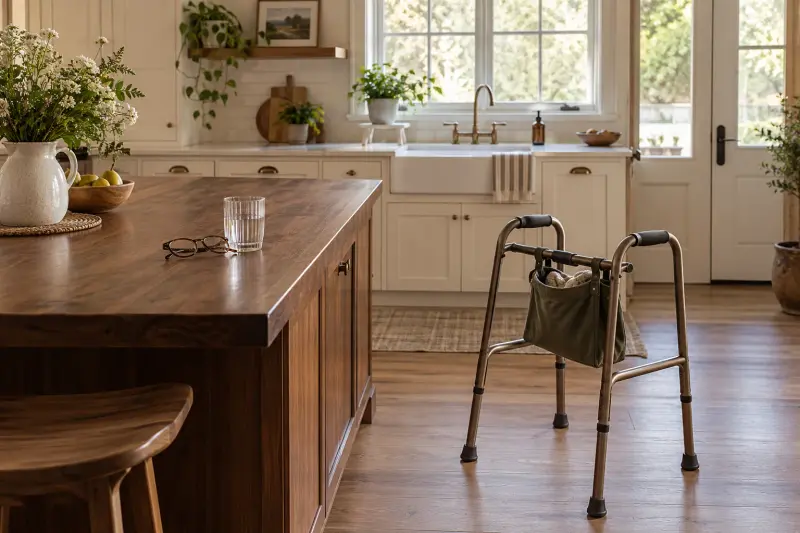
If the frame came with a basket or pouch, look at it first. A second bag can crowd the same space, and the maker's own accessory is usually designed around that frame.
- Width of the bar or handles the straps go around
- Gap between the user's legs and the frame while walking
- Clearance around brake levers and the folding latch
- Whether the bag stays on when the frame is folded
| Position | Frame | What to check |
|---|---|---|
| Front cross bar | Standard walker | The bag must not swing into the shins |
| Handles or push bar | Rollator or wheelchair | Brake levers stay free; nothing presses on the user's back or catches the wheels |
| Under the seat | Rollator | The frame still folds; any maker's basket or pouch may already use this space |
The Vive walker bag: specs at a glance
We list one walker bag that is verified on Amazon.com and matches a product on the maker's own site. Vive sells it as a Wheelchair Bag, and its page says it also works on walkers and some rollator styles. The listing does not name a color, so check the color and size on Amazon before ordering.
Note the size. At 19 x 14 inches (48 x 36 cm) the black version is larger than many front-bar walker bags, which is useful on a wheelchair push bar but may sit close to the legs on a narrow walker. Measure the space first.
| Spec | Vive Wheelchair Bag |
|---|---|
| Size | 19 x 14 in (48 x 36 cm), black version |
| Load | Up to 10 lb (4.5 kg) |
| Pockets | Two exterior pockets, one large interior compartment without dividers |
| Attachment | Two adjustable buckle straps for handles or a push bar, no tools |
| Fabric and care | Nylon Vive describes as waterproof; machine wash cold, air dry |
| Off the frame | Padded shoulder strap |
What should you pack in a walker bag?
A light bag keeps the frame stable. Heavy items hung at the front can tip a walker forward or make a rollator harder to steer and brake.
Pack the items used every day and leave the rest at home. Put the phone in an outside pocket so it can be reached without bending far.
Give each item a fixed pocket and keep to it. When the phone always lives in the same place, it is easier to find in a hurry, and a helper knows where to look too. A small card with emergency contacts in an inner pocket is a simple extra.
- Phone, keys, glasses and a small water bottle
- A list of medications and emergency contacts
- A light layer such as a scarf
- Leave heavy groceries for a cart, a delivery or a helper
- Keep hot drinks in a lidded cup in a holder, not loose in the bag
Setup and care
Tighten the straps so the bag cannot slide sideways or swing. Then walk a short indoor route and check that it never touches the legs or the wheels.
Check the straps and buckles every few weeks for fraying. Empty the bag before washing and follow the maker's care label. Vive says to machine wash cold and air dry.
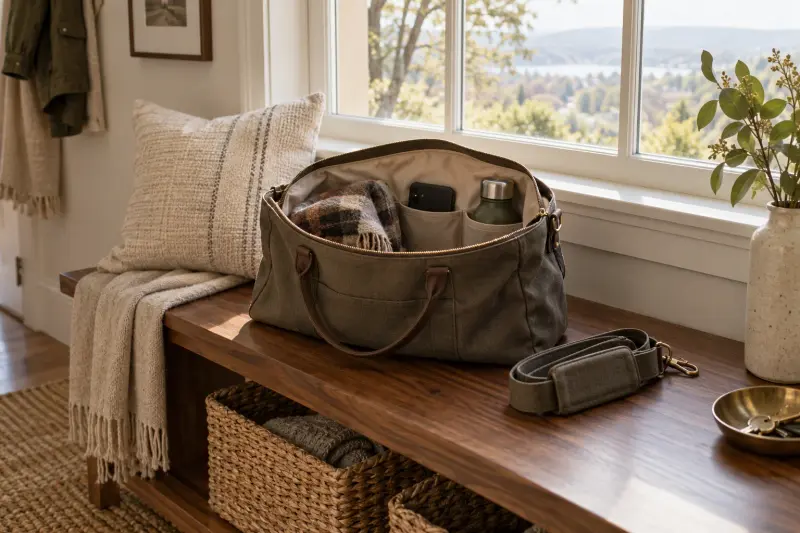
If the user switches between a walker indoors and a rollator outdoors, decide whether one bag moves between them or each frame keeps its own. Moving one bag is cheaper, but only if the straps are easy for the user or a helper to undo and refasten.
- Fasten straps snugly before the first walk
- Walk a test route indoors and watch the leg gap
- Check buckles and stitching every few weeks
- Empty and wash as the care label says
Common mistakes
The most common mistake is overloading. A 10 lb (4.5 kg) rating is not a target, and a full bottle of water and a book quickly add up.
Another is hanging a bag where it blocks the brakes or the seat. If anything about the frame feels different after adding a bag, ask a physical therapist to take a look.
A third is choosing a bag the user cannot open. Stiff zippers, small clasps and deep pockets can be hard with arthritis or reduced grip, so try the closures, or ask the user which they find easiest.
- Treating the weight rating as a goal
- Blocking brake levers or the folding latch
- Hanging a purse loosely from one handle
- Letting a long shoulder strap dangle near the wheels
MAKE THE SPEND MEANINGFUL
Walker bag: low-cost alternatives
- A small tote or zip pouch already at home, tied snugly to the front bar, can test where a bag works best
- Many rollators include an under-seat pouch or basket; check the frame before buying another bag, since it may already be enough
- A lightweight cross-body bag worn close to the body keeps hands free at no cost
In brief
Walker bag: questions answered
How do you attach a bag to a walker?
Most walker bags use two adjustable straps, buckles or hook-and-loop tabs that wrap around the front cross bar of a walker or the handles of a rollator or wheelchair. Fasten them snugly so the bag cannot swing, then walk a short test route to make sure it stays clear of the legs and wheels.
How much weight can a walker bag hold?
It depends on the bag, and the frame matters too. Vive rates its wheelchair bag at 10 lb (4.5 kg). Even within a bag's rating, a heavy load at the front can change how a walker or rollator handles, so carry only daily essentials and use a cart or delivery for groceries.
Is a rollator bag different from a walker bag?
Often the same bag fits both, but the mounting points differ. A standard walker has a front cross bar, while a rollator may have handles, a backrest bar or space under the seat. Check the maker's list of compatible frames and measure where the straps would go before buying.
What walker accessories are most useful?
A bag or basket for carrying items is the most common, since it keeps both hands on the frame. Others include cup holders, tray tops and glide caps for standard walkers. Add only what the user needs, and ask a therapist before adding anything that changes the frame's height or balance.
How this guide was prepared
AI-assisted editorial research, checked against the linked primary sources.
Written with AI assistance from the sources listed below and checked against them. We have not tested these products in person.
How we use sources and AI assistance ↗Sources & fact checks
The guide separates sourced facts from editorial questions and examples. How we use sources and AI assistance.
Found an error or an outdated detail? Contact the editorial team.